


 Locations


Lizards are one of the newer creature types to receive Wizards' focus; while they've been around since Homelands' Leaping Lizard, it's only with Bloomburrow that they've been supported as a cohesive creature type.
Prior to 2024, Lizards were mostly in Jund colors (Black, Red, and Green) and mostly represented reptiles and wildlife like the euphonious Saddleback Lagac and Torpid Moloch. There is a caveat - at one point, Viashino, the humanoid lizardfolk native to Shiv and Jund, were their own creature type from 1996's Mirage. With Outlaws of Thunder Junction, they were folded into the Lizard type.
So Retromancer, printed in 1998 as a Viashino, is now a Lizard Shaman and the Izzet-aligned Viashino of Ravnica went from sentient lizardfolk to the equivalent to a Carolina anole. Personally, I always find it mildly disappointing when we lose a creature type that's unique to Magic.
This change came out of nowhere considering one set earlier in Murders at Karlov Manor there were five creatures printed as Viashino before the Lizard switch. It paid off in Bloomburrow, though, where the Red/Black pair picked up Lizard as the primary creature type, and Wizards printed enough Lizards to boost the power of a mostly-ignored creature type.
Magic's Top Eight Lizards
With over thirty years of Lizards to leaf through, many of which have been surprisingly relevant in competitive Magic for such a mundane creature, there are some real winners.
Honorable Mention: Alpha Deathclaw
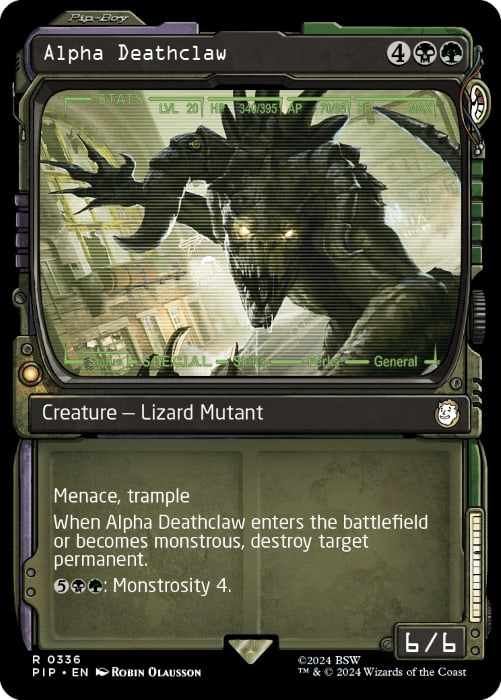
Dreadmaw stats with Deathclaw verve. A 6/6 with Menace and Trample that Vindicates on entering is a steal for 

 , and it segues neatly into going Monstrous the following turn. Alpha Deathclaw isn't necessarily a flashy Lizard, but one you won't be unhappy to draw. It's especially great in Jenova, Ancient Calamity or Yarok, the Desecrated. It's easy to view this Lizard Mutant as just a big, dumb beater, but I died to enough of these bad boys in Fallout 3 to respect big, dumb beaters.
Sprouting Thrinax

While an unimpressive card by modern standards, Sprouting Thrinax was a feared three-drop in the Standard Jund deck of its era, mostly because it could be Cascaded into by a Bloodbraid Elf. For its time, a 3/3 for  was huge, and leaving behind a trio of Saprolings that could chump block a Woolly Thoctar or trade with your opponent's Thrinax meant it was one of the best creatures in the best deck.
While the true power behind Standard Jund was Bloodbraid Elf, Thrinax was great on its own merits, and even better when cast for free. At a time when the competition on the battlefield was Knight of the White Orchid or Knight of Meadowgrain, Jund's ability to scale up with the scaly sprouter was a big advantage.
Party Thrasher

One of two Lizards printed in the base set of Modern Horizons 3, Party Thrasher hasn't seen as much love as Basking Broodscale. Primed to boost "exiles matters" Commanders like Prosper, Tome-Bound, Faldorn, Dread Wolf Herald, and Pia Nalaar, Consul of Revival, it also plays well with Madness/Mayhem, Delirium, and reanimation effects.
I always see it go late in Cube, because I think people are looking for ways to maximize synergy, when it's really a simpler card than it appears. It's a bad mana dork/great blocker that lets you discard extraneous lands to draw extra cards post-combat. Give it a shot outside of Prosper or Pia - you'll find it's a more versatile card than your average Red two-drop.
Basking Broodscale

The other Lizard found in Modern Horizons 3 boosters, Basking Broodscale tied the Rootwalla trope into the Eldrazi archetype. As soon as it was revealed, though, players noted that it went infinite with Blade of the Bloodchief and (more problematically) with forgotten Tempest common Sadistic Glee. This speedy, two-card combo was a bit powerful and omnipresent in Pauper for Wizards' tastes, and they banned the Eldrazi Lizard.
Iridescent Vinelasher
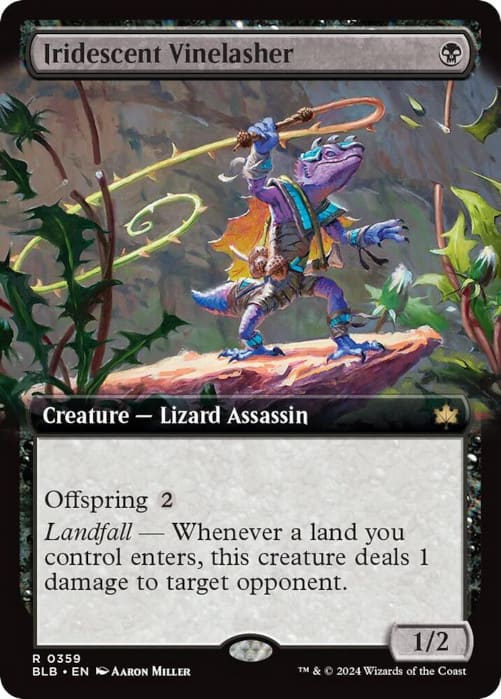
Landfall isn't usually Black, but Bloomburrow brought the color Iridescent Vinelasher (and its Offspring) to make Golgari, Jund, or Sultai landfall more feasible. Vinelasher references little-loved Ravnica card Vinelasher Kudzu, but where the easily-chumped-and-killed Kudzu only grew itself, Iridescent Vinelasher can pass out pings, trigger crimes, and - in decks like Azusa, Lost but Seeking and Hearthhull, the Worldseed - end the game with a flurry of landfall triggers.
In a more fair deck, where Iridescent Vinelasher only passes out one to four damage per turn, it's rarely relevant. When you're bringing multiple fetchlands back per turn with Icetill Explorer or Ancient Greenwarden, it adds up quickly.
Frilled Mystic
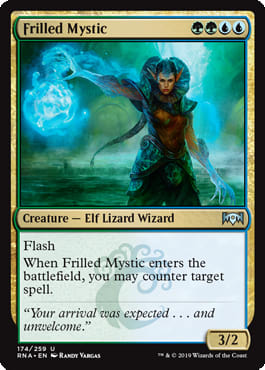
Magic's first Elf Lizard Wizard (we have yet to see a King Gizzard), Frilled Mystic is an update to Apocalypse's Mystic Snake. In exchange for a more devoted mana cost, Frilled Mystic offers a slightly more relevant body.
Neither the upgraded stats nor the updated creature type really matters, but Frilled Mystic was a linchpin of Simic Flash in Standard and shows up in Cube and Commander frequently as a counterspell that you can reanimate, blink, or copy.
Gev, Scaled Scorch
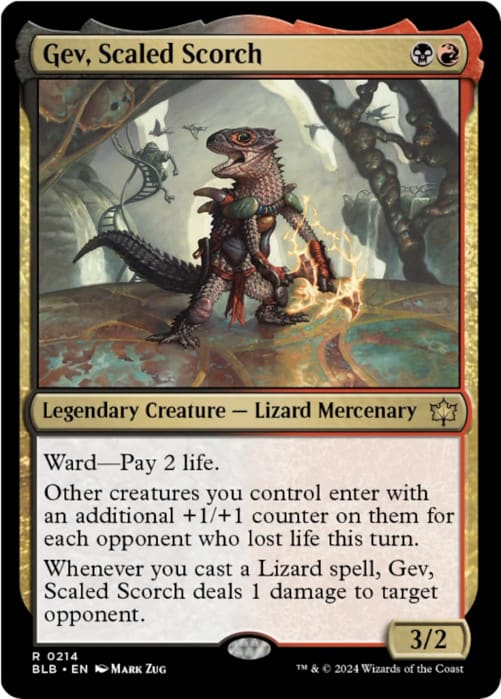
Gev is Bloomburrow in microcosm. While he's at his best in a deck full of Lizards, so long as you can get through for damage, he can boost non-Lizard creatures. Unlike previous typal sets like Onslaught and Lorwyn, Bloomburrow explored the overlap between creature types, and so cards like Gev were printed to push you in a direction while having utility if the draft didn't fully break your way.
Outside of Limited, he has reasonable stats and just a bit of built-in self-protection, as well as an easy way to boost creatures in future turns. He's an outlaw who helps triggers crimes, a Lizard who plays well with Changelings, and even a fun offbeat group slug Commander - note that creatures enter with a +1/+1 counter for each opponent who has lost life, so he's great in a deck built around Valgavoth, Harrower of Souls.
Laughing Jasper Flint
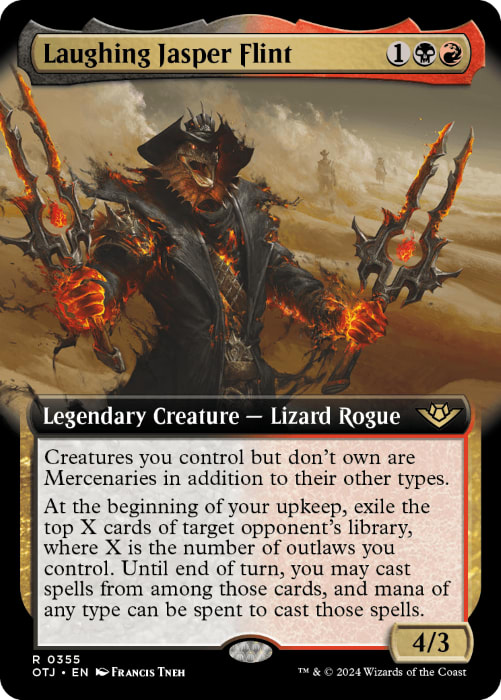
From seven total Legendary Lizards to three in one year, this mirthful Mercenary is playable even without other outlaws. Most of the Bloomburrow Lizard crew tend to be Warlocks or Assassins, so a dedicated Lizard deck will have a lot of overlap. On stats alone, Flint is great. A three-mana 4/3 that draws you an extra card per turn (off your opponent's deck) would be unimaginable a few years ago without a drawback.
It demands an answer from your opponent immediately before it snowballs into heisting several cards from their deck each turn. He works well as a Commander that scales based on what your opponents are playing, and I respect his potential in Standard. Rakdos Lizards may not have taken off the way I was hoping when Bloomburrow first was released, but with a Standard that's been in flux for the last few months, it remains a tantalizing possibility.
Basking Rootwalla

Basking Rootwalla is a 1/1 that can become a 3/3 temporarily, which is uninspiring and barely worth the mana and the card. When, however, you're discarding it for a benefit and then casting it for zero mana, it becomes a different proposition.
Like Memnite in the Tempered Steel deck of its age, Rootwalla intersected with the rest of the Blue-Green Madness Standard deck to be an actual threat, saving your Wild Mongrel from a removal spell and putting another body on the board. That wasn't the end of the little Lizard's career. Some years later, it broke Legacy in conjunction with Survival of the Fittest and Vengevine.
Basking Rootwalla isn't worth a card unless you're wringing full value of the discard and the body, but when your deck cares about a) discarding creatures and b) casting multiple Green creatures in a turn, then it's a crucial element. "Basking" is the most dangerous adjective in Magic's history - three cards with "Basking" in their names have been printed, and two have led to bans, which means Basking Capybara is on notice. See also Blazing Rootwalla, which only pumps power.
Wrapping Up
"Lizard" covers a lot of territory, from Obstinate Familiar's iguana-like lizard to the hybrid mutant of Unruly Krasis to Spider-Man's nemesis Curt Connor, so it's hard to find a shared identity within the type.
We've gotten close with the Bloomburrow faction, though, which features small creatures that rely on non-combat burn when they get outclassed - an early aggressive rush that's then supported by benched Lizards like Agate Instigator and Hired Claw. It's an interesting niche that feels different from Rakdos Vampires in both function and flavor, and I hope Wizards continues to develop it.
Even if Bloomburrow was just a temporary experiment, Lizards have a surprisingly strong pedigree, from integral to Odyssey Standard to banned in Pauper to dominant in Shards of Alara block. Not bad for a creature type whose real-world functions are being prey for housecats and inefficient insect control for households.