


 Locations


Vampires, as befit their aristocratic status in fiction, have one of the longest pedigrees in Magic. There are 423 Vampires in Magic's history (424 if we count Unstable's Old-Fashioned Vampire, which has the droll creature type "Vampyre"). They range the gamut from your standard mesmeric-bloodsucker-in-a-cloak (Vampire Nocturnus) to Salem's Lot-style feral drones (Vampire Outcasts) to a mosquito (Fumulus, the Infestation).
Alpha/Beta introduced Sengir Vampire, which was Black's foil to Serra Angel, Mahamoti Djinn, and Shivan Dragon. While it would trade or outright lose out in combat against those three, it could tangle with lesser creatures and outpace them. The flavor of the card was crystal clear - the Vampire fed off of weaker creatures to grow stronger. The compellingly hideous Anson Maddocks art of a snarling Nosferatu made it an early icon of the game's initial years, to the extent that Torment was partially sold as the triumphant return of Sengir Vampire.
By that point, of course, Sengir was thoroughly outclassed. Still, it had become a part of the game's iconography and worldbuilding and a point of comparison, from Baron Sengir to Crovax the Cursed to Repentant Vampire. Vampires were an early competitor for Zombies as Black's iconic midrange creature type, although it would take until the Zendikar through Innistrad era for them to truly reach their full potential. Once Vampires took off, though, they took off hard.
The Twilight era of pop culture and the new player acquisition push post-Great Recession meant that players were primed to be enthralled, and we finally got tournament-caliber Vampires to match the player base's enthusiasm. While I would love to include Sengir in a list of the Top 8 Vampires for Competitive Magic, it would only appear to be a reasonable pick to be a time traveler from 2001, and I imagine they'd have more pressing concerns than ranking vampires. Instead, here are the actual top eight Vampires that have proved their worth in competitive Constructed:
Honorable Mention: Drana, Kalastria Bloodchief (Limited)
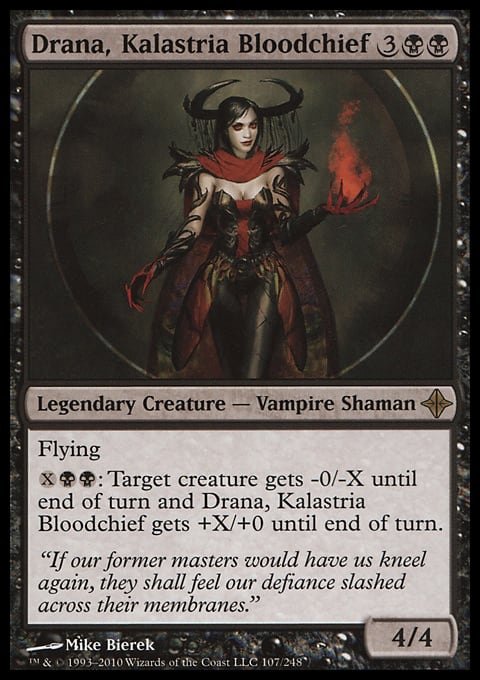
While we're talking about competitive Constructed nightstalkers today, I'd be remiss if I didn't mention one of the most dominant Limited cards of its set. Rise of the Eldrazi had a lot powerful things going on, from Vent Sentinel winning games without a single creature attacking to 8/8 Eldrazi coming down on turn five. You'd think a midrange Vampire would be simply fair in an environment like that.
On the contrary, Drana exploited the "battlecruiser" expectations of the format to act like a Plague Wind that crashed in for damage by mowing down opposing creatures and powering herself up. The classic criterion of Ultimate Limited Bomb is "does this win me the game all by itself if unanswered?" and Drana's response is an unqualified "yes." She never made the jump to Constructed, as her Standard was the era of Baneslayer Angel and Jace, the Mind Sculptor, but many of us remember her power in 40-card formats.
Blood Baron of Vizkopa (Block/Standard)
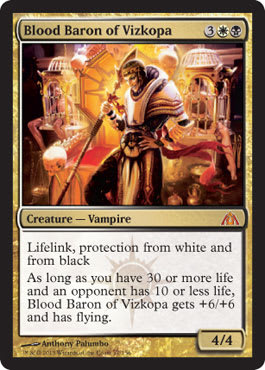
Blood Baron doesn't read as an impressive tournament card, but the double protection from both White and Black made it extremely resilient in Return to Ravnica Standard. The best removal spells of the time (Bedevil, Assassin's Trophy, Detention Sphere) couldn't touch the Vampire, and it presented a very scary clock against the White-Black-Red Aristocrats deck of its Standard and, as showcased at Pro Tour Dragon's Maze, a threat in Block Constructed (back when that was a tournament format).
Return to Ravnica Block Constructed was dominated by Selesnya and Boros aggro and Esper control - a couple copies of Blood Baron helped break open the mirror match and staunch the bleeding against the White-based aggressive decks. In the intervening decade, Blood Baron has languished outside of thematic Vampire decks but is a great reminder that the little-lamented Block Constructed format did have its joys.
Falkenrath Aristocrat (Standard)

In Innistrad-Return to Ravnica Standard, Sam Black designed a deck that used Falkenrath Aristocrat and Cartel Aristocrat to sacrifice Doomed Traveler or Lingering Souls tokens to either Aristocrat to sneak in for damage and drain out the last few points with Blood Artist. It was one of those compelling decks that looks weak on paper but executes its thesis with ruthless focus and took down a Pro Tour back in 2013.
A similar build is legal in Standard currently, with Sephiroth, Fabled SOLDIER feeding off of Infestation Sage (your Doomed Traveler equivalent) and Umbral Collar Zealot serving as your Cartel Aristocrat. It's missing another Falkenrath Aristocrat for when you don't draw the Sephiroth, but there's a powerful core there that hearkens back to Mardu Aristocrats.
Bloodghast (Extended/Modern/Standard, potentially)
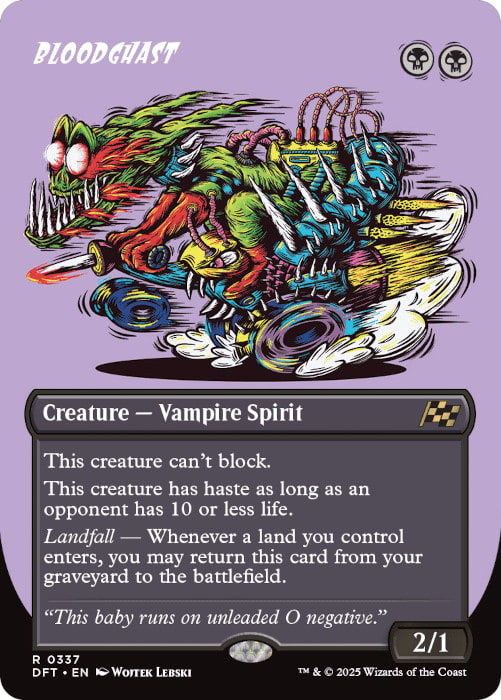
Once a fearsome Modern threat thanks to Dredge, Bloodghast was reprinted to Standard in Aetherdrift to a fair amount of hype. It hasn't lived up to its potential yet, because a recursive 2/1 just doesn't cut it in a powerful meta like our current Standard, but there is enough self-mill that Bloodghast could come roaring back, as Bloodghast tends to do.
In the old pre-Modern Horizons format, Bloodghast was run as a locked-in four-of to soften up opponents until a fatal Conflagrate could take them out. It was resistant to creature removal (although weak to graveyard removal) and could come back with Haste off something as simple as a land drop. Early versions of Dredge even used it and Narcomoeba as fodder for Dread Return. Created to be a fair card for the Zendikar-era Vampire aggro deck, it instead was a crucial tool for one of Extended and Modern's most unfair decks.
Kalitas, Traitor of Ghet (Pioneer/Standard)
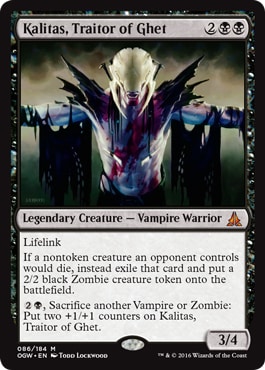
In the early days of Pioneer, Kalitas was a rock-solid sideboard pick that often was run in the maindeck for base-Black decks. He wasn't the most potent card on stats alone, but he did enough across several axes, from creating an army to gaining life to serving as incidental graveyard hate, to be one of the best things to do in a fair deck. Fatal Push is always great, but it's even better when it comes with a free 2/2.
He's since been dramatically outclassed as the format evolved, but right at the cusp of the COVID pandemic, he was selling for $30 a copy. Now, you can get him for a tenth of that, and if you run a creature typal Cube or a Vampire Commander deck, I highly recommend doing just that. He may never rise again, as Pioneer play has plateaued and he was recently reprinted in a Secret Lair drop, but for midrange players of a certain era, he'll always be a Vamp champ.
Vampire Hexmage (Legacy)
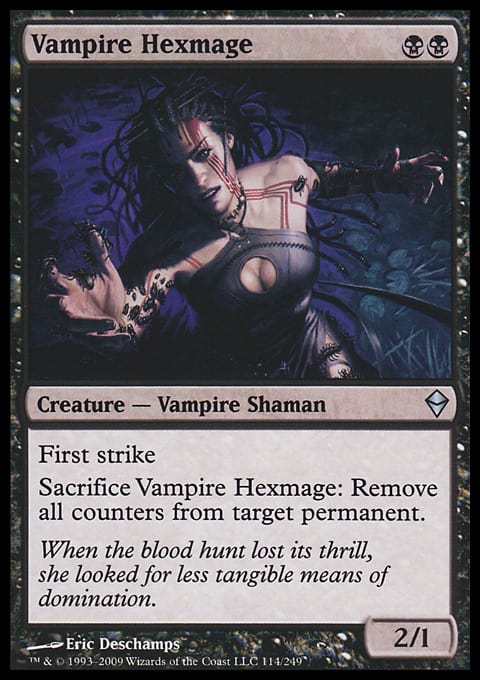
Zendikar gave us not one, but two 2/1 Vampires for  that ended up being more of a combo card than an aggro card. Bloodghast helped define Dredge for half a decade while Vampire Hexmage formed a two-card combo with Coldsnap's Dark Depths, trading itself in for the Depths' ice counters and creating a Marit Lage on turn three (or, with an absurdly lucky hand, turn two).
Dark Depths/Hexmage (with Thespian's Stage as a backup) would go on to be a pillar of Legacy and was banned in Modern with the launch of the format. Originally pitched as anti-Planeswalker tech, Hexmage instead launched a new combo deck that could compete with the most powerful decks in Magic's history.
Blood Artist (Standard/Commander/Modern)
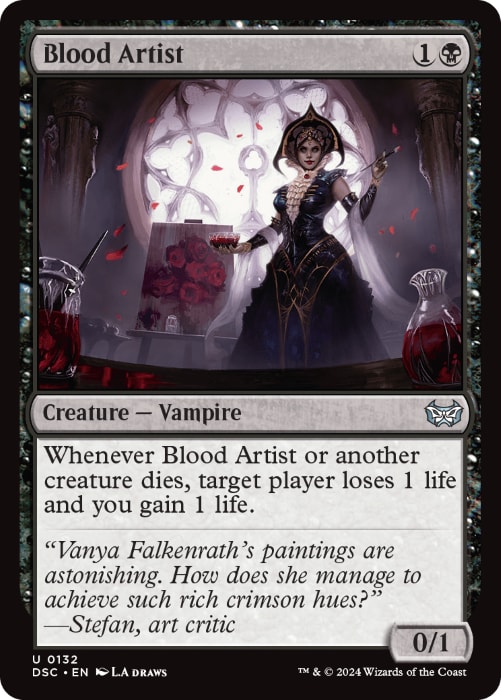
The Disciple of the Vault to Falkenrath Aristocrat's Arcbound Ravager in the Aristocrats shell, Blood Artist makes a board wipe seriously painful, and enables combo kills with any kind of sacrifice loop to this day. It takes a lot for a zero-power creature to see significant play, but Blood Artist more than met the threshold.
Just look at how powered-down later iterations of Blood Artists are, from Zulaport Cutthroat to Vraan, Executioner Thane to Vengeful Bloodwitch. There is one notable exception to this trend, which we'll discuss momentarily, but Blood Artist outshone its blockmate Falkenrath Noble to be the most-remembered draining Vampire until 2024.
Amalia Benavides Aguirre (Pioneer)
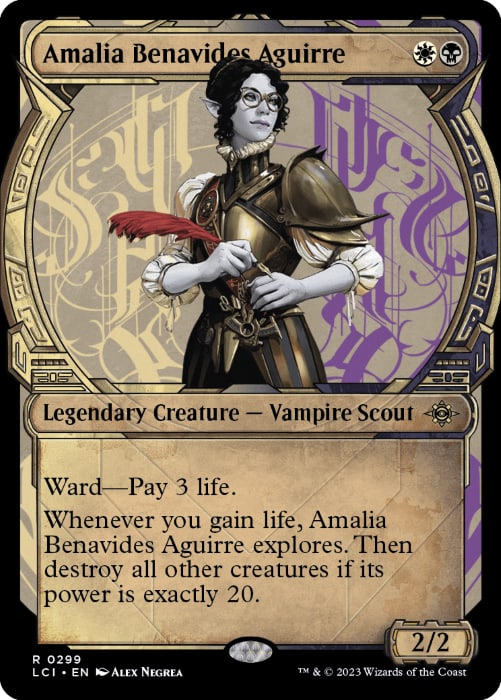
The vampiric conquistador was a true menace to Pioneer. In conjunction with Wildgrowth Walker, and with a suite of spells to help you find and recur both halves of that combo, i.e., Return to the Ranks and Collected Company, you could gain 50+ life, nuke the board, and attack with a 20/20 Amalia. As Wizards isn't a huge fan of combo loops in the format - especially ones that require constant clicking and passing priority in digital form or ones that can lead to accidental draws in both physical and digital play - the deck was banned, but not before Amalia defined the Pioneer metagame for the bulk of 2024.
Vein Ripper (Pioneer)
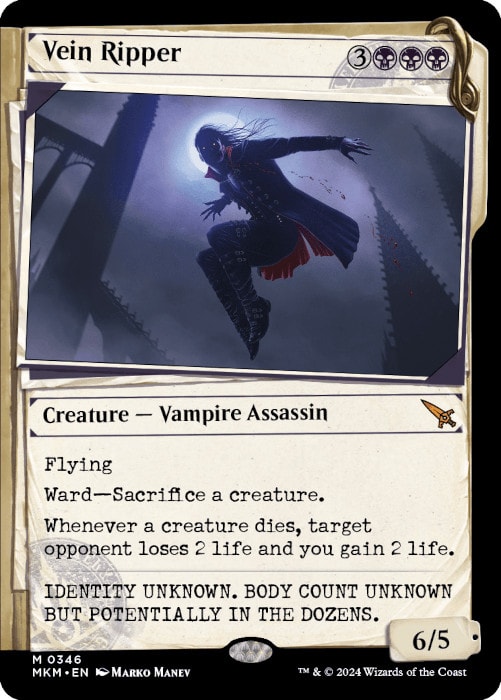
Exactly two years ago, Vein Ripper headed an explosive Rakdos Vampires deck in the hands of Seth Manfield. Like Sam Black's Pro Tour-dominating Aristocrats, the deck came out of nowhere to suplex the competition - only instead of the combination of Falkenrath Aristocrat and Doomed Traveler, Manfield's deck ran the powerful-but-niche Sorin, Imperious Bloodlord with the newly-released Ripper.
Players had experimented with New Capenna's Lord Xander, the Collector as a target for Sorin's -3 ability, but Vein Ripper was more difficult to deal with than the demonic mafioso. So difficult was it to deal with, in fact, that it caught a Pioneer ban in August of 2024, less than six months after Manfield's win.
Vein Ripper, while too powerful in conjunction with Sorin, is the ideal synthesis of everything that Vampires do - it's a massive flying creature and a Blood Artist effect that can either win through combat or combo out. It may not be quite as evocative as Sengir Vampire, but it's certainly an upgrade in almost every situation.
Conclusion
Unlike some creature types, Vampires aren't going anywhere. They're native to Innistrad, Zendikar, Ravnica, Dominaria, Mirrodin - hell, it's probably easier to list planes that don't have Vampires than the litany of planes who do. That inescapability translates to the tabletop, too. Edgar Markov remains among the top-played Commanders of all time, several Vampires have resulted in multiformat bannings, and there's a potent Vampire for every format, from Modern's Blood Artist fueling Golgari Yawgmoth combos to Pioneer's Bloodtithe Harvester cycling through cards for reanimator archetypes.
Some of us may prefer our undead to be less elegant and more putrid, but it's clear that players love Vampires, from the most casual kitchen table players to global champions. There's something resonant in that - that the archetypal seductive and aristocratic Vampire can take over top tournament tables and make us all into Renfields.