 Locations



In the early days of Magic (we're talking mid-to-late 90s), Wizards of the Coast explored creative mechanics to simultaneously juice the power level of certain cards while tacking on a drawback of some sort. Phasing was such an example. Breezekeeper was a 4/4 flying creature for just 3U, but you'd only have it in play every other turn. Cumulative Upkeep and Echo were other mechanics that served a similar purpose.
When Nemesis released at the turn of the century, Wizards of the Coast tried yet another such mechanic. This new keyword would be included on above-the-line cards, meaning they'd have more power than usual. The drawback? They stick around for only a few turns before they're sacrificed!
WOTC called this new mechanic Fading (N). The mechanic wasn't long for Magic, but it definitely had an impact during its brief time in the spotlight.
The Rules of Fading
According to the MTG Fandom Wiki, "Fading is a keyword ability that limits the number of turns a permanent is on the battlefield." The ability was first introduced and made its most recent appearance in Nemesis. I guess this is an indication to how WOTC felt about the mechanic.
Let's take a look at an example to dig deeper: Skyshroud Ridgeback.
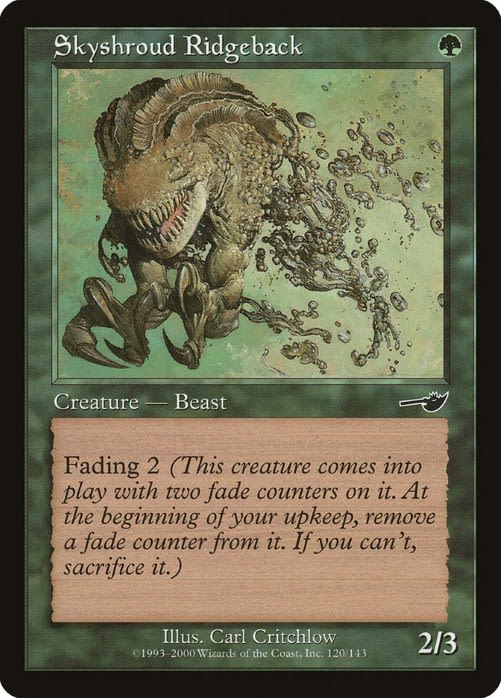
A one-mana 2/3 would be overpowered even by today's standards, especially in Limited. Back in 2000, you can imagine the response to such a creature. To balance the card, Wizards of the Coast gave the Beast Fading 2. As the reminder text indicates, you remove a fading counter during your upkeep and if you can't, you sacrifice it. A helpful shortcut to remember for creatures with Fading is that they get to attack N times when they have Fading N. You get two attacks with Skyshroud Ridgeback (assuming no Relentless Assault shenanigans) before sacrificing the creature.
Unlike abilities like Banding and Cumulative Upkeep, Fading's comprehensive rules are quite simple! So simple, in fact, that I have the space to write rule 702.32 in its entirety below:
"Fading is a keyword that represents two abilities. 'Fading N' means 'This permanent enters with N fade counters on it' and 'At the beginning of your upkeep, remove a fade counter from this permanent. If you can't, sacrifice this permanent.'"
That's all there is to it!
Noteworthy Fading Cards
Considering Wizards of the Coast printed tournament legal cards with Fading in exactly one set, you may question if any noteworthy cards with Fading exist. I would argue the mechanic swings well above its weight in this regard--there are multiple game-changing cards that contain this ability, one of which you may even run into in Vintage Cube!

Vintage Cube aficionados should recognize the powerful enchantment Parallax Wave! There's an important distinction to make here. When a creature has fading, it usually means the creature has extra power and abilities, but a limited number of turns it stays in play. When an enchantment has Fading, such as with Parallax Wave, you have many more decisions to make! Let's break this one down.
Parallax Wave has Fading 5, meaning it comes into play with five fade counters on it. As mentioned before, during your upkeep you remove a fade counter and, if you can't, you sacrifice Parallax Wave. OK, simple enough.
The middle line of text is where things get interesting! You can remove a fade counter from Parallax Wave at instant speed to remove a creature from the game (until Parallax Wave leaves play)! You can remove one counter to keep a creature out of play for four turns, or you could remove two counters to keep a creature out of play for three turns, etc. If you're looking to make an all-out attack, you could even remove all five counters to exile five of your opponent's creatures for one turn! That's accomplishing quite a lot for just four mana.
In Vintage Cube, you have even more optionality because sometimes exiling your own creatures to reset enter the battlefield effects or dodge creature removal. Despite having a limited number of turns with which to leverage this card, Parallax Wave has unmatched power in the right deck. It's no wonder the card showed up in World Championship decks in 2000.
Speaking of World Championship decks, Tangle Wire is another Fading card (this one is an artifact) that disrupted play for multiple turns.

Sticking this on turn three can really slow down a game, especially if your opponent has few non-land permanents in play. You don't have the flexibility of removing counters like you did with Parallax Wave, but forcing each player to tap all their stuff for a couple turns can really slow development for everyone! You probably need to find creative ways to break this symmetry, but you could see how this artifact could be a clutch sideboard card in the right matchup).
While we're discussing non-creature cards with Fading, we might as well touch on a couple more. Parallax Dementia is an Aura that pumps a creature for one turn and then destroys it. Rejuvenation Chamber is probably one of the worst cards with Fading. A three-mana artifact that does nothing but tap to gain you 2 life? AND it is sacrificed after two turns? I guess not all Fading cards were balanced properly.
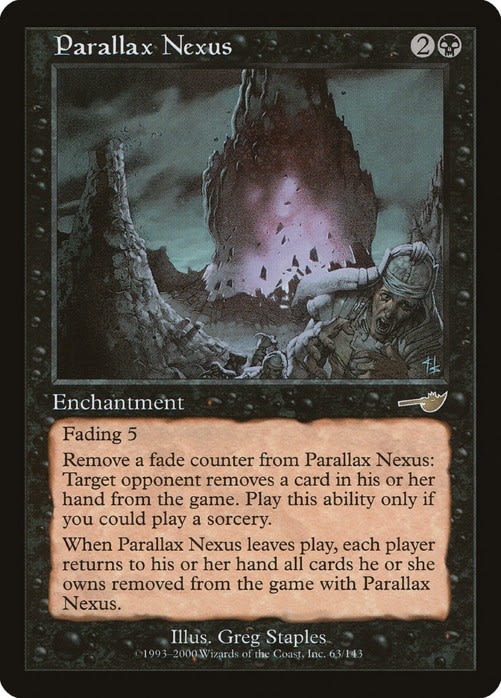
In a similar vain as Parallax Wave, we have Parallax Nexus and Parallax Tide, the other members of this three-card cycle.
 |
 |
These are both enchantments with Fading 5, and give you a benefit when you remove a fade counter from them. For Parallax Nexus, you have target opponent remove a card in their hand from the game. With Parallax Tide, you can remove a land from the game. Both enchantments are suffocating in nature, and arguably quite unfun. Parallax Tide is actually worth quite a bit (around $20), but I'm not sure you'll make many friends if you drop this onto the battlefield at your local Commander FNM.
Saproling Burst is arguably the Green enchantment of the cycle, despite not having the word "Parallax" in its name.

Instead of removing things from the game, Saproling Burst creates creatures with power and toughness equal to the number of fade counters on Saproling Burst. Thus, you can make one 6/6, two 5/5's, three 4/4's, etc., that get smaller and smaller until Saproling Burst is sacrificed. The versatility of this card made it quite powerful for its time.
The last card with Fading I want to discuss in this section is Blastoderm, a creature that made significant waves in competitive play during its time in Standard. Blastoderm was a well-loved card that showed up in World Championship decks in 2000 and 2001. The card also saw a reprint in Duel Decks: Garruk vs. Liliana.

Yes, you only got to attack three times before having to sacrifice this creature. Despite this, Blastoderm was difficult to deal with as a 5/5 for just four mana with Shroud. The fact that Blastoderm couldn't be killed with spot removal made it quite the nuisance! You can't targe tit, so Blastoderm usually challenged you with a question for three turns: do you chump block me or take five damage? There weren't many creatures at four mana that traded with Blastoderm, and even if you could double block, did you really want to lose multiple creatures to something that would be sacrificed in a couple turns anyway?
I definitely remember Blastoderm being a nightmare to see on the other side of the battlefield back during Nemesis' heyday.
A Couple Honorable Mentions
For completion's sake, let's talk about the one card that interacted with the Fading mechanic, also printed in Nemesis, of course.
Parallax Inhibitor is an artifact that lets you sacrifice itself to add a fading counter to each permanent you control with fading. In other words, it allows your fading permanents to stick around one extra turn.

This card was printed at rare, but I don't think it did a whole lot in tournament gameplay. If you didn't have to sacrifice Parallax Inhibitor to use it, the artifact would be extremely powerful in Nemesis constructed and a sweet build around in Limited. As printed, however, I just don't see this card ever doing much.
The last card I want to discuss with Fading is symbolic in nature: Old Fogey, from Unhinged.

The joke of this card was that it was an extremely powerful creature (7/7 for just 2 mana) that had all the obsolete drawbacks that Wizards of the Coast explored in the earlier years of Magic. Notice the card has Phasing, Cumulative Upkeep, echo, and Fading all at the same time! Each of Old Fogey's abilities referenced obsolete abilities that Wizards of the Coast won't likely print again in a premier set.
Wrapping It Up
According to a Blogatog post from August 2015, Fading is an 8 on the Storm Scale. Mark Rosewater adds, "Possible but would require the exact right world."
Will we ever return to a world in Standard where Fading shows up? Never say never. Though, I feel like Wizards of the Coast already created an ability to functionally replace Fading, even if the effect was deemed important for a new set. That ability was called Vanishing, and it functioned the same way as Fading except you sacrificed the permanent when you removed the last counter rather than the turn after, when you couldn't remove a counter. I guess WOTC deemed Vanishing more intuitive to players than Fading was.
With the advent of Vanishing, I'd say it's even less likely we see Fading return, even to a reprint or Commander set. I suppose it's not impossible--at least Fading isn't being passed over for being too powerful. In fact, I find cards like Parallax Wave and Tangle Wire extremely interesting in design and play pattern. While such prohibitive cards may be unfun by today's standards, I suspect variations on these effects could make for highly dynamic and interesting gameplay in a modern game of Magic.
For this reason, I'll continue to hold out hope. Perhaps Old Fogey will get its time to shine, proving once and for all you can teach an old dog (or dinosaur) new tricks.