


 Locations



"In response..."
Don't you just hate that phrase? I remember playing casual games of Magic with my friends many years ago, and my one friend built the most obnoxious "turtle up" deck. Whether we were attacking him, destroying his cards, or casting burn spells at his face, he'd always pause for a few seconds to think carefully, and then respond with an array of preventative activations and spells to stay alive.
Those games took way too long.
What's more annoying than a lengthy, defensive game is all the activating and spell casting my friend used to cast in response to everything. It seemed like no matter what spell we cast, he'd find some defensive countermeasure to avoid the worst of the damage.
Split Second: The Better Way
Enter split second, a static keyword ability that prevents much of the shenanigans associated with pesky "responses." Sick of your opponents negating your creatures' combat damage? Tired of endless countermagic stopping your fun and powerful spells? Is it exhausting whenever your opponent responds to your spells with some sort of defensive measure? Then split second is the ability for you!
What exactly is split second? Put simply, "split second" means "As long as this spell is on the stack, players can't cast spells or activate abilities that aren't mana abilities." The keyword was introduced in Time Spiral (one of my favorite sets of all time). Let's look at an example to dive into the rules a little further.

Sudden Shock is as simple as it gets. We have a two-mana instant that deals two damage to target creature or player (Planeswalkers were off the hook back in Time Spiral because they hadn't been printed yet). Simple enough, right? It would be just another burn spell if not for that first line of text on the card: split second.
If your opponent plans on casting a spell in response to Sudden Shock, such as Counterspell or Healing Salve, they'd better think again. They also can't tap Samite Healer in response, while Sudden Shock is on the stack. Because of the split second keyword, Sudden Shock prohibits spells or activated abilities from being used until Split Second leaves the stack upon resolution.
Here are some additional rules associated with split second, courtesy of the MTG Fandom Wiki.
- Players still get priority while a card with split second is on the stack.
- Split second doesn't prevent players from activating mana abilities.
- Split second doesn't prevent triggered abilities from triggering. A triggered ability would still be placed on the stack (more on this later).
- Split second doesn't prevent players from performing special actions, such as turning a face-down creature face-up. (I'll touch on this later, too).
- Split second doesn't affect spells and abilities that are already on the stack.
- If the resolution of a triggered ability involves casting a spell, that part of the effect won't work if a spell with split second is on the stack.
Iconic Split Second Cards
Split second was introduced in Time Spiral, back in 2006, but it was actually designed by Devin Low as an Izzet mechanic for Guildpact (originally called "superfast"). Since its release, only 18 cards have been printed with this mechanic, the majority of which are from Time Spiral block.
One split second card that has made significant waves in Constructed play is Angel's Grace, a one mana instant that prevents you from losing the game for the turn.

The effect in a vacuum is already powerful at one mana, enabling combo shenanigans, especially in Eternal play. Tacking on split second, however, makes this a most difficult spell to interact with as it dodges countermagic. This card has seen reprint in Modern Masters and Time Spiral Remastered, yet it's still worth around $7 due to its playability.
Two more classic cards with split second that made waves in tournament play are Sudden Spoiling and Extirpate.
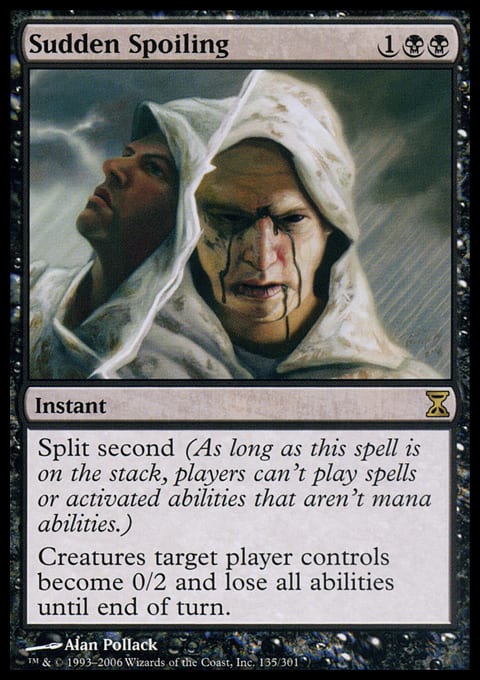 | 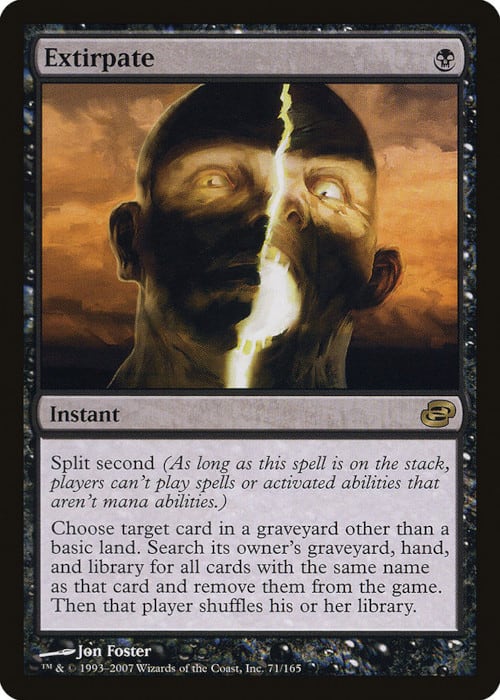 |
Besides having amazing artwork, both these split second cards from Time Spiral block wreak all sorts of disruption. Sudden Spoiling renders an opponent's creatures harmless until end of turn by turning them in to 0/2 creatures with no abilities. Extirpate was a popular sideboard card in Eternal play because of its ability to remove key combo pieces from an opponent's deck. Once again, the split second clause on each of these cards makes them extremely difficult to disrupt, making them highly valuable in the right match-up.
Who could forget about Commander staple Krosan Grip?
Being able to destroy pesky artifacts and enchantments is always valuable. Being able to do so at split second speed, so that opponents can't cast spells or activate abilities in response, is even better! This card is fairly popular in Commander, hence why it saw reprint in Commander 2013, Commander 2015, Commander Anthology, Commander 2020, and Time Spiral Remastered. Players love including this destruction spell in their 99, and for good reason.
The last split second card I'll mention from original Time Spiral block is Trickbind, a Stifle variant with split second.

One of the most valuable cards with split second, Trickbind, has wide-ranging utility. Countering activated and triggered abilities has been useful for years, and doing so in a way that makes it difficult for your opponents to interact is even stronger. Granted, that extra mana in Trickbind's casting cost is nontrivial. I think it's worth the investment, however, to earn that split second clause.
Newer Split Second Cards
While the only premier sets to contain split second were from Time Spiral block, Wizards of the Coast has given us a couple newer cards with the keyword in various supplemental sets.
For example, the most valuable card with split second was actually printed in Tales of Middle-earth Commander: Legolas's Quick Reflexes.
For just one Green mana, you untap a creature, give it hexproof and reach, and an extra ability that allows the creature to bite another creature when it becomes tapped. That's a lot of power in one mana! Then you tack on the split second text, and you have a card that's nearly impossible to respond to!
There's also a Fallout card that utilizes the split second mechanic: Inventory Management.
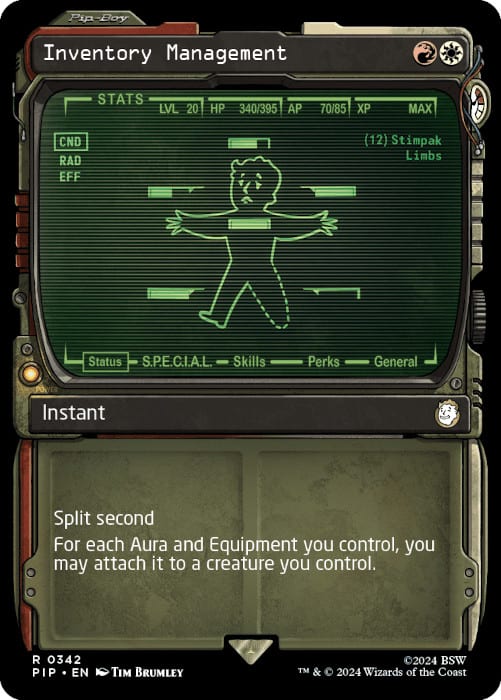
I won't lie--I am unfamiliar with the Fallout franchise. If you ask me, taking stock of your weaponry doesn't exactly invoke lightning-speed activity. I suppose it's akin to equipping your army at breakneck speed, given the card's effect. Regardless of the card's flavor, it's utility in the right Commander build has supported this card's $7 price tag for some time now.
Lastly, I want to touch on a noteworthy Commander 2019 card. It's a plan on similar cards we've seen before, where a player can exchange a creature with a [noncreature] spell on the stack, reminiscent of Perplexing Chimera. Only, this card also has split second.
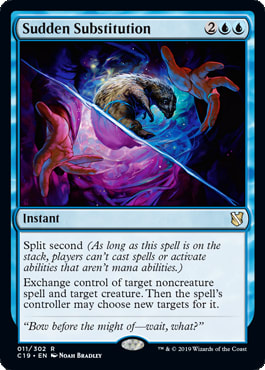
The card is called Sudden Substitution, and like many other split second cards, it resembles an effect we've seen on other cards, but includes the split second keyword. If Naturalize is to Krosan Grip, and Stifle is to Trickbind, then Perplexing Chimera is [kind of] to Sudden Substitution. I know, it's not an exact analogy, but it's close enough for the sake of explanation.
The bottom line is, Wizards will sometimes take a card that already exists, staple split second to it, adjust its casting cost, and voila! New card.
Wrapping It Up
When I started playing split second cards against my friend, his reaction wasn't what I had intended. Rather than accepting the fact that he could no longer respond to all my spells, he started finding and leveraging loopholes in the rules!
For instance, he started playing Voidmage Apprentice in his deck. Because flipping a card face-up is allowed even when a split second card is on the stack, he'd leverage the creature's morph ability to flip up and counter my split second spells! This works because turning the card face-up is allowed and triggered abilities, such as Voidmage Apprentice's counterspell ability, can also resolve while a split second card is on the stack. Thus, morph cards started becoming more popular in our casual games.
Despite this workaround, I have developed a fond appreciation for split second. While it may just be easier to print a card with the "cannot be countered" text, the addition of split second makes for interesting decision space when you're considering if a player is holding a split second card in hand or not. The interaction forces new decisions, but also underscores the importance of priority and the stack--something newer players may struggle with. Perhaps it's this complexity that places split second as an 8 on the Storm Scale (it could return, but only if the stars align).
I hope the stars do align someday, and we see split second again. As a long-time player, the effect reminds me of the olden days, back when we had interrupts, which also couldn't be responded to with instants or activated abilities.
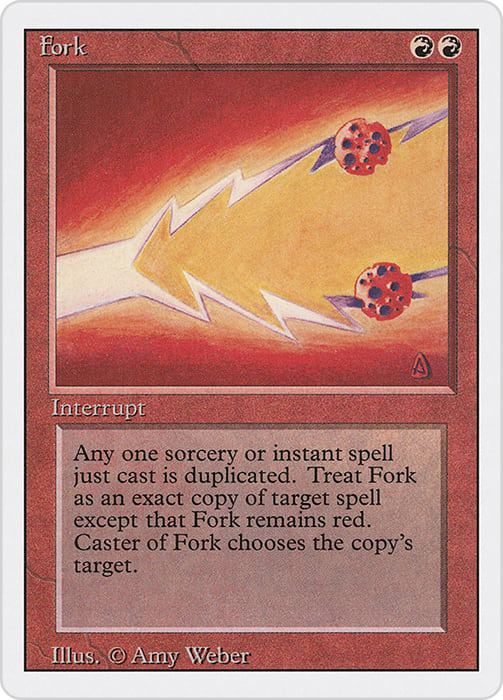
I know rules become more complicated when a new time constraint is added, a la split second or the old interrupt days. Still, with modern rule sets and templating, I bet it could be done in a straightforward enough way to work. Who knows, maybe we'll see split second return one day. It's only a matter of time...