


 Locations



Back in May, I wrote about the Fading mechanic, a tool Wizards of the Coast to print more powerful creatures and spells with a balanced drawback: the permanent would only stick around for a limited time. The combination led to iconic cards such as Blastoderm and Parallax Wave. The idea was simple and elegant in nature: juice a card's power level, but only give it a handful of turns for which it can be in play.
A permanent with Fading would enter with a certain number of counters on it, and its controller would remove a counter during their upkeep. When the last counter is removed, then--
No, wait a second. That's not how Fading works. Instead, of sacrificing the permanent when the last Fading counter is removed, its controller sacrifices the permanent when a Fading counter can't be removed when one is required. That's rather counter-intuitive!
Vanishing: A Fixed Fading
Wizards also recognized the confusing nature of Fading, so when they wanted to introduce another "limited time only" mechanic in Planar Chaos, they opted to create a new version of Fading; one that followed intuition more closely. Thus, the Vanishing mechanic was born!

Vanishing plays almost identically to Fading except for one key difference. Instead of sacrificing the permanent when a counter can't be removed, the permanent is sacrificed when the last counter is removed. For example, Waning Wurm enters with two time counters--one is removed each upkeep, and when the last is removed, the controller sacrifices Waning Wurm.
Therefore, a creature (without haste) entering with N Vanishing counters can effectively attack N-1 times, whereas a creature with N Fading counters can attack N times. Wizards of the Coast hoped the more intuitive mechanic would resonate more strongly with players, especially because they leveraged time counters alongside cards with suspend, so that the two abilities would be inversions of each other. That is, "suspend times when a spell becomes active while vanishing times when a permanent becomes inactive by leaving play."
The Rules of Vanishing
Vanishing's rules are on the simpler side, and even the comprehensive rules lists just three subsections to explain the mechanic in its entirety. You can find this information in 702.63.
- 702.63a: Vanishing is a keyword that represents three abilities. "Vanishing N" means "This permanent enters with N time counters on it," "At the beginning of your upkeep, if this permanent has a time counter on it, remove a time counter from it," and "When the last time counter is removed from this permanent, sacrifice it."
- 702.63b: Vanishing without a number means "At the beginning of your upkeep, if this permanent has a time counter on it, remove a time counter from it" and "When the last time counter is removed from this permanent, sacrifice it."
- 702.63c: If a permanent has multiple instances of vanishing, each works separately.
That's all the rule book says about the mechanic. Seems fairly straightforward, right? Of course, there are a couple rulings nuances you should be aware of if you plan on sleeving up some of these cards. It's noteworthy to point out that Vanishing uses time counters--the same time counters used by suspend cards. Some cards interact with time counters, such as Jhoira's Timebug, and this can affect permanents that have vanishing.

Perhaps one of the more interesting interactions is when the sacrifice ability is countered as the last counter is removed, such as with Stifle or Trickbind. In that case, the permanent remains on the battlefield indefinitely with no time counters on it! This is a key separation from Fading, which would simply be sacrificed the turn after when once again a counter can't be removed. Vanishing only cares about the last counter being removed; once it gone, the last counter can't be removed again, so the permanent sticks around indefinitely.
Popular Vanishing Cards
After covering abilities like Sweep, which only exists on a few cards, it's refreshing to talk about a keyword that can actually be made into a deck theme. That's because there are currently 22 unique cards to-date with Vanishing. The mechanic debuted in Planar Chaos, and while it hasn't seen print in a premier set in a long time, it shows up in special sets now and again. Most recently, the mechanic has appeared in Modern Horizons 3.
Despite showing up on almost a dozen rares, Vanishing cards tend not to be all that valuable (nor powerful). Despite this, there are a few that at least lead to some interesting gameplay interactions.
The most valuable card with Vanishing is Chronozoa, only printed in Planar Chaos.

A 3/3 flying creature for 3U is hardly exciting, but Wizards of the Coast gave this card a little extra zing with that last line of text. Effectively, three turns after casting Chronozoa, its controller sacrifices it and then creates two copies of the creature, each with three-time counters. Then after three more turns, those two creature tokens are sacrificed and the player then puts four token copies of Chronozoa into play. In this way, the creature doubles itself every three turns, creating a bit of inevitability, albeit a gruelingly slow bit.
While not really valuable, I find Lost Auramancers an interesting twist on a classic.

This creature is sacrificed after the third time counter is removed, and then its controller can tutor for an enchantment and place it directly into play. It's basically an Academy Rector with a built-in way to send to the graveyard. If there's no faster way to kill the creature, you can wait for that last time counter to be removed, and then fetch your game-breaking enchantment spell (Omniscience, anyone?) and place it directly into play!
Modern Horizons 3 found new ways to utilize the Vanishing mechanic to create interesting interactions. For instance, check out Dreamtide Whale.

A 7/5 creature that costs just three mana?? What's the catch? Well, the whale enters with just two Vanishing counters on it, and after the second one is removed the whale goes away.
However, the whale has a lifeline--if a player (including you) casts two spells in a turn, you can proliferate. I.e., you can add a time counter to Dreamtide Whale, keeping it alive for another turn. This can lead to a fun little minigame whereby a player tries to preserve their 7/5 creature as long as possible, gaining enough advantage to generate an early win with the aggressively costed creature.
Then there's the Doctor Who set, which introduced a handful of new Vanishing cards, such as Flesh Duplicate and Four Knocks.
 |
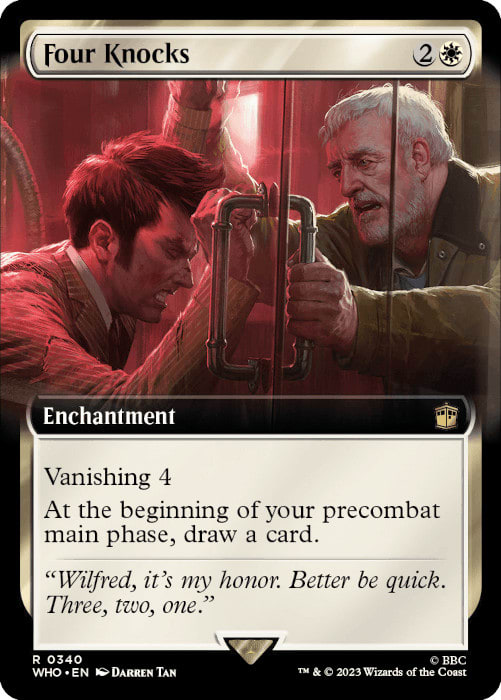 |
The former is an aggressively costed two mana Clone, balanced by the fact that it enters with Vanishing 3. The latter is a card-drawing engine with Vanishing 4. Both these permanents can be abused a bit if you're able to proliferate the time counters, thereby keeping them on the battlefield longer than their prescribed number of turns. Doctor Who and temporary effects must go hand in hand flavor-wise because the set contained six Vanishing cards, increasing the count of cards with the mechanic from 16 to 22.
Lastly, I'll shout out a guest appearance of the Vanishing mechanic in Bloomburrow Commander, on Deep Forest Hermit.

This Elf Druid is a fun spinoff of Deranged Hermit, which also generated four 1/1 Green Squirrel creature tokens and also acted as an anthem for Squirrels. Instead of having echo as its drawback, however, Deep Forest Hermit has Vanishing 3. Thus, you don't have to pay the casting cost a second time to keep Deep Forest Hermit around, but without some sort of proliferating, the creature will be sacrificed in time.
Wrapping It Up
Vanishing is an updated way for Wizards to print a juiced-up card with a balanced drawback. Namely, the permanent can only stick around for a fixed number of turns before it must be sacrificed. By using time counters, however, players can postpone that sacrifice clause by adding counters to the card. This can be accomplished either by proliferating or by leveraging cards that specifically mention time counters, such as Jhoira's Timebug or Timebender.
Mark Rosewater has given Fading an 8 on the Storm Scale, meaning a return of the mechanic to Standard is highly unlikely. Does Vanishing, an updated and more intuitive form of Fading, receive a lower number? Technically, yes, but not by much. Vanishing is given a 7, adding that its return is "still not super likely."
That's a shame because I find the mechanic versatile, with many interesting synergistic possibilities. The ability becomes even more interactive in a set with proliferate and the possibility of placing additional time counters on the Vanishing cards. Alas, I guess I'll have to find my Vanishing fix in supplemental sets like Doctor Who or special sets like Modern Horizons 3.