


 Locations



I ran a quick Google search this morning, inquiring after approximately how many Magic: the Gathering cards have ever been printed (not unique cards, but in total). The result I found was upwards of 50 billion! If I accept that as correct, then you could connect each card end to end longways and you'd stretch about 2.4 million miles. That's like traveling to the moon and back more than five times!!
With so many cards printed, what do you think the odds are that every single card has been printed perfectly and without mistakes? I'd wager pretty much zero. In fact, I don't have to speculate--there are nearly countless examples of card errors throughout Magic's history. Many are from the game's early years, as I'd suspect quality control has improved since its first printing in 1993.
An article on print errors could go numerous directions because there are so many variations of said errors This week, I want to start with the basics: the most obvious print errors, where cards contain the wrong picture, wrong casting cost, and wrong expansion symbol. This category is where you're going to find the most famous and recognizable print errors.
Ten Obvious Misprints To Know
Serra Elemental
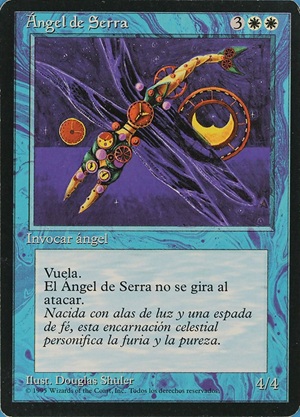
The text and casting cost for this Spanish Fourth Edition Black Border card belongs on Serra Angel. The frame is Blue, however, and the artwork is supposed to be Time Elemental. This is one of the coolest misprints because it involves one of Magic's classic, iconic creatures.
Spanish Burrowing
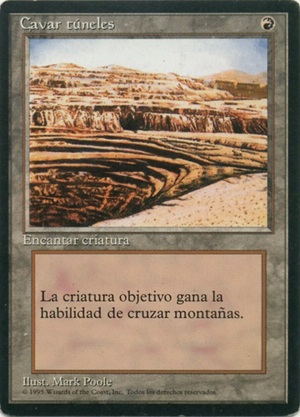
I know enough Spanish to read that this card grants an enchanted creature the ability to cross mountains (Mountainwalk). That's Burrowing, alright, and the casting cost is also correct. The art and frame, on the other hand, belong to none other than the much-maligned Strip Mine!
Wald (Forest) with Six Trees
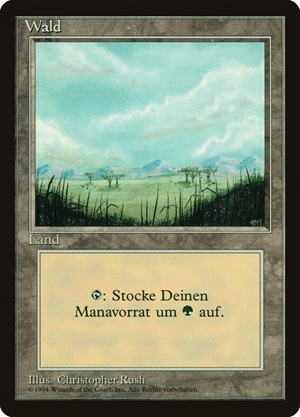
You know how sometimes Wizards will print basic lands with art that makes it nonobvious which basic land it's supposed to be (the Kamigawa: Neon Dynasty basics are notorious for this). Well before we had Neon Dynasty, there was Wald! I'm less familiar with German, but it only takes one look at that mana symbol to see that this card is a Forest. The art and frame, however, are that of a Plains. Maybe German forests only contain six trees?
heer der geplagten Skelette (German Drudge Skeletons)
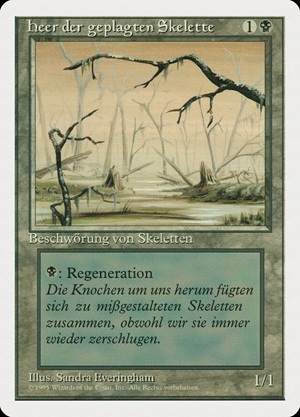
Drudge Skeletons have been reprinted countless times across many different languages. The most intriguing version was the Fourth Edition German copy, which took the art and frame for Swamp and threw it on Drudge Skeletons. At least these skeletons could conceivably arise from the swamp, but I'm still scouring for them in this card art to no avail.
El-Hajjâj Reduced to a Pancake
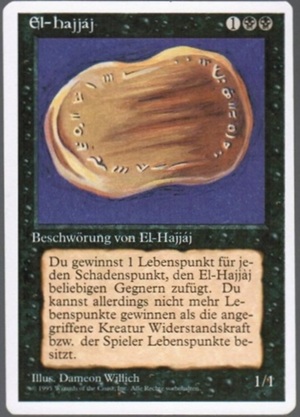
The FWB German Fourth Edition copy of El-Hajjâj was reduced to nothing more than a pancake with ancient runes written along the edges. At least, that's what the art depicts without any context. Enfranchised Magic players may recognize the art of Warp Artifact as the imposter illustration taking the space reserved for the Human Wizard creature.
Manabarbs? You're Trolling Me!
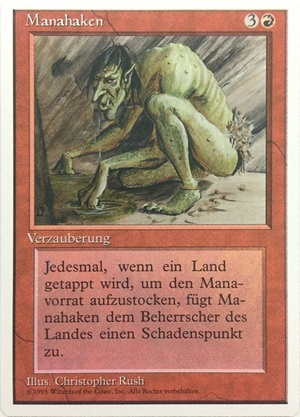
Only a troll would play a card like Manabarbs, which deals one damage to a player whenever they tap one of their own lands for mana. Talk about an unfun card! Perhaps that's why the German FWB Fourth Edition printing of Manabarbs showcases the art for Sedge Troll instead. When you cast Manabarbs in a game of Commander, all your opponents view you as the Troll in this picture.
Jandor vs. Aladdin: Whose Ring is Nicer?
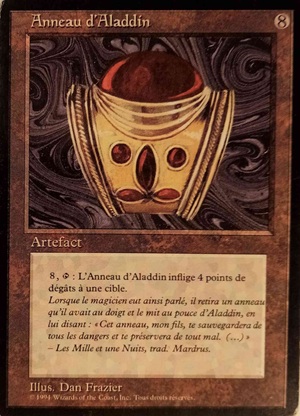
This print error is a little less obvious unless you're familiar with the various rings from early Magic. In Arabian Nights, both Jandor and Aladdin had rings depicted on Magic cards. Jandor's makes you discard a card you've just drawn to draw a new card while Aladdin's dealt four damage to a creature or player. The FBB French copy decided that Aladdin's Ring was the more powerful, but that Jandor's Ring the more attractive. This is evidenced by the fact that Jandor's Ring's art is used on Aladdin's Ring's card!
Reality Ripple As Seen by Shaper Guildmage
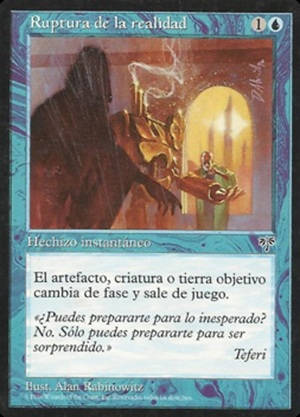
This is one of the more "recent" major misprints, appearing in Spanish Mirage (1996). At first, you may not be able to identify the issue. Players familiar with the set, however, will readily point out that the artwork on this version of Reality Ripple is that of Shaper Guildmage!
The Famous Serendib Efreet
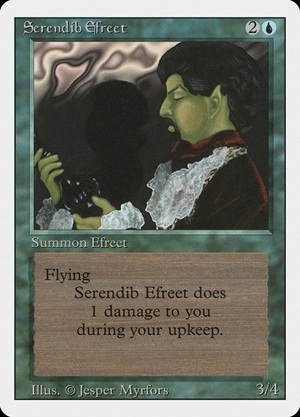
New players who started playing Magic in the mid-90s are likely to name Serendib Efreet when asked about the first misprint they remember seeing. This is my recollection as well--it's incredibly jarring to see a Revised copy of Serendib Efreet with a Blue casting cost and Green border. This error appeared on the normal, English printing of the card, so this was pretty much the version nearly everyone remembers. Incidentally, in this case the foreign versions of this card contain the correct artwork and not the illustration for Ifh-Biff Efreet.
Blue Hurricane
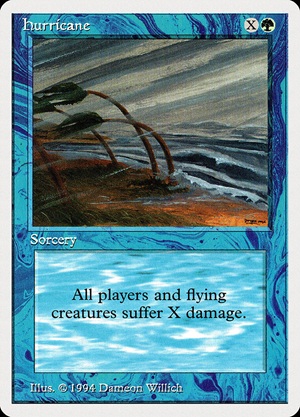
If you poll a group of experienced players and ask them to name the most valuable misprint of all time, you may frequently hear Blue Hurricane as the winner. That's because this card appeared only in Summer Magic, a printing of Revised Edition that ended up getting scrapped due to numerous issues. Only a small quantity of product accidentally hit the market, making the Hurricane printed with Blue frame one of the rarest and most expensive misprints ever created.
A Couple Honorable Mentions
I started with these misprints because they are some of the most obvious examples of human-created print errors in Magic. When a card has the incorrect artwork and frame, it's immediately recognizable, even in a foreign language.
Of course, there are seemingly infinite other examples of misprints. Rather than list every possibility, I want to touch on a couple more that I think merit an honorable mention for being more recent. What's more, the nature of these misprints would make it worthwhile for you to be familiar with them, in case your opponents attempt to cheat with them in a competitive match.
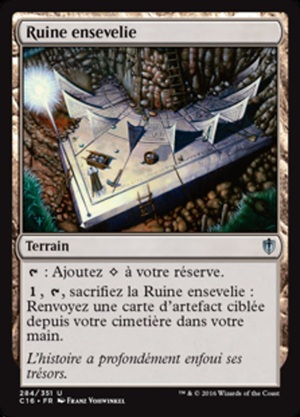
Buried Ruin isn't exactly a tournament staple, but it's one such example worth being knowing about. The land taps for a colorless; you can also pay two generic mana and sacrifice it to return an artifact from your graveyard to your hand. The French printing from Commander 2016 was "special." In that particular printing, the card only requires one generic mana for activation. It's worth knowing the difference in case your opponents are suspiciously playing a deck where these are the only non-English cards.
You may not run into Braids, Cabal Minion too often, as the creature is highly unfun to play in Commander (and I think she used to be banned...). If your opponent does cast the creature in a match, make sure it's not the Portuguese foil Odyssey version:
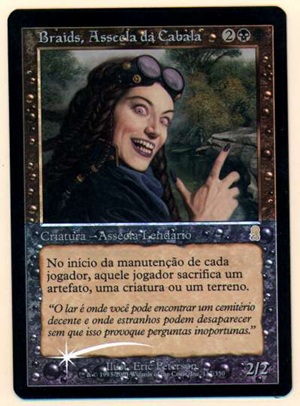
This printing dropped one of the Black pips in the casting cost, making the card 2B instead of 2BB to cast!
Lastly, I want to talk briefly about Meloku, the Clouded Mirror. This is a Blue Legendary creature originally from Champions of Kamigawa. Being legendary, you may run into her once in a Blue moon while playing Commander. She has an activated ability for one generic mana, where you can return a land you control to its owner's hand in exchange for a 1/1 flying creature.
Well, it's a 1/1 flying creature as long as you're not playing the Spanish printing.
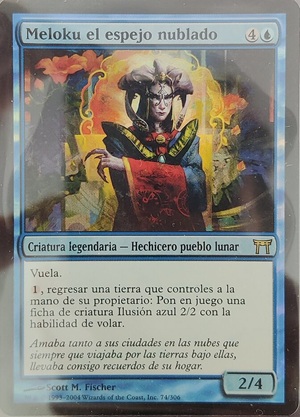
Spanish copies of Meloku, the Clouded Mirror state that the tokens are 2/2 flyers instead of 1/1! Again, don't be fooled by the foreign language misprint--if your opponent's deck is all in English except for their Spanish Meloku Commander, you may want to call shenanigans depending on how much you like them.
Wrapping It Up
The list, of course, goes on and on. I found numerous other errors where a card's casting cost or abilities are different on a certain language of a card. In some cases, the card actually got worse (the +2 ability on Korean Ashiok, Nightmare Weaver is +1 instead). In other cases, even the improvements delivered by the misprint weren't enough to make the card worth knowing about in detail.
Whatever the misprint may be, one thing is clear: Wizards did not print all the billions of cards they've created perfectly--not by a long shot. Still, as a percentage basis, I must say I'm impressed with the robustness and thoroughness of Wizards of the Coast's quality department. While they made some pretty significant missteps in the 1990s, the mistakes have been much subtler in recent history.
Because this is a game created by humans, there are bound to be some occasional mistakes. Luckily for Wizards of the Coast, many players see the mistakes as a fun positive to collectability than a strike against gameplay. As long as players don't exploit misprints, they may add more to the game than they detract.