



 Locations


As I start writing this column, much of the U.S. has been buried in a colossal amount of snow and ice thanks to winter storm "Fern." At my age, shoveling for hours may not put me in the mood for much, but it did get me thinking about building a snow deck. Magic: The Gathering's latest Lorwyn Eclipsed set doesn't have anything even vaguely resembling a snow theme, but "Fern" makes me think of Green things coming up out of the ground.
In my little corner of New England it may be many weeks before a patch of bare ground again becomes clear, and little Green sprouts start poking up out of the earth. In just about every way right now, I am not a fan of ice, so I'm very happy to cast my eyes forward and write a deck about Green things.
Today's Commander is a Treefolk Druid with a hefty seven mana casting cost and an interest in little Green things.

Ferrafor, Young Yew is a 4/7 legendary Treefolk Druid with a couple of neat abilities. When Ferrafor enters, I'll create a number of 1/1 Green Saproling creature tokens equal to the number of counters among creatures target player controls. It also has an activated ability where Ferrafor can tap to double the number of each kind of counter on target creature.
While I'd love to build a good low powered Treefolk deck, Ferrafor wants to make Sparolings and the easiest way to guarantee there is a player with a lot of counters on creatures is simply to be that player. That means this is a deck that will be built around going tall and going wide. I'll do the former with +1/+1 counters, and I'll do the latter with 1/1 Saprolings.
Ferrafor's high casting cost means this deck may struggle at faster bracket 3 tables, and is unlikely to be playable in B4. Bracket 5 is out of the question, but that's OK. I love a good stompy lower powered deck that can do interesting things, so let's see what kind of shenanigans we can unleash.
Going Tall
The first theme I fell into for Ferrafor is to build around Hydras. In Magic, Hydras are a great way to amass a lot of +1/+1 counters, though they are an odd fit thematically for a Treefolk commander. There are a lot of Hydras in Green, but I avoided any that don't use +1/+1 counters. Those are this deck's currency and how we're going to win games, whether we go wide or we go tall.
 |  |  |
Managorger Hydra is the Hydra equivalent of Forgotten Ancient, which is also in this list. These creatures get a +1/+1 counter whenever a player casts a spell. While I'm not likely to be playing a ton of spells on my turn, these creatures are quite capable of getting big enough to matter over just a few turn cycles.
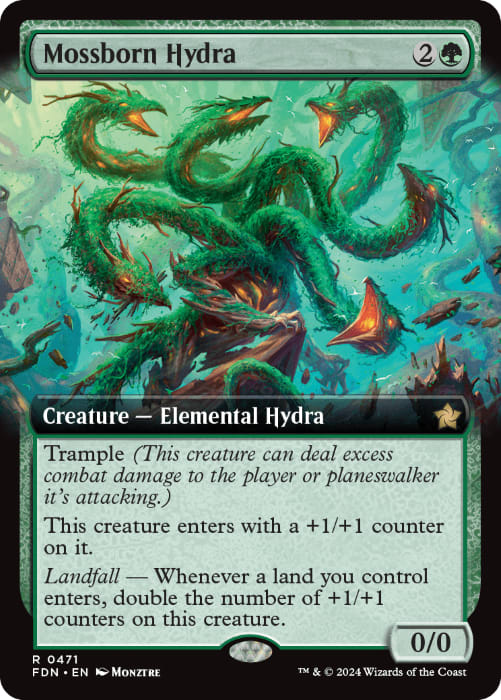
Hydras that can double their counters are another very potent way to get +1/+1 counters onto my creatures. Mossborn Hydra will enter play with just one counter, but whenever a land I control enters I'll double the number of +1/+1 counters on it. That might not seem like much, but with a little ramp and enough turns, that 1/1 Hydra could become an 8/8, 16/16 or more. If I've managed to get Kalonian Hydra into play and I can attack with it, I'll double the number of +1/+1 counters on each creature I control.
Wildwood Scourge is in this list as a way to get more counters whenever I put counters on non-Hydra creatures. I'm also running Steelbane Hydra as a way to clear out artifacts and enchantments, Rampant Rejuvenator as a way to possibly get some extra lands into play, and Benevolent Hydra as a way to get some extra counters on my creatures. Primordial Hydra is also in the list and will double its +1/+1 counters at the beginning of my upkeep. I'm also running Hydra's Growth, an aura that will put a +1/+1 counter on enchanted creature and double those counters on my upkeep.
Hydras alone could probably get this deck where it wants to go, but I wanted to add a few extra +1/+1 counter cards to really lean into this theme. I am running The Ozolith, Doubling Season, Hardened Scales and Parallel Lives to help out, but it's worth looking at a few more creatures that work with this theme. And Magic has plenty of creatures that work with +1/+1 counters.
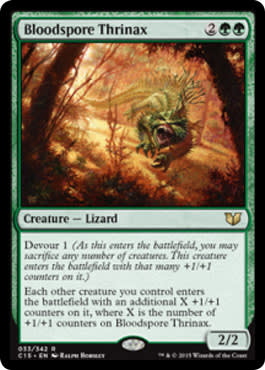 |  |  |
Bloodspore Thrinax can provide extra +1/+1 counters when creatures enter play. It has devour 1, which means I can sacrifice any number of creatures when it enters play, and it will get +1/+1 counters equal to the number of creatures it devoured. In the late game if I've created 10 1/1 saprolings and Bloodspore Thrinax devours them all, it will be a 12/12, and creatures that enter play under my control will enter with 10 +1/+1 counters.
Bane of Progress will enter play and destroy all artifacts and enchantments. That means there will be games where it sits in my hand because I don't want to lose my support cards. If I pull that trigger and play it, I'll put a +1/+1 counter on it for each permanent destroyed when it hits the battlefield.
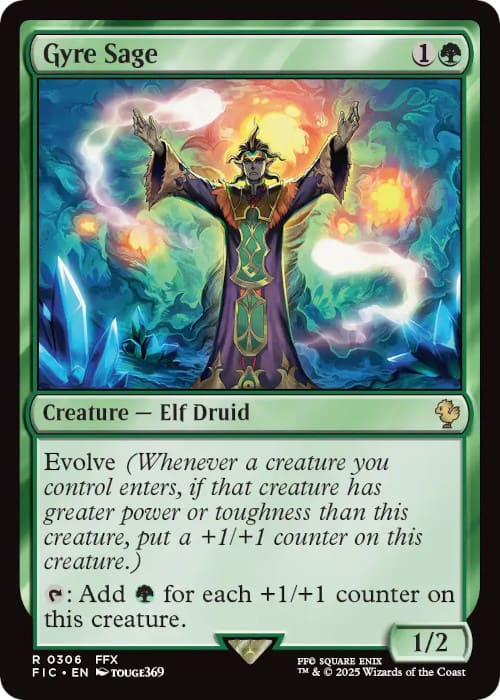
I've got a lot of support cards in this deck that play with counters. Gyre Sage has evolve, so it will get a +1/+1 counter whenever a creature enters play under my control with a higher power or toughness. Gyre Sage taps for Green mana for each +1/+1 counter on it, so it's a perfect fit for an aura like Hydra's Growth and plays well with my other counter doublers. Fertilid enters with two +1/+1 counters and I can pay 
 and remove a counter to tutor up a basic land. Armorcraft Judge will enter play and draw me a card for each creature I control with a +1/+1 counter on it.
Not everything in this list cares about counters, but I like to lean into a theme pretty hard.
Going Wide
I may well be able to win games without ever playing my commander, but for this deck to live its best life, I'm going to need to get to seven mana, play Ferrafor, and have a few turns afterward to do silly things with my commander in play.
 |  |  |
Panharmonicon isn't in this list, but could easily slot in as a way to double the fun when Ferrafor enters the battlefield. I'm going to build this in paper, and I may well include it in place of cards I don't have available.
This deck's dream scenario involves playing a Conjurer's Closet and probably at least one token doubler. Conjurer's Closet will have me exile target creature I control and then return it to play under my control. It's only on my end step, but it's a way to steadily put pressure on the table as my saproling army grows and grows. Chump blockers often don't mean a lot in Commander, but in sufficient quantities they can absolutely be a threat to win the game. Another nice way to get an extra ETB for Ferrafor is Sword of Hearth and Home, which on attack will let me tutor up a land and flicker target creature I control.
Blade of Selves and Helm of the Host deserve a special mention. The former gives equipped creature myriad, which means when it attacks I'll create a token copy of the creature attacking each other opponent. At a four player table one Ferrafor attack would give me two additional ETB triggers, though my token copies would be sacrificed immediately because of the Legend rule. Helm of the Host will have me make a hasty nonlegendary copy of equipped creature at the beginning of combat. I'll want to hold priority with the ETB trigger on the stack to tap it and double the number of counters on target creature before making my saprolings.
I'm running Tendershoot Dryad to support my Saproling army. It gives me a 1/1 Green Saproling creature token at the beginning of each upkeep, and my Saprolings get +2/+2 as long as I have the "city's blessing". That simply means I need to control at least 10 permanents, and once I have it I can't lose the city's blessing. I'm also running Loyal Guardian, a five-mana Green Rhino which will have me put a +1/+1 counter on each creature I control at the beginning of combat if I control my commander.
If I am able to create a big Saproling army, Shroofus Sproutsire is in the mix as a way to let my deck go even wider. If it's in play, whenever a Saproling I control deals combat damage to a player I'll create that many 1/1 Green Saproling creature tokens. I might be setting myself up for a horrible death at the hand of a Massacre Wurm, but that's a risk worth taking.
The Long Game
It's worth asking if a deck that needs to build up a big board, play its commander, make a ton of Saprolings, and then swing with them to win games will ever be fast enough to compete in today's game. The format in 2026 is a place some players willfully misconstrue the bracket system and many view the "you should expect the game to last at least X turns" to be an instruction that they should be attempting to win on that turn. Ferrafor is a commander built for the EDH of years gone by. Seven mana is prohibitively expensive for higher bracket play, and if you're in a meta where folks are aggressively trying to win by "turn X", you might not get much joy out of playing a Ferrafor deck.
Playing a long game can be done in a few ways. You can build decks with so much interaction that nobody can establish a board or keep key creatures in play for very long. You could also just accept that a longer, lower powered, less interactive game of EDH is where a deck like this might find its home. I'm running Heroic Intervention and Inspiring Call, but in general I think a faster, higher powered (B3) meta will sometimes have games ending before you can even play your commander. That can be frustrating, so just be aware of what you're getting into if you want to build a Ferrafor, Young Yew EDH deck.
Ferrafor, Young Yew | Commander | Stephen Johnson
- Commander (1)
- 1 Ferrafor, Young Yew
- Creatures (34)
- 1 Armorcraft Judge
- 1 Avenger of Zendikar
- 1 Bane of Progress
- 1 Beast Whisperer
- 1 Benevolent Hydra
- 1 Bloodspore Thrinax
- 1 Bristly Bill, Spine Sower
- 1 Craterhoof Behemoth
- 1 Dawntreader Elk
- 1 Devoted Druid
- 1 Evolution Witness
- 1 Farhaven Elf
- 1 Fertilid
- 1 Forgotten Ancient
- 1 Gyre Sage
- 1 Heartwood Storyteller
- 1 Kalonian Hydra
- 1 Kami of Whispered Hopes
- 1 Loyal Guardian
- 1 Managorger Hydra
- 1 Meltstrider Eulogist
- 1 Mossborn Hydra
- 1 Mycoloth
- 1 Neverwinter Dryad
- 1 Pathbreaker Ibex
- 1 Primordial Hydra
- 1 Rampant Rejuvenator
- 1 Sakura-Tribe Elder
- 1 Sazh's Chocobo
- 1 Shroofus Sproutsire
- 1 Springbloom Druid
- 1 Steelbane Hydra
- 1 Tendershoot Dryad
- 1 Wildwood Scourge
- Instants (8)
- 1 Archdruid's Charm
- 1 Beast Within
- 1 Gaea's Gift
- 1 Heroic Intervention
- 1 Inspiring Call
- 1 Return to Nature
- 1 Silkguard
- 1 Snakeskin Veil
- Sorceries (6)
- 1 Ezuri's Predation
- 1 Nature's Lore
- 1 Rampant Growth
- 1 Shamanic Revelation
- 1 Three Visits
- 1 Titania's Command
- Enchantments (6)
- 1 Doubling Season
- 1 Growing Rites of Itlimoc
- 1 Guardian Project
- 1 Hardened Scales
- 1 Hydra's Growth
- 1 Parallel Lives
This first draft feels like it's got a lot of room for growth. I thought about slotting in Akroma's Memorial, Eldrazi Monument, and Beastmaster Ascension to try to increase the chances that my Saproling army can hit for a little more damage. The current list's best finishers are probably Craterhoof Behemoth and Pathbreaker Ibex. The former is a format staple that enters play and gives my creatures trample and +X/+X where X is the number of creatures I control. The latter plays well with my tall/wide strategy, as it gives trample and +X/+X until of turn where X is the greatest power among creatures I control.
To tune this list down I'd probably lean into a Treefolk subtheme and try to find a balance between a "trees and sprouts" theme and a more synergistic +1/+1 counters theme. It might need more ramp, but a seven-mana casting cost already keeps this deck from being too degenerate. To tune it up I think I'd lean into more powerful ramp creatures like Nyxbloom Ancient, artifacts like Caged Sun and Extraplanar Lens, and other ways to increase the chances that you'll play your commander earlier than turn seven. If you're not interested in playing your commander, you probably want to think about finding a better leader for the bracket 3 or 4 Green deck you're trying to build. There are plenty out there to choose from.
Early Results
I was able to get this list into a game on Tabletop Simulator this past Thursday night. The deck was able to get out a few early blockers, and I was able to get out a handful of creatures with +1/+1 counters. I started with four lands in hand and hit a few land drops and ramp spells after that, so I was able to get to the point where I could have cast my commander.
I'm not sure whether I was being greedy or just misread the speed of the table, but I ended up playing out a Loyal Guardian and a Benevolent Hydra with the plan to play Ferrafor the next turn and then maybe try to get up to some trouble.
The entire table was caught a little off guard by a player on the recently spoiled Quintorius, History Chaser. They played a Moonshaker Cavalry with enough of a board that using Quint to give their team double strike and vigilance meant only a Fog would have saved us. I had tapped out on my turn and didn't even have a Fog in the 99, much less in my hand.
The Quintorius player didn't have lethal on everyone, and chose to leave a player on Freyalise alive. That player was then able to put together enough of an attack to win. I might have put more effort into pleading my case, but I've had a remarkably good month in terms of winrate and decided to go down quietly. It's easy to point out that you are the one who should be spared, but I had every intention of making a ton of Saproling blockers on my turn. As it turned out the next card I would have drawn was Craterhoof Behemoth, so killing me was probably a good decision.
The list I have put together in paper does have Fogs, but is lacking a bunch of staples it should have. It's cobbled together from cards I've got lying around, so I don't have a spare Heroic Intervention or Craterhoof. I'm comfortable playing unoptimized lists in lower powered games and enjoy the challenge of trying to get a win with a deck that clearly could be stronger. It also gives me room for improvement if the deck isn't "getting there" but is giving me entertaining games. Making upgrades can be fun, and if your first draft is always tuned as much as possible, there might not be much you can do to make it better.
Final Thoughts
While the format may be moving away from a place where a seven-mana commander feels playable, it's important to remember that your playgroup can play any kind of Commander you like, providing you're able to come to an agreement and all stay on the same page. You can decide that you want seven mana commanders to be viable and each build at least one deck that plays for a longer, lower powered game. It is incredibly frustrating to have a new deck with a high mana commander and play a bunch of games where it's over before you are even able to get to seven mana. That's not an unrealistic scenario with a commander like Ferrafor, Young Yew, even if you think you leaned into a decent ramp package for the bracket you'll be playing at.
The good news is that if you're able to balance your ramp package and get your list to the point where you're able to play Ferrafor and have a few turns to get up to some nonsense, you should have the occasional game where you can do very silly things. You might make over a hundred Saproling creature tokens. You might swing out with over a thousand power, and trample to make sure your damage gets through. Crazy things are possible, but you will need to find a pod where this deck has the time to mount that kind of threat.
I played a few Treefolk decks back when the The Lord of the Rings: Tales of Middle-earth came out, and I really enjoyed them. Much like Ferrafor, they weren't about to push up into bracket 4 (or possibly even bracket 3) territory, but they leaned into a theme, had some synergy, and were fun to play. That was Fangorn, Tree Shepherd, at seven mana, and Quickbeam, Upstart Ent, at six mana. Both had similar casting cost challenges to Ferrafor. Both Old Man Willow and Treebeard, Gracious Host weigh in at four mana, but I never built either of them. I may revisit Treefolk as a kindred deck later this year, especially if we get anything interesting in The Hobbit set that comes out this Summer.
That's all I've got for today. Thanks for reading and I'll see you next week!