


 Locations



If you've played Modern at all, you've probably heard of the infamous Storm mechanic. You know, that one ability that rewards you for casting lots of spells and killing your opponent in a single turn with the bulk common Grapeshot? Well, now, may I introduce to you the long-lost sibling of that "broken" mechanic that instead counts how many permanents have gone poof from the battlefield to the graveyard in a turn and then copies itself accordingly? That's right, in today's Mechanics Overview Segment, we're going to be covering Gravestorm, the mechanic that's kind of like a fixed version of Storm, but (as you'll soon find out), not really.
What Is Gravestorm?
Gravestorm (When you cast this spell, copy it for each permanent put into a graveyard this turn. You may choose new targets for the copies.)
Gravestorm is a triggered keyword ability that copies a spell when you cast it, but unlike Storm, which copies based on how many spells have been cast that turn, Gravestorm counts how many permanents were put into any graveyard from the battlefield that turn.
Sp, say you're playing your favorite sacrifice-heavy deck. You sacrifice three artifacts, a creature, and a land; that's, count em', five permanents have just been sent to the graveyard this turn. Now, you cast a spell with Gravestorm. When it resolves, Gravestorm kicks in and creates five copies of that spell. That's six instances in total: the original plus five copies.
The History of Gravestorm
If you've ever been fascinated by Magic's evolution as a game, Future Sight (2007) likely stands out as one of the game's most daring sets. Released in 2007, it was a look into possible futures for Magic, filled with "preview cards" from upcoming sets, but also a treasure trove of experimental mechanics. Among these mechanical oddities was Gravestorm, then dubbed "Deathstorm" during early design talks. The idea was straightforward but potent: instead of counting spells cast like Storm, why not count permanents going into the graveyard? What could possibly go wrong?
Bitter Ordeal, The First Gravestorm Card
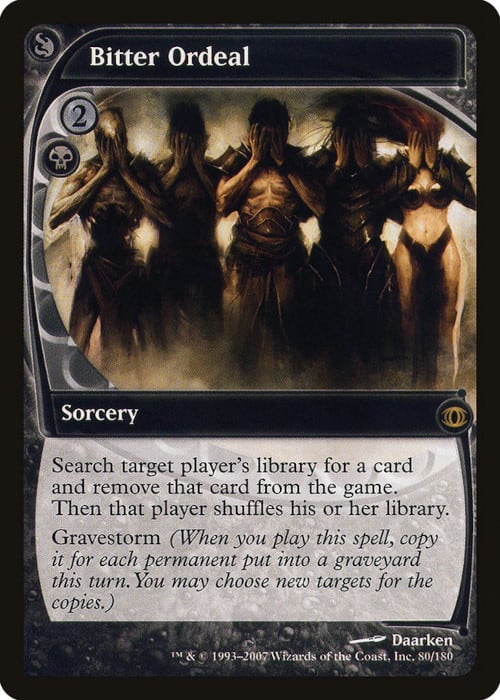
The original Gravestorm card, Bitter Ordeal, is a perfect encapsulation of Future Sight's design philosophy. It's an arguable mana-efficient black sorcery that lets you exile specific cards from your opponent's library, and crucially, it copies itself for each permanent that was put into a graveyard this turn.
What does this mean in practice? Well, if you managed to kill off a bunch of tokens or creatures that turn (which is a fairly common occurrence in most black decks), you could potentially exile a ton of powerful cards from your opponent's library in a single, devastating spell.
Gravestorm: An 8 On The Storm Scale
Mark Rosewater has since openly discussed Gravestorm's challenges. He likened its design problems to Storm, as both mechanics have a major balancing problem. When you cast a spell with Gravestorm or Storm, you create copies based on a number that can quickly explode, leading to very swingy and sometimes unfun gameplay. And because of this, Gravestorm was largely shelved after Future Sight, relegated to the status of a cool one-off mechanic that was "pretty broken" and not quite right for the evolving Magic ecosystem.
Let's Follow the Bodies
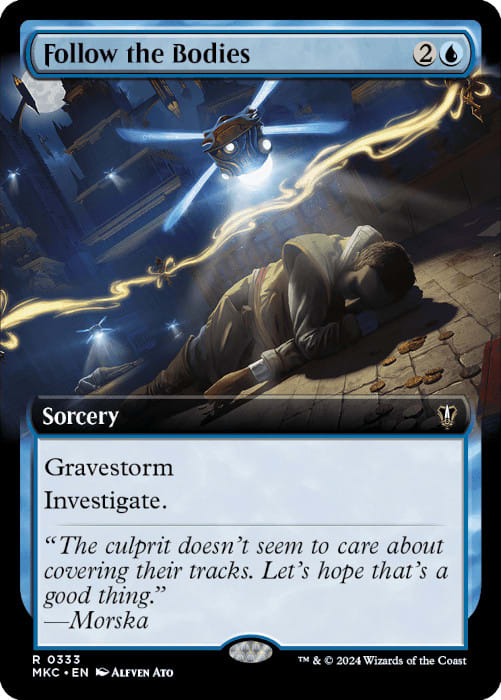
For years, Bitter Ordeal remained the only card with Gravestorm. Then, in 2024, Murders at Karlov Manor (2024) dropped, and much to everyone's surprise, Gravestorm returned, but this time on Follow the Bodies, a much more subtle and less intimidating card that allows you to draw cards with lots of Clues rather than exile your opponent's library.
Follow the Bodies shows us that Gravestorm can be revisited, carefully, if the power level and context are just right. Instead of exiling entire libraries or copying lethal spells, it rewards the player with incremental value, leaning on synergy and flavor rather than "oops, I've just won the game".
Storming Out with Gravestorm
As I always preach, Magic is as much about flavor, creativity, and surprises as it is about competition and strict balance. Gravestorm belongs to that rare class of mechanics that aren't necessarily designed to dominate in competitive settings but to enrich the game's lore and player experience. In my opinion, it is mechanics like Gravestorm that spark player curiosity and deck-building creativity. How many permanents can I destroy this turn? When's the best time to maximize on these copies? How salty will my opponent be if and when I pop off? For many players (myself included), it's these very moments, where you find a hidden combo or build a deck around an unusual mechanic, that become the most memorable.
Will we ever see Gravestorm again in a major set? Unlikely. But if it does return, it will likely be in a more measured form, like Follow the Bodies, where it adds flavor and synergy without overtaking the game.
And with that, I'm pretty much done storming off about Gravestorm. As always, happy brewing, and may you keep sacrificing, keep destroying, and your Gravestorm spells copy beyond your wildest dreams! Until next time.