 Locations



Today, we will discuss what it takes to build a successful Commander deck. Hopefully, you've played a little bit of the format before, & maybe even delved into how to build your own deck.
Preconstructed decks, or precons, are a great place to start, and will help you understand the bare bones of what should be in a deck.
This article will go through the basics of building a deck: choosing a commander, establishing a theme, optimizing mana curves, and other important tips.
There are some hard and fast rules, but most of them will be dependent on your Commander. Don't worry though. We are here to help guide you through the deck building process.
The Basics of a Commander Deck
Magic: The Gathering Commander uses 100-card singleton decks. Singleton means you can only have one of each unique card aside from basic Lands. You must have a legendary Creature (or two if they have Partner), Spacecraft, or Vehicle in your Command Zone. Sometimes you can have Legendary Creatures with a Backgrounds in your command zone too.
In most cases you're going to be running 98-99 unique cards, aside from your Commander(s). All these cards should focus on a central theme or mechanic.
How do you decide what to build your deck around? Here are some things to consider.
Choosing Your Commander
This doesn't seem like the hardest step, at first, but making a deck that does what you want it to do is difficult without research. Looking at a Commander doesn't give you everything you need to know.
You might like the idea of a Kasla, the Broken Halo deck, built around the Convoke mechanic. However, after a bit of research you learn your choices for Convoke cards in those colors might be limited or hyper-specific. It's hard to know right at first glance if a Commander will do what you want.
The Commander you pick will define your deck's colors and strategy. Balancing these two things can be very difficult. Resources like EDHREC and Scryfall are great ways to make those decisions.
Searching Kasla on EDHREC will show you what other players choose for a deck surrounding her. Even looking up the keyword "Convoke" in Scryfall can clarify if this is the type of deck you want to build.
Establishing a Theme
Decks -- and commanders -- tend to fall into categories, or themes, but you don't have to be limited by the obvious theme of a Commander.
Teysa Karlov decks are often Aristocrat, benefiting off the death triggers inherent in this kind of strategy. Aristocrat strategies get value from Creatures being sacrifices or dying. This Teysa deck gets to double dip with double death triggers, making this a good build around for her.
However, she buffs tokens too; you could always build a more combat-focused deck around swinging in buffed token with Flying.
Identifying Synergies Between Cards
When building a deck, you must think about a main strategy or mechanic, and select cards based on that. Focus on cards that move you closer to the goal your deck is working towards. Sticking closely to this idea will yield better results.
Let's use an example to demonstrate the point. Zimone, Mystery Unraveler and Threats Around Every Corner are very synergistic, put you in a strong position. Zimone uses Lands entering, or Landfall, to trigger her Manifest Dread ability. The face down card will trigger Threats Around Every Corner, bringing in a Land, triggering Zimone again.
These two cards make each other better, feeding off each other's abilities. This is what it means to synergize. If too many cards aren't working towards a common goal, it'll be hard for your deck to function properly.
Next, we will talk about balancing card synergies with the other important aspects of building a deck.
The Contents of a Commander Deck
Every deck, regardless of its game plan and theme, will have some of the same categories of cards. Let's get into what will be in your 99 (or 98):
- Lands
- Ramp Spells
- Draw Sources
- Removal/Interaction Spells
- Win Conditions (Wincons)
- Synergy Pieces
Most decks will have some combination of these types of cards. Sometimes cards will have dual functionality. There are schools of thought in how much of each should go into a successful deck.
Let's talk about the most popular one.
Using the "11 9s" Structure
The "11 9s" system isn't the most effective way to make a deck, and here's why. First, we'll need to understand structure.
11 9s organizes the 99 cards in your deck into 11 groups of 9 cards.
- 36 (3x9) x Lands: A streamlined & efficient Mana base. Additional Lands can be compensated for in the ramp section of this article.
- 9 x Ramp: These are cards like Cultivate and the infamous Sol Ring. These will give you more mana early on so you can have more impactful turns at the start of the game. It's also where you can slot in a few extra Lands if you need them.
- 9 x Card Draw: These are cards like Rhystic Study, Necropotence, or Trouble in Pairs. These are cards that will fill your hand throughout the course of the game. One-off card drawing Instants and Sorceries can fall into this category too like Return of the Wildspeaker.
- 9 x Removal/Interaction: These are cards like Swords to Plowshares, Counterspell, and Damnation. The best way to think about this category is disruption of the opponent's game plan. Being able to interact with your opponent's spells and permanents is a key part of Commander.
- 45 (5x9) x Theme/Synergy: This is where you would play something like Dryad of the Ilysian Grovein a Zimone, Mystery Unraveler deck. Cards that synergize with the theme of your deck would go here. This is the fun part of building a deck.
The Problem with the 11 9s Structure
The problem with this deck building structure is that it's too "one size fits all." Commander decks are so unique that this cut and paste strategy just leads to players diluting the strengths and weaknesses of their decks.
Not all decks need 9 pieces of card draw. Self-Mill decks like Coram, the Undertaker use the graveyard as an extended hand and will need less card draw and more Mill cards.
Some decks are going to need more Lands, like an Aesi, Tyrant Gyre Strait. Landfall decks need more Landfall triggers and more Lands to search for from effects. You will often find those decklists running significantly more Land than other types of decks.
The categories to break a deck into are accurate. We should be considering ramp, card draw, disruption, and synergy when we build decks, but the perfect combination of these things are highly dependent on the deck.
The Command Zone Podcast released their own deck building template which is shown below, but even then, the podcast talks about how it is a guideline not a perfect list. It's a starting point to get builders in the right space for general efficiency. Builders should be optimizing up and down these numbers. How do you structure your deck then?
The Alternative Deck Building Strategy
We're going to use a sample Commander to talk about how to build around one. Let's follow some of the steps we've outlined in this article so far.
Select a Commander
Let's talk about Coram, the Undertaker. Coram is a Legendary Creature - Human Warrior. It cost 


 to cast him. He's a 0/5.
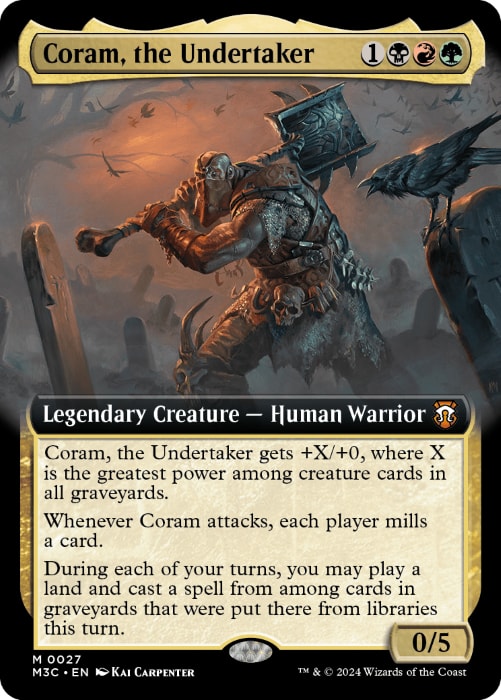
Notice that Coram cares about the greatest power among Creatures in all graveyards and can play Lands and cast spells if it was milled this turn. These are important. It gives us an indication about what this deck is trying to accomplish. This is what should be kept in mind when going from selecting cards for your deck.
Select a theme
Coram might seem like a deck that would be a good deck for milling everyone, considering he cares about all graveyards, but from a quick search on Scryfall it is evident Jund , is better at milling itself. In these colors, it's easier to guarantee what goes into the graveyard as well. We will be building around a strategy of milling ourselves instead of our opponents.
The Contents of the Deck
Lands
There are tons of resources suggesting that a Commander player should never go below 37 Lands in a deck, and Coram doesn't care about Landfall so it doesn't exactly help to have more. Additionally, just because the mana curve, or the distribution of mana costs across the whole deck, is somewhat high doesn't mean we'll need more Lands. Coram isn't trying to play these high mana cost cards. He wants them to go directly from the library to the graveyard or go to the graveyard without casting them.
Dakmor Salvage is great Land to run here because if you mill it, or get it into your graveyard some other way, you can swap the draw with more mill. It's also a Land, so it does the thing all Lands do.
37 cards in this slot makes the most sense.
Ramp Spells
Including cards like Hedge Shredder helps you generate more mana. Your deck will put cards from the library to the graveyard so being able to ramp a Land each time is good. In a pinch being able to Crew it and mill 2 also helps with the Self-Mill strategy.
Tato Farmer puts Lands into play beyond the one for turn, and gives you Rads for Landfall. This allows you to put more cards into the graveyard. It's better than a Cultivate in most situations.
Additionally, running turn two mana ramp to get Coram out on turn three is important. Things like Fellwar Stoneand Nature's Lore are great includes here. The faster Coram gets out, the more value you get from his abilities.
Eight pieces of ramp make the most sense here because a lot graveyard decks tend to cheat mana costs.
Draw Sources
Self-Mill or graveyard decks need way less card draw than most decks. The graveyard becomes an extension of the hand. Coram allows players to choose from the things milled that turn to play. It's like drawing cards. Actual draw will be limited.
Greater Good is a good pick here because it takes advantage of how big Coram can be to draw a lot of cards. It also can turn a removal effect targeted at Coram into card draw by sacrificing him in response to being targeted.
Five pieces make the most sense here because the mill cards and reanimation cards will help flesh it out more. They'll pull double duty.
Removal/Interaction Spells
Coram is very vulnerable to removal because of the colors he's in, but the hope is that the deck can recover quickly. If Coram dies then we'll Reanimate him or use Living Death after a board wipe to get back in the game.
Disrupting others is still important, however. Other decks can be faster than Coram. Mandate of Abaddon is a good board wipe because Coram should ideally have the highest power among Creatures. His ability to mill big Creatures like Yargle and Multani can guarantee board wipes leaving only him alive.
Six pieces here will suffice. Most of the things that will remove Coram will be destruction, which he is very resilient to. In Jund , there aren't a lot of ways to protect him from exile effects aside from Heroic Intervention type effects.
Win Conditions (Wincons)
To close out games, there are cards that are the most powerful and synergistic that win you the game when you see them. You want to put a decent number of them in your deck if you want to win consistently.
Chandra's Ignition and Jarad, Golgari Lich Lord are going to be your game enders. Getting Coram's power nice and big and burning out the table based on his power is great way to take advantage of his ability.
Seven pieces are good here. Coram has combat on his side and sometimes grinding through with the biggest Creature can close out the game on its own. However, when opponent's decks are fast and/or resilient, you need some hay makers to secure the victory.
Synergy Pieces
Let's end with some synergy pieces. Cards that Mill in addition to other effects are preferred above cards that just do one thing. It makes each card dual purpose and adds consistency to the deck.
Coram cares about putting big Creatures in the graveyard to make him big and scary. That will be our focus.
Yargle and Multani is a great Creature to mill because it makes Coram an 18/5. Slapping some Trample on him with something like Garruk's Uprisingand you can have a deadly combo. This choice focuses on Creatures with the greatest power.
Ripples of Undeath and Out of the Tombs are great ways to put cards into the graveyard from the library for Coram to play that turn with his ability, or to increase his power.
36 pieces here are ideal if you can balance some of the dual-purpose functions of each section. Using Self-Mill as card draw and Reanimation as interaction, for example.
These are examples of what the contents of a deck are, but let's take it further into certain aspects of deckbuilding that gets ignored.
Mana Curve
Something unmentioned in some other structures for deckbuilding is the mana curve. As a reminder, a mana curve is the distribution of mana costs across the whole deck. It's how many one drops to 10 drop spells you run in your deck.
Some decks have high curves. That means they're filled with spells with high mana costs. Because of this, they'll need more ramp and Lands. Some have low mana curves and need less ramp and Lands. Some decks cheat their spells into play.
The Amazing Spiderman is a deck with a high curve but low ramp because with mana dorks and Bant 
 , you can cast any Legendary spell regardless of its mana cost. Ramp isn't super important here. Protection for your Commander is.
In the example with Coram, ramp is somewhat important because getting Coram out early is important and the curve is high. However, Coram's deck has ways to cheat things into play for really cheap, so ramp isn't exactly the biggest or most dedicated concern.
On the other hand, lower cost curves might run out of gas quickly, so card draw becomes a big concern for these kinds of strategies.
Understanding what your deck needs is important to determining its curve. It's important not to be in situations where you can't forward your game plan reasonably because of the mana cost of the cards in your hand.
Turn Mapping
Another thing not mentioned in building a deck is turn mapping. This might seem like we're talking about a mana curve, but it's a little different. You want to be able to see what you can play consistently on turns one through ten. This is how to map your turns.
In decks that need to ramp earlier, you want to have a decent amount of turn one or two plays. To guarantee this you have to have a reasonably amount of them to potentially draw early in the game.
Commanders that cost three and want to be out as soon as possible might run more one drop mana dorks to get there. Commanders that are four mana value might run more two drop ramp.
Hitting your curve is the idea of turn mapping. You want to be able to consistently do something on each of your turns. Understanding this is very nuanced and somewhat more advanced deck building. Don't sweat this one too much.
Coram for this example would run more two-drop mana ramp to get him out sooner rather than later. Things that produce colors because he's a three-mana-pip commander would be ideal. So Fellwar Stone and Sakura-Tribe Elder are great choices here.
Similarly, getting cards that put things into your graveyard before Coram's out might be helpful too. The more you can put into the graveyard over the course of the game the better. So, having more things like Out of the Tombs or Ripples of Undeath are great.
Summarizing Commander Deck Building
Walking through the steps taken to build a Coram, the Undertaker deck is an attempt to explain how incredible nuanced each deck can be. The logic you would use on each deck is specific and internally determined. It's important to follow the practicality of the examples, though.
Think about what your Commander's strengths and weaknesses are. Some decks need more protection while other decks are so resilient that it's a waste of a slot. Sometimes decks need more card draw because the cost of their spells are lower.
The concoction of a deck is the sort of formulation that you'll have to tweak with time as you play it. It'll come more easily with experience, but if you want to be an efficient builder, it can't be one size fits all strategies. You'll leave so much on the table.
Essential Tips
Here are the final things to keep in mind building a Commander deck:
- It's a singleton format. You can only have one copy of any card, except basic Lands. Doesn't mean you can find a lot of different cards that do the same thing!
- Every card must match the color(s) of your Commander. Remember your Commander's color can be indicated by activated or triggered ability in the text box as well as at the top.
- Use your tools! EDHREC and Scryfall are great for building. The more experience you get with the tools, the more helpful they become.
- Buy Singles! Do not try to buy booster boxes looking for one card. You'll waste more money looking that way. It's easier to see what a site is listing them for and just pay upfront.
- Playtest your decks. Moxfield and Archidekt allow you to build your decks online and play them. This is a good way to see how a deck flows -- how consistent they can be -- before you commit to buying anything. It's good even after you committed to see what changes you can make after facing real opponents.
Conclusion
It can be very daunting building a Commander deck the first few times. Remember to use your resources and ask for help. It is so fun and rewarding to create something of your own. Use this guide! I'm @strixhavendropout on everything.