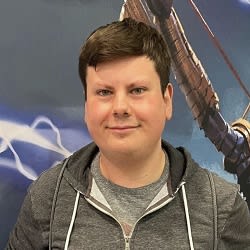
 Locations



From 1998 to 2026, Ron Spears dedicated countless hours and immeasurable passion to the world of Magic: The Gathering. Unfortunately, Ron recently lost his battle with cancer. In memory of him, we're going to look at the years of art he contributed to the game.
I've been playing Magic for 27 years. In that time, Ron became an artist that I think of very fondly. A master of his craft, Ron started to produce art for the game in 1998, just before I picked up the game. His work has been part of my entire history with the game.

Last week, Ron tragically passed away at a young 66.
The community has been shocked by the suddenness of this news. Nothing had been revealed publicly prior to the announcement of his passing. Not only has the community come together to sing his praises but to also share several of their personal favorite artworks that were done by him.
It's with heavy hearts that we mourn the passing of iconic artist, Ron Spears.
With a flair for the fantastic, Spears's illustrations have transported players to planes across the Multiverse for over 20 years?magic.wizards.com/en/news/feat...
— Magic: The Gathering (@magic.wizards.com) June 24, 2026 at 6:33 PM
[image or embed]
Wizards also put out a tribute celebrating Ron's contributions to the game. Along with his contributions from behind the pen, he spent several years as Art Director. During that time, he helped shape the visuals for every major expansion from Urza's Saga up through Odyssey in the late 90s and early 2000s.
This was a critical and formative era of mine. I grew up with many of Ron's works and have grown a deep fondness for his art and the cards that feature it.
Today, I'd like to go through and highlight some of his best pieces and show off how awesome he made this game during his lifetime.
The Premodern Era
He was a massive part of the game's earlier years, especially prior to Eighth Edition and the Modern era of Magic.
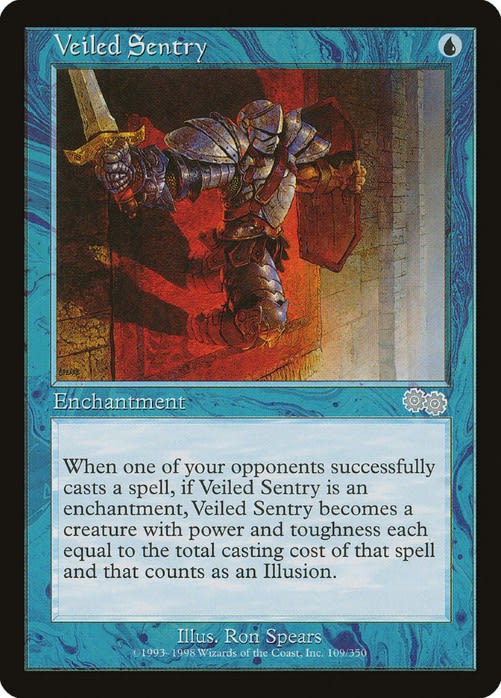
It's widely reported that Ron's first piece for the game was for the card Veiled Sentry in the Urza's Saga set. This depicts a knight coming through a wall tapestry and plays into the various Enchantment cards that could turn into Creatures if the right conditions are met.
However, from what I found, this was actually not his first published piece. That honor goes to his three contributions to the series of Promo Basic Lands for a special promotion in the Asia-Pacific (or APAC) region.


Each depicts a different setting in Japan and are well known for their gorgeous and unique style. The second Swamp depicts a foggy bog set in Indonesia surrounded by gnarled trees.
They're fan favorites and status symbols among the game's most enfranchised players. Two of these Lands - the sunflower Plains and graveyard Swamp - are among the most coveted of these Basics.
It is possible that these were submitted after Veiled Sentry but were the first to be released. Nevertheless, they represent an excellent start to his career.


His work began in earnest with three pieces of art in Urza's Legacy: Erase, Opportunity, and Beast of Burden.
If you have even a passing familiarity with Urza's Legacy, you likely best recognize Beast of Burden among these three. The big Golem served as both the artwork for the booster packs as well as the Prerelease foil. In its time, it was a fan favorite among newer players, in part because of this standout art.


For the final set in the block - Urza's Destiny - Ron did four excellent artworks. These include Aura Thief, Reckless Abandon, Thran Dynamo, and Thran Golem. Each has a solid amount of play, both in Casual and Competitive spheres.
However, the one that likely takes the cake among these is the powerful mana rock Thran Dynamo. Not many mana generators grant you mana like this these days and it is still a solid standout of Commander.


Next came the Mercadian Masques block. Here, Ron produced six pieces of art, with two appearing in each set.
Perhaps the most notable of these is the card Rootwater Thief. This card was the Invitational winner design from infamous former pro player and cheater Mike Long. The artwork depicts Mike in a rowboat, about to be attacked by a terrifying merfolk that has emerged from beneath the waves.

I also want to highlight the artwork for Deepwood Drummer. It's the kind of art that stands out thanks to its colors and the clear energy of the subject in the piece. For me, it made for a very memorable piece in my first year.


In the Invasion block, Ron did things a little differently. He had three pieces in Invasion and two in Planeshift, with perhaps the most famous of these being Phyrexian Altar with the devilish depiction of Tsabo Tavoc.
Interestingly, though, he didn't have any art in the main set for Apocalypse. Despite this, he did contribute the promotional Goblin Soldier token for the powerful Goblin Trenches.


His absence in Apocalypse could possibly be attributed to his work as an art director, but also his significant contributions to Seventh Edition.
The set is known for giving new art to every card. Some were better than others. Thankfully, Ron's depiction of Goblin King has become a true fan favorite, with the art seeing reprints in every Core Set through Tenth Edition.
Crafting Otaria
With Apocalypse, the Weatherlight Saga was over. Yawgmoth was defeated and Dominaria was left devastated. The story leaped forward 100 years, and we would find ourselves on the Dominarian continent of Otaria as the plane heals.
It's not a stretch to suggest that Ron's work truly helped this setting flourish. Many of the pieces he made for the era are seared into many players' minds as what Otaria looks like.


By the time the Odyssey block was released in 2001 and 2002, Ron was growing more prolific. This included seven works in Odyssey and three apiece in Torment and Judgment.
In Odyssey, he would produce the art for one of the most innocuous appearing, powerful cards of all time: Entomb. This strange tutor lets you take a card from your deck and put it right into the graveyard. That might sound counterproductive until you combine it with powerful recursion to get back a huge Creature.
Hapless Researcher, a Judgment Common that Ron also illustrated, would also see play in many of these Reanimator-style lists.

Also, in Odyssey came the printing of Atogatog with art by Ron. This card was originally meant for the unreleased Unglued II: The Obligatory Sequel. As this set was scrapped, it was good to use in Odyssey, which had a cycle of five Atogs in it - including the infamous Psychatog.


Perhaps Ron's biggest contribution, though, came with Onslaught. Here he had a whopping twelve pieces of brand-new art for the set. Many of these are classics, to the point that even if you might not be familiar with the cards, you might very well recognize their artwork.


He even got to produce artwork for a handful of cards with a Competitive pedigree. Astral Slide is easily the most notable of these cards, acting as the centerpiece of its namesake archetype. One of his other cards, Naturalize, provided a strong early means of Artifact and Enchantment destruction in Green. The card may look quaint today, but it was a big deal in its time.
The powerful Biorhythm was also one of his pieces. The costly Sorcery depicts a close-up of Kamahl and was banned for many years in Commander until quite recently. Even setting Commander aside, however, it still makes a showing from time to time in Premodern Elves list, providing an alternate win condition against deck with a low Creature count.


Ron Spears' most iconic work of all time came with Legions. This was, of course, the beloved duo of Phage the Untouchable and Akroma, Angel of Wrath. Both these cards have been fan favorites from the day they were printed and continue to be both popular and inspire all kinds of cool new designs to this day.

What was especially fun for many players to discover was that the arts for both was one large painting. It's a stunning piece that truly shows just how much a master of his craft Ron was in this era.


In addition to that masterpiece, Ron did the art for four other cards. If you're of a certain age, seeing cards like Brood Sliver and Krosan Cloudscraper is sure to make you crack a smile. His art, along with a handful of fun designs, really helped to make the cards sing.
The Modern Era
Following Legions, Ron took a break from illustration for roughly a year. This would mean no new artwork in Scourge, Mirrodin, or Darksteel.


He would return once more for Fifth Dawn with four great new pieces of art. Both Condescend and Engineered Explosives have shown up quite a bit in tournament settings. The latter remains a current mainstay of the Modern format thanks in no small part to the current rise of Weapons Manufacturing Affinity.


Though Ron didn't do any pieces for the ill-fated Saviors of Kamigawa, he did quite a bit for both Champions of Kamigawa and Betrayers of Kamigawa. Many fans of the classic plain will likely recognize his iconic works with Brothers Yamazaki and perhaps his Prerelease rendition of Ink-Eyes, Servant of Oni.

I love Empty-Shrine Kannushi. It's a fun way to show off the art of origami in a card and the bright colors of the origami itself really pops.


Following a brief jaunt with a couple cards in Unhinged, Ron's work continued throughout the original Ravnica block on several cards per set. Utopia Sprawl, in particular, is a fan favorite, known for its lush visuals on a rock solid Constructed playable.

No card in his long career is quite as much of a Competitive player as Dark Confidant, though. This was yet another Invitational winner card, this time for Bob Maher, Jr.
Unlike Mike Long's Rootwater Thief, Dark Confidant became an instant hit, dominating games in all formats all the way back to Legacy. Ron's art became so loved, in fact, that the art which replaced it in Modern Masters was lambasted for being a marked step down.


A series of nostalgic throwbacks soon followed, with the printing of Coldsnap soon to be followed by the Time Spiral block. Many of these pieces are particularly beloved, like Mystical Teachings and Foresee.
Teachings has even seen a recent printing in Foundations, allowing that same classic Ron Spears art to shine in Standard once again.

Without a doubt, though, the card he's best known for here is easily Sliver Legion. Slivers remain a favorite among Casuals and this card is a must-have in any Sliver Commander deck.


Ron's final set for many years would be Lorwyn, which he produced only four pieces of art for this time around. These would include cards like Eyeblight's Ending and Inner-Flame Acolyte, as well a panorama piece for a much-beloved Island and Swamp.
After this, Ron largely stopped producing new art for Wizards. For the most part, only existing pieces would be re-used for various reprint releases. Only one new piece was used in this time: the art for Flamekin Village in Commander 2014. This would remain Ron's only art for Magic for a roughly 15-year span.
A Return to Form
With the release of Double Masters in 2020, as well as a handful of noteworthy pieces in the years prior, Wizards once again began contracting older artists to do new art for Magic. This led to the return of beloved names like Mark Poole, Richard Kane Ferguson, Thomas M. Baxa, and RK Post - just to name a few.


With Double Masters 2022, even more classic artists were commissioned. This time, the works included Ron Spears, who provided new art for the Borderless treatment of three cards: Assassin's Trophy, Supreme Verdict, and Selesnya Sanctuary.

Following this, Ron Spears began showing up more frequently, starting with a one-off piece for the Secret Lair x Post Malone: The Lands release. Here, he depicted yet another Basic Land fit for the classic retro frame treatment.


Ron's Borderless treatment art continued to grace a variety of sets from there on. These would include Dominaria Remastered, Commander Masters, and Modern Horizons 3. Each of these included several high-profile cards like the ones above, as well as heavy hitters such as Gauntlet of Power, Ohran Frostfang, Spectator Seating, and Undergrowth Stadium.


Ron finally returned to traditional frame cards in earnest with the release of Outlaws of Thunder Junction. There, he provided wondrous new art for the ever-popular Spirebluff Canal. These pieces would continue with gorgeous renditions of Dreamtide Whale in Modern Horizons 3 and Exotic Orchard in Bloomburrow Commander, just to name a few.
When Lorwyn Eclipsed released earlier in 2026, a major selling point for the set was the many classic artists returning once again. Doing this provided the set with a much more classic flavor and feel to celebrate coming back to a beloved world.


As a result, Ron Spears did a whopping six new pieces of art for the set. Five were for the main set, including cards like Boggart Mischief, Lavaleaper, Mischievous Sneakling, Wary Farmer, and an Island. Additionally, he did a Command Tower illustration for the set's Commander decks.
Each showed both the worlds of Lorwyn and Shadowmoor at their best, and given Ron's knack for bringing a plane to life, these were really special to fans.
As of now, it's unclear if Ron produced any works for any other upcoming sets. With luck, we'll be graced with one more masterpiece that's still coming down the pipe.
Conclusion
Ron Spears was more than just an artist when it came to Magic: The Gathering. He was a force of nature, hitting this game with knockout after knockout.
When I first picked up the game in the late 90s and through the early 2000s, Ron's art was one of the ones that drew me in the most. To this day I can't see cards like Syphon Soul or Reckless Abandon without smiling because of just how awesome they seemed to a kid like me.
It's a sense of wonder that pulls you in and makes you want to be a part of this world that makes Magic so fantastic.
The game just won't be the same without him.
Rest in peace, Ron Spears.