


 Locations


One of the first decks I ever built to play regularly was a mill deck, back in Return to Ravnica using Dimir. While Dimir is one of the most well-known mill colors out there, Edge of Eternities has made Azorius mill something viable. And it all comes from the interaction of two cards.
Life Gained = Cards Milled?

When I started fiddling around with this deck, it centered around using heavy control to deal with potential threats. While Dimir, the original color pair that I built this deck for, was good at dealing with single threats, it lacked a lot of answers for multiple threats. On more than one occasion, I'd be overwhelmed by lifegain rabbits running some of Bloomburrow's top cards.
Now, this wasn't a bad thing. It showed me that lifegain through weenies was a viable strategy, although one that quickly hit a brick wall after a board wipe. That's fine though, all I needed to do was get my hands on Space-Time Anomaly while my life was high and I'd manage it. Unfortunately, we do not live in Magical Christmas Land so my success with this plan was far less than if I was building lifegain myself.
So, after some more failed experiments, I noticed that Hope Estheim wanted to do the same thing I did, namely mill and count my life total. The upside was that it would work sometimes. More often than not, the opponent would easily spot what I was trying to do and kill her before she had any real impact on the board.
With the only really significant lifegain engine in Standard being a creature package, what I realized was that instead of milling my opponent out, I'd "accidentally" run them over with my lifegain creatures, and that's definitely not the goal of the deck. No, this had to have another answer.
Putting The Pieces Together
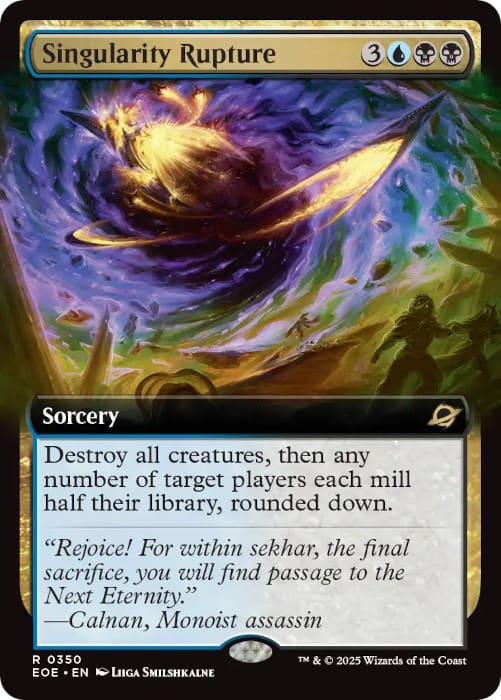
When there are so many sets running around Standard, the lower levels of the ladder (where I spend most of my time testing janky brews) have some wild and out-there experiences. I ran into another mill deck that seemed to be testing the same strategy I was, but by replacing Space-Time Anomaly with Singularity Rupture doing double-duty as both a board wipe and a mill spell.
The impressive thing wasn't the Singularity Rupture itself, but how it worked with another card. Enter Riverchurn Monument. While the regular ability to mill two cards isn't so impressive, the exhaust ability turns into a two-card combo with Singularity Rupture. If you threw in The Water Crystal, the monument would be able to mill 6 cards, which isn't nothing. If only Black's ability to deal with low-cost creatures wasn't so terrible, that combo would have been perfect.
For a little while, I played around with an Esper build, and it had some success, but more often than not, I'd end up with hands that left me vulnerable. Control was what I wanted this to be, but I had to keep it to two colors or risk getting color screwed.
That led me to realizing that Azorius Control was where the sweet spot for this deck would be, making it consistent and responsive, without shutting out options. Aside from the two-mana removal spells in White, I also had access to four and five-mana board wipes. Spectacular Pileup could serve as a good answer to the grindy decks playing Ketramose, The New Dawn and Zodiark, Umbral God.
Blue offered additional "board wipe" effects in Aetherize, as well as a good enough draw engine to churn through my deck quickly enough while my life total was still high. Cards like Consult the Star Charts are all-stars, even when it's not kicked to give me an extra card in hand.
Choosing The Right Artifacts
 |  |
At the start of this experiment I was using The Water Crystal as a way to make my Blue spells cheaper and to help me mill more cards. It was pretty impressive in Azorius Mill with Hope Estheim. However, I realized that, while The Water Crystal was a great card, it felt very underwhelming in this build. There were times I'd have cast a Consult the Star Charts, got a Crystal and a Riverchurn Monument and just won off the back of that interaction, but more often than not I'd have one Crystal on the field and one or two stuck in hand.
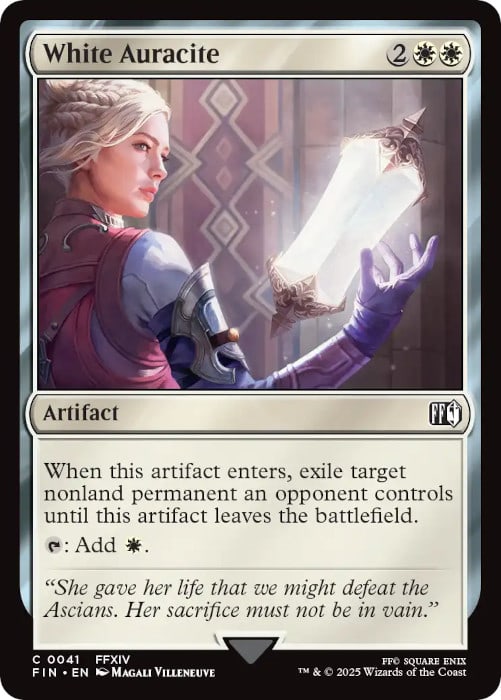
After running into a few decks that had some threats I couldn't deal with using my removal package, I opted to switch it up a bit. I cut The Water Crystal and instead opted to add White Auracite as catch-all removal. It didn't technically reduce my mana costs, but it gave me an extra land drop on an artifact that could remove even planeswalkers.
The Final Build
Azorius Standard Mill | EOE Standard | Jason Dookeran
- Instants (13)
- 3 Aetherize
- 3 Not on My Watch
- 3 Ride's End
- 4 Consult the Star Charts
- Sorceries (12)
- 2 Day of Judgment
- 3 Spectacular Pileup
- 3 Space-Time Anomaly
- 4 Stock Up
- Enchantments (3)
- 3 Authority of the Consuls
- Artifacts (5)
- 3 Riverchurn Monument
- 2 White Auracite
- Lands (24)
- 4 Island
- 6 Plains
- 2 Mistrise Village
- 4 Fabled Passage
- 4 Floodfarm Verge
- 4 Meticulous Archive
- Sideboard (15)
- 2 Bovine Intervention
- 2 Disenchant
- 3 Negate
- 1 Not on My Watch
- 3 Rest in Peace
- 1 Ride's End
- 1 Space-Time Anomaly
- 2 White Auracite
 Export Arena
This is my final Best-of-Three build for this deck. I also have a Best-of-One version, but it's nowhere near as consistent as this one. More often than not, it surprises opponents enough so that they don't really have anything to sideboard against it. It's not a T1 deck (maybe T2?) but it's quite a lot of fun to play. If you like milling your opponent and like playing control, this is the perfect solution. Try it out and let me know if you enjoy it, or what you'd change about it!