


 Locations


Well, it had to happen at some point. There's only so many sets to go around, after all. If you've scrolled down or opened this article on a monitor (or simply read the title), you'll know what I'm talking about: Golgari only has one legitimate entry in this series. In all the time Arena has been with us, through every limited format that encapsulates, Golgari was the best deck just one time.
I even tried switching the filters around on 17lands. These articles are based on Premier Draft win rate, so I tried swapping to Quick and Traditional but it didn't help.
That leaves me with a few options. Writing a much shorter article than usual is a non-starter, but I could go a bit more in-depth about that one set. I could write about the times it was nearly the best deck - there are quite a few 2nd and 3rd places I could mention. I could go on hearsay and nostalgia, trying to remember older sets where it Green-Black was on top, but I don't think I have the authority to pull that off.
Wilds of Eldraine
I think the most interesting option is to go into more detail about WOE. What was it about this format that set it apart from other modern Magic sets? What made it such fertile ground for Green-Black mages? It must have had something unique going on if it's the only set in years where Golgari came out on top.
Firstly, I think it's important to address something that the previous articles in this series have only hinted at: the differences between best and second best are slim. Even in WOE, Golgari was 0.2% ahead of Rakdos and Boros. There are many, many sets where Golgari is similarly close in second place. Indeed, I was a little surprised that it wasn't the best deck in Aetherdrift, but less so upon seeing the 0.1% differential. The best colour pair in that format, by the way, was Simic, which shared a lot of cards with Golgari and not just because both are Green.
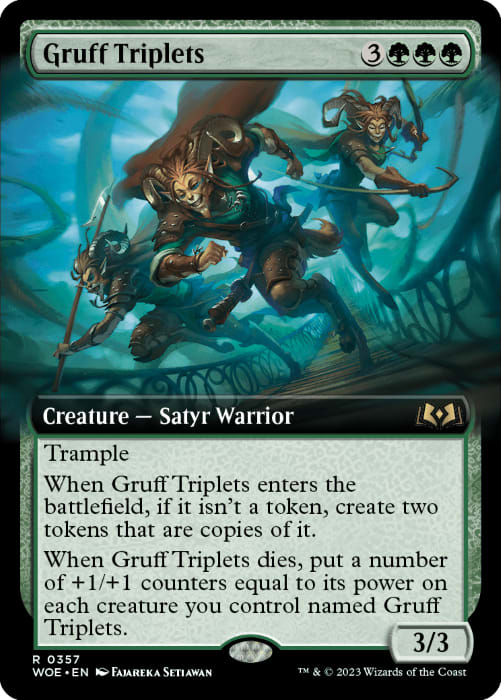 | 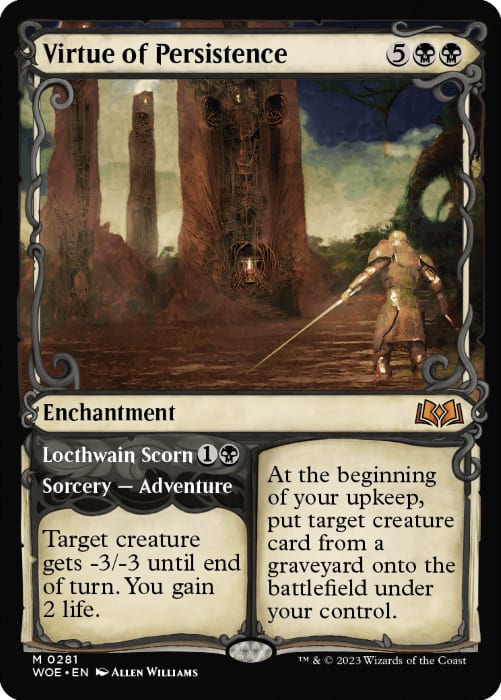 |  |
As for WOE itself, well I often like to start with the rares, and there are some clues about Golgari's success there. Gruff Triplets is a messed up card and, being at rare, it came up fairly often. It is head and shoulders above the other rares. In fact, the second winningest rare in the set was Virtue of Persistence (also in Golgari colours), almost 3% back. Lord Skitter, Sewer King and Faunsbane Troll also fit nicely into the format, both making an A rating on 17lands with over 63%.
What is interesting about WOE on a meta level is that the two colour pairs tied for second are both aggressively-slanted. Golgari was uniquely equipped to deal with this, in the classic "midrange beats aggro" fashion. Perhaps more importantly, the other part of that rock-paper-scissors equation ("control beats midrange") didn't really pan out. Dimir was more of a faeries-style tempo deck and Azorius was just not good at all. Essentially, Golgari got to prey on its traditional victims while dodging its traditional predator.
 |  | 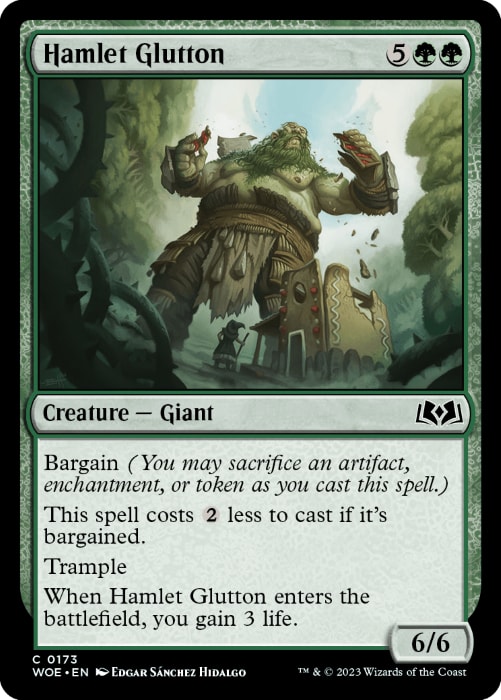 |
To be more specific, there were a lot of cards that put you over the top of aggro decks. Gingerbread Hunter was a house against Red decks, providing multiple road blocks, not the least of which was a 5/5 for 5. Tough Cookie making a two foods and a 4/4 was an incredible way to stabilize the game as early as turn two and the two uncommon Sagas in Golgari almost look like they're designed with the sole purpose of beating aggro decks. Oh, and few things are as disheartening to a Red mage as seeing a Hamlet Glutton resolving on the other side of the board.
This was a set in which food tokens featured prevalently, and in a way, it's impressive that Boros and Rakdos decks managed to do so well in such a hostile environment. Imagine what the format could have looked like if so many players didn't effectively have 26 or more life.
A Wild(s) Conclusion
This was classic The Rock game play. Removal was abundant and powerful, with Candy Grapple being one of the best commons in the set. Medium-to-large size creatures were good, and there were multiple playable discard effects. Maybe you've heard of a little thing called Hopeless Nightmare?
Amusingly, I think the most illuminating statistic about Golgari's success in WOE comes from the top Red cards. Imodane's Recruiter was two letter grades above the next best uncommon (A, versus Gingerbread Hunter's B+). This is partly because it's an incredible card, regardless of context, but it's partly because the reach it provided was absolutely essential to overcoming Golgari decks. Hell, the threaten effect in the set (Twisted Fealty) had a 59.6% win rate for the same reason. You almost never see that kind of card near the top of 17lands rankings, but stealing a Hamlet Glutton for one turn was sometimes enough to end games, even if you had no way to bargain it away.