


 Locations



About a month ago, I covered the lore of the cards for the debut stream of Magic: the Gathering - Final Fantasy. Inside that piece, I noted that there were two things I wouldn't be covering: the basic lands and the many iterations of Cid, Timeless Architect. Each one of those topics is meaty enough to get a whole article all to themselves.
Now, after weeks of covering various other aspects of the set, I'm finally gearing up to dive into these topics! For this week, I'll be looking at the sixteen basic lands in the set. As you might expect, this doesn't include any of the non-basic lands. In some cases, I'll cover those in their own articles for their respective games.
As a small note before we get started, I do want to mention there are a small handful of games on this list that I either haven't played or haven't finished. Because of this, there are some titles where I haven't reached the relevant areas. As such, I've done some reading online, but may present some elements slightly inaccurately. My hope is to present you with a reasonable amount of info to understand the setting, even if it may not be perfect.
With all that out of the way, let's dive in!.
Final Fantasy I - Mountain - Mount Gulg
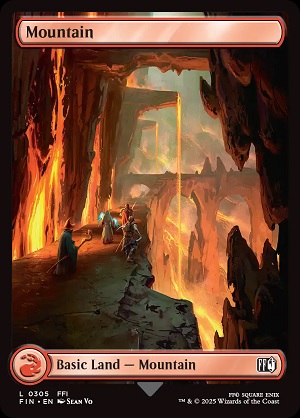
I've mentioned this in other Final Fantasy lore articles thus far, but Final Fantasy I was a pretty basic Dungeons & Dragons campaign. You go through the world trying to restore the evils present in areas of the elements earth, fire, water, and wind. Mount Gulg is the second such area you explore, though it looks a bit different in the game. You don't really see overhanging arches spouting lava, rather it's just a big cave with lava pits (that you can traverse, at that). It's pretty plain, but is memorable for its solid music and great associated concept art (see the set's Ancient Copper Dragon).
Final Fantasy II - Swamp - Semitt Falls
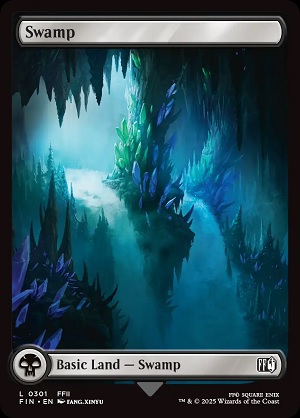
This one was probably the most difficult of these basics to identify, if only because there isn't much in terms of clear visual representations for places in Final Fantasy II. This is largely due to it being a NES title with minimal visual flair. Even though I've completed the game multiple times - including once fairly recently - nothing stood out to me that I could think of, unlike with other games on this list. The closest I could determine was the Semitt Falls, one of the game's first true dungeons and the only one I could find that had a clear waterfall in it (obviously), even though it lacked the crystalline formations on the walls.
The party gains access to Semitt Falls after encountering Josef in the town of Salamand. Here, the group discovers that many of the townsfolk - including Josef's daughter - were taken to the Falls as slaves of the Empire. There, they were forced to mine mythril. To gain Josef's trust, the party goes and frees the enslaved townspeople and acquires some mythril for later. Soon after, Josef joins the party and grants them access to his snowcraft that was hidden at the Falls.
Final Fantasy III - Forest - Chocobo Forest
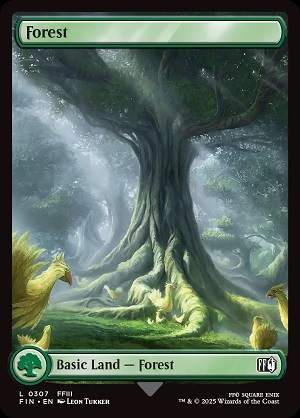
Throughout many of the early titles in the Final Fantasy series, chocobos would be found in small hidden chocobo forests. These would usually stand out on maps, having a distinct circular shape compared to other forests you encounter through the games. In most of these titles beginning with Final Fantasy II, you'd simply enter a chocobo forest, interact with a chocobo, and start riding across the overworld without running into random battles.
So, if the chocobo forests were introduced in Final Fantasy II, why are they using it for Final Fantasy III instead? This is likely because Final Fantasy III introduced something new to the chocobo forests: Fat Chocobo. Yes, the same one you can find on Summon: Fat Chocobo. Before it was a random summon in later titles, you could make Fat Chocobo appear in the chocobo forests (as well as certain other locations). There you'd be able to store unneeded items with the big bird due to item storage limitations caused by the NES and Super NES (in the case of FFIV), providing a powerful ally in the process.
Final Fantasy IV - Mountain - Mount Ordeals
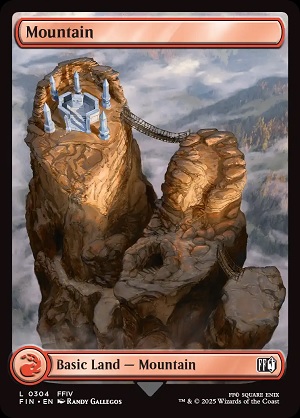
Roughly a third of the way through Final Fantasy IV, Cecil - the main character you play as - is separated from the rest of the party as the powerful Leviathan swallows their ship. As a result of this wreckage, Cecil is left afloat on the sea until he reaches the mystical town of Mysidia, a place where both white and black mages are trained.
As fate would have it, Cecil, a dark knight of Baron, had recently pillaged the town for its crystal on the king of Baron's orders. The town's citizens refuse to trust or accept Cecil and the elder tasks him to traverse the deadly Mount Ordeals to become a paladin. If he managed to survive - something no person had done before - they would welcome him.
Cecil travels with young mages Palom and Porom to the mountain, where he finds the great sage Tellah. The group brave the mountain's perils and defeat the mighty Scarmiglione at the summit. There, Cecil enters a mirrored room where he faces off against himself. Enduring the trial set before him, Cecil sheds his vicious dark knight ways and becomes a paladin, earning the trust of the Mysidians.
Final Fantasy V - Swamp - Ship Graveyard
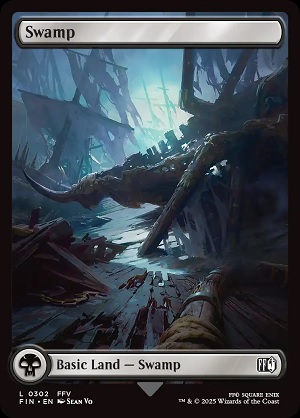
Not long into the game, the party joins up with a pirate captain named Faris to seek out and save The Wind Crystal. When the crystal shatters, it deems the party the new Warriors of Light and sends them to save the other crystals. On their way to Walse and The Water Crystal, the party is attacked by a monster in the Torna Canal, which swallows the sea dragon Syldra that allowed the ship to move.
With the Wind Crystal shattered, the wind has completely stopped blowing throughout the world. As a result, the ship is left adrift on the sea. Eventually, it ends up at the Ship Graveyard, as seen on this art. The dungeon is filled with undead monstrosities and at the end lies the deadly Siren, who attempts to steal away the souls of the party members.
Final Fantasy VI - Mountain - Mount Kolts
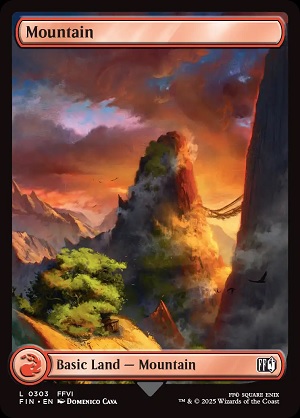
Following an epic and showy escape from Castle Figaro, the party of Terra, Locke, and the Figaro king Edgar take off to meet up with a rebel faction known as The Returners. After a brief stop-off in the town of South Figaro, the group reaches Mount Kolts, a winding mountain that leads to The Returners' hideout.
Along the way, the group sees a shadowy figure wandering around in the background. Eventually, near the end of the mountain, the group runs afoul of the martial artist Vargas, who attacks them. As they battle, the shadowy figure reveals themself to be none other than Sabin, Edgar's brother who left the crown behind and became a monk under the tutelage of Duncan, Vargas' father. Vargas grew jealous of Duncan's treatment of Sabin and attempted to murder Duncan (later revealed to be fine) and then Sabin. Sabin defeats Vargas and joins the party as they continue on.
Final Fantasy VII - Plains - Seventh Heaven/Sector 7
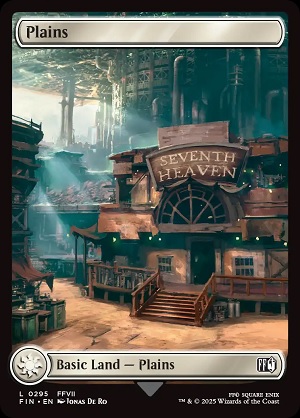
Early on in Final Fantasy VII, a small bar in Sector 7 acts as the base for the eco-terrorist group Avalanche. It's primarily a bar for patrons throughout the Sector 7 slums to visit, but it also contains a secret room as well. The pinball machine inside holds a secret switch that activates an elevator down to a hidden room where Avalanche holds their secret meetings.
You only visit Seventh Heaven once in the original iteration of Final Fantasy VII between the bombings of Mako Reactor 1 and Mako Reactor 5. After the attack on Reactor 5, Cloud is separated from the party in Sector 6 and only returns to Sector 7 right before the slums are destroyed by the evil Shinra dropping the upper plate of the city on top of it.
In Final Fantasy VII Remake, the party can spend a bit more time here, but Seventh Heaven itself continues to make up only a small amount of the game overall. Despite the brief appearance, however, it remains an iconic set piece for fans of the series.
Final Fantasy VIII - Island - Edea's House/Orphanage
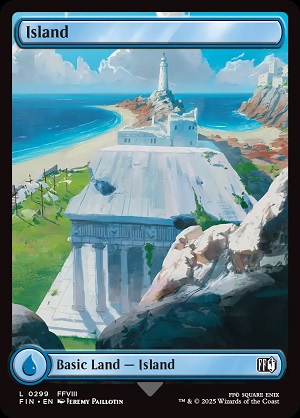
Many of the basic lands in this set depict locations from earlier parts of the game. That isn't quite the case for Final Fantasy VIII. This location depicts the house of the sorceress Edea, which she has used as an orphanage to house young children who lost their parents in an ongoing war. While there, she is visited by a time traveling Squall, who tells her to establish the SeeD Academy, and a defeated Ultimecia - the game's villain - who passes her abilities onto Edea. This establishes a time loop of sorts and is what initially sets into motion the game's core events, thereby making it a key central part of the Final Fantasy VIII's story.
Final Fantasy IX - Forest - Evil Forest
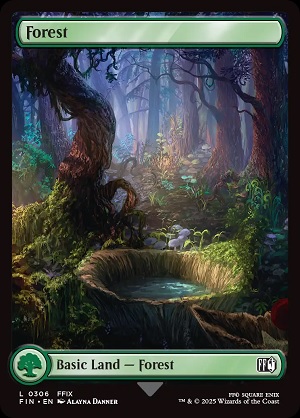
Don't let the look of this art deceive you. This is the Evil Forest from Final Fantasy IX, a location where the Tantalus Theater Troupe crash lands (see Airship Crash) after escaping the kingdom of Alexandria. The Troupe had been performing the play "I Want to Be Your Canary" as a ruse to steal away the princess, Garnet. When Queen Brahne learns of their plans, she fires at the ship, the Prima Vista, and brings it down.
The forest lives up to its name, famously petrifying those who walk within its woods. The various members of the eventual party cross paths here, joining to take down a mighty foe. Once they defeat it, the entire forest is petrified and the party can no longer return.
This Forest in particular depicts the forest's healing spring, where the party can catch a breather and recover their HP and MP.
Final Fantasy X - Island - Besaid Island
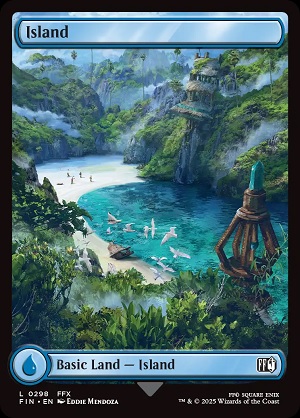
Shortly after being transported to the world of Spira, Zanarkand blitzball player Tidus washes up on the shores of Besaid Island. As he comes to, he quickly impresses the local blitzball team, the Besaid Aurochs, with a small show of his skills and is asked to join their team by their captain, Wakka. Wakka takes Tidus back to the village where he meets the locals, rests, and then finds himself entering the local temple of Yevon to help "save" a fledgling summoner.
The summoner, Yuna, and her guardians - including Wakka - depart from Besaid soon after she emerges from the temple. The Besaid Aurochs also join along, heading along the same route to a blitzball tournament in the port town of Luca. This makes Besaid essentially the primary starting point of the game's true journey, despite a few settings appearing briefly before it.
Final Fantasy XI - Forest - Ronfaure
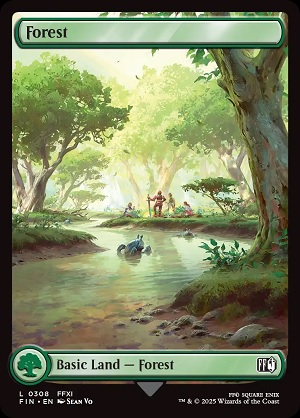
In Final Fantasy XI, there are three main starting nations: the industrial Bastok, the natural and magic-focused Windurst, and the medieval kingdom of San d'Oria. Outside each of these starting nations is an initial area where the player can defeat small enemies to start their quest. This Forest depicts a small creek known as Knightwell in the area of West Ronfaure, which is one of the two starting areas outside of San d'Oria. This area is known for its many trees, orcs, and Knightwell being an excellent spot for beginner fishers.
Final Fantasy XII - Plains - Giza Plains
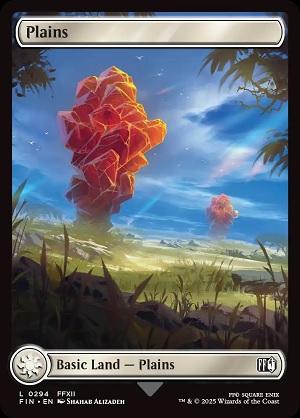
Shortly after leaving the Dalmascan city of Rabanastre, recently taken over by the Arcadian Empire, thief Vaan heads for the nomad village on the Giza Plains. This area is known for its alternating dry and rainy seasons, with the nomads leaving during the rainy seasons. At the start of the game, Vaan visits during the dry season, where he acquires a sunstone from the villagers and takes it across the plains to charge. The large crystalline monoliths absorb sunlight, which is then transferred into the sunstone. Vaan later uses this stone to enter the Rabanastre palace, kicking off the game's main storyline.
Final Fantasy XIII - Island - Lake Bresha
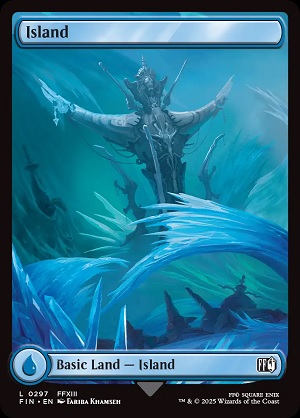
I almost forgot about this one until I started looking up information about the locations on these lands. Final Fantasy XIII is a game I truly did not enjoy. After playing it for a few hours and eventually getting utterly confused with its core gameplay mechanics, I put it down and never touched it again. So, when I saw this land, I couldn't figure out what on earth it was, but then I looked it up and it all came back to me.
This is Lake Bresha, a lake that turns into crystal as the Pulse Vestige containing the fal'Cie Anima falls into its depths. With it falls the party's main cast of characters, as they realize that they've been branded l'Cie after battling with Anima. A l'Cie is a person given a task by a fal'Cie. Should they complete the task, they will turn to crystal, and if they fail they will become Cie'th, or monstrous fiends.
Once the group falls to the lake, they argue amongst one another and figure out their next move. Being marked as a l'Cie means that they're treated as enemies of Cocoon and are to be wiped out. The party leaves the area and presses onward and continues on their adventure throughout Cocoon.
Final Fantasy XIV - Swamp - Mor Dhona
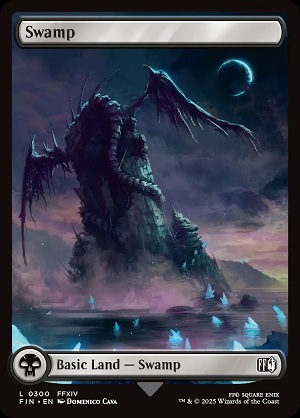
It's somewhat funny that I don't know this one very well. While much of the greater story of Final Fantasy XIV has eluded me, I have played a fairly modest amount of A Realm Reborn and even bought the game on launch during its original 1.0 release. However, I never seemed to reach the point in the story where this became relevant, though I am learning it was in the trailer for 1.0 and I simply did not know it.
This location is Mor Dhona, a barren wasteland that was left in its current state following an invasion by the Garlean Empire. This resulted in the death of the great wyrm Midgardsormr, whose corpse lies atop a landmass in the center of Lake Silvertear, making it a tremendously iconic landmark in the game's world. I'm sure there's much more to it than that, but unfortunately, that's about the most I've got when it comes to this particular title. But hey, the game's quite free to play these days for the earlier story aspects, so give it a try and learn more about it for yourself!
Final Fantasy XV - Plains - Roadway
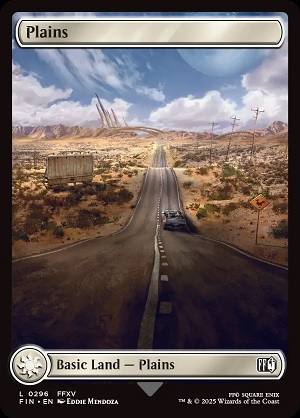
As the game kicks off, Prince Noctis Lucis Caelum is sent on a journey to Altissa where he is to marry Lady Lunafreya as part of a treaty agreement with the Nifl Empire. Joined with a group of loyal retainers and friends, Noctis sets out along the roadways in the Regalia, but the car stalls out, leaving the group stuck along the side of the road seen in this art. The group pushes the car to the gas station Hammerhead and gets repair work from Cid, a friend of Noctis' father and mechanic. As the repairs happen, the group scours the area taking on odd jobs, until they're eventually set on their way towards an epic new journey with the roads providing quick travel routes in an open world setting.
Final Fantasy XVI - Wastes - Deadlands
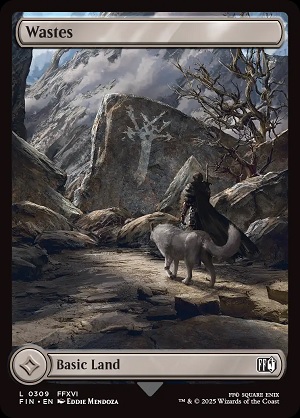
The most recent game in the series, Final Fantasy XVI, is the one game in the entire series that I have not touched at all yet. However, I am slightly aware of the story elements, thanks largely to the design team for this set explaining the inclusion of Wastes. The game's main antagonist, Ultima, saps away the land's mana, rendering magic unusable and causing life to wither away, thereby making certain areas uninhabitable. This is known as the Blight, with the areas affected by it being referred to as the deadlands.
I'm not sure of specific lore beyond this, but in the end, it made for a surprisingly fitting inclusion as the set's unusual sixteenth basic land.
That wraps things up for yet another week of heavy lore deep dives into the world of Final Fantasy! Seeing these lands get the red carpet treatment with fantastic full-art renditions has been simply fantastic. I'll be back next week for one more bigger lore roundup talking about all fifteen different versions of Cid, Timeless Artificer, so be sure you don't miss it! I also have smaller lore articles coming out over the next several weeks, so be sure to check those out as well!
Paige Smith
Bluesky: https://bsky.app/profile/themaverickgirl.bsky.social
Twitch: twitch.tv/themaverickgirl
YouTube: TheMaverickGal