



 Locations



I picked up Magic at a pretty young age, starting in 1999 with a bunch of cool sets. However, for a few years after, I found myself prioritizing games like Pokemon and Yu-Gi-Oh instead, only getting pretty deep into MTG around the time of Onslaught. When I say deep, I mean deep. I started playing every day, began attending FNM events when I could, and even picked up Magic Online.
What this also meant, though, was that I really got into the story. When I first picked up the game, we were right in the middle of the Weatherlight Saga, and thus I came to think of the characters as recognizable and interesting. I could glean a lot of story from the art, but I never found myself reading any written material until I first picked up a Judgment fat pack and read the novel inside.
This got me super interested in reading further stories, which led me to checking out the Onslaught books and the rest of the Odyssey block as well. I fell in love with these characters as well as the settings. So naturally, when Mirrodin came out at the end of 2002, I was chomping at the bit to pick up a copy of the book: The Moons of Mirrodin.
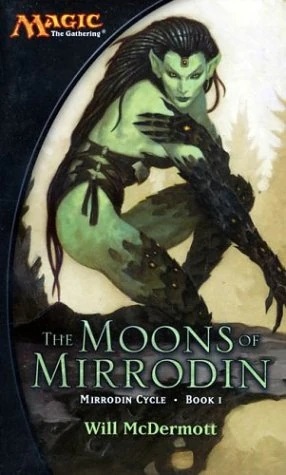 |  |
Much like with the Otarian stories of the former two blocks, I quickly fell in love with all of the characters in this book. Glissa was a cool heroine, with Slobad and Bosh providing quirky sidekicks along her journey. Throughout the novel, they ran into various characters from throughout the various environments of the world.
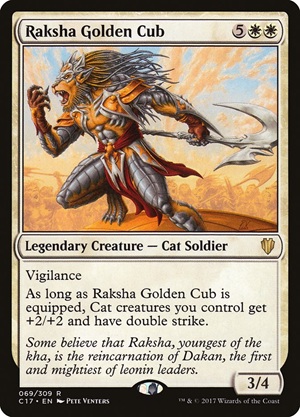
One that stood out to me, though, was Raksha. I liked reading about this character, a proud warrior who would stand up for his village at any cost. It also helped that at the time, the leonin felt novel, much like the cephalid, the nantuko, and the aven did in Odyssey and Onslaught as they showed an expansion of possible creatures in Magic's multiverse. At the time I was eager to see him get a card, and while it ended up being fairly costly to play, it wowed my still largely casual sensibilities.
So, when it was announced that we would be going back to the world with Scars of Mirrodin right as I was returning from a short hiatus, I was stoked. Who would I see again among the original characters, especially with the ending of the first series of books? Would we see new versions of them or what?
As it happened, we wouldn't see many of them in the first set of the block. In fact, the only one I recognized - a bit gleefully, I might add - was Geth, Lord of the Vault. However, we would get some cards that represented descendants of certain groups. Enter Kemba, Kha Regent.
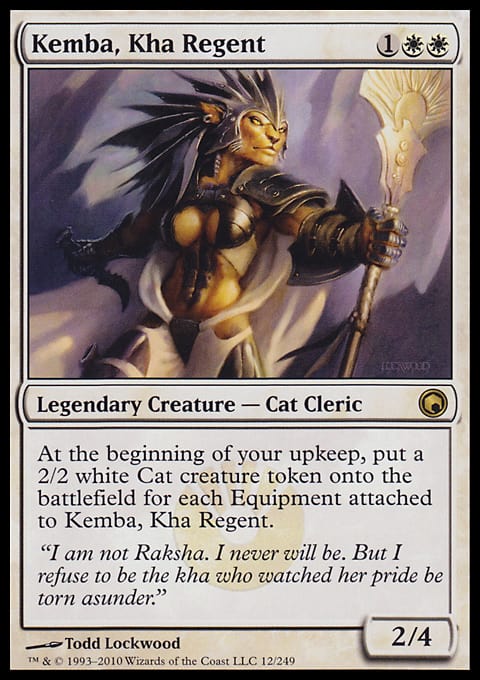
Kemba wasn't Raksha. Hell, she even said so on the card, and thus it was clear that Raksha was gone. However, she still played in some fairly similar space, caring about equipment and doing things with cats. As fate would have it, the card turned out to be quite powerful for a then burgeoning format.
Commander was just starting to gain traction at this time. Remember that Scars of Mirrodin predated Commander 2011 - the format's first preconstructed decks - by nearly a year. At that point in time, it was simply known as EDH, and I had the pleasure of being introduced to it by some friends in college. I gravitated heavily towards the legendary cards I had access to at the time which, naturally, led me to build a Kemba deck.
While we've long since past this point in time and Kemba is far less popular now than she used to be, we can still find cool ways to revisit the past. PreDH captures this point in time perfectly, building Commander decks utilizing cards from New Phyrexia backwards. It's been quite some time since I last covered one of these decks and it felt like a good time to revisit a classic.
Let's check out the decklist!
Kemba, Kha Regent | PreDH | Paige Smith
- Commander (1)
- 1 Kemba, Kha Regent
- Creatures (20)
- 1 Auriok Windwalker
- 1 Deathless Angel
- 1 Eternal Dragon
- 1 Isamaru, Hound of Konda
- 1 Leonin Shikari
- 1 Mirran Crusader
- 1 Mother of Runes
- 1 Myrsmith
- 1 Puresteel Paladin
- 1 Raksha Golden Cub
- 1 Sanctum Gargoyle
- 1 Savannah Lions
- 1 Steelshaper Apprentice
- 1 Stoneforge Mystic
- 1 Stonehewer Giant
- 1 Student of Warfare
- 1 Sun Titan
- 1 Taj-Nar Swordsmith
- 1 Treasure Hunter
- 1 Weathered Wayfarer
- Planeswalkers (1)
- 1 Elspeth, Knight-Errant
- Instants (9)
- 1 Apostle's Blessing
- 1 Argivian Find
- 1 Disenchant
- 1 Dispatch
- 1 Enlightened Tutor
- 1 Path to Exile
- 1 Return to Dust
- 1 Shelter
- 1 Swords to Plowshares
- Sorceries (4)
- 1 Day of Judgment
- 1 Mine Excavation
- 1 Steelshaper's Gift
- 1 Wrath of God
- Enchantments (5)
- 1 Crackdown
- 1 Ghostly Prison
- 1 Honor of the Pure
- 1 Oblivion Ring
- 1 Quest for the Holy Relic
- Artifacts (22)
- 1 Basilisk Collar
- 1 Batterskull
- 1 Darksteel Plate
- 1 Everflowing Chalice
- 1 Helm of Kaldra
- 1 Konda's Banner
- 1 Lightning Greaves
- 1 Loxodon Warhammer
- 1 Marble Diamond
- 1 Mind Stone
- 1 Quietus Spike
- 1 Sculpting Steel
- 1 Shield of Kaldra
- 1 Skullclamp
- 1 Sol Ring
- 1 Strata Scythe
- 1 Sword of Fire and Ice
- 1 Sword of Kaldra
- 1 Sword of Light and Shadow
- 1 Sword of Vengeance
- 1 Trailblazer's Boots
- 1 Whispersilk Cloak
 Export Arena
Kemba is pretty much the equipment commander. Or, at least that's how it was for some time until Boros's whole thing became equipment-based strategies. However, in the PreDH era, most of those had yet to come out and as a result, Kemba was the best around. So naturally, the first place to start is with the equipment themselves.
Thankfully, a blessing to this deck is how flexible it can be in this spot. When I plugged the deck into Moxfield, it gave me a total estimated price of about $300. That's not too bad for a decently well constructed Commander deck that has some power behind it, but in reality a solid amount of that cost is in the equipment themselves.
 |  |  |
If you take out Konda's Banner, Skullclamp, Shield of Kaldra, Sword of Fire and Ice, Sword of Kaldra, and Sword of Light and Shadow, the price drops dramatically. Those handful of cards al1-drop the price by a cool $100, and there's still plenty of great equipment out there to replace them with. For the purposes of this article, I decided to go a bit more all-in like this, though you'd do just fine with something simple like a good old fashioned Bonesplitter.
Make no mistake, though: there are plenty of classics still to be found here! When I think of classic equipment cards, the first one I always come to is Loxodon Warhammer. Nowadays, it looks somewhat trivial, but at the time of release it was not only awesome, but remained a fantastic casual card throughout the entirety of the PreDH era. Lightning Greaves also represents another favorite of the time, long before the likes of Swiftfoot Boots and Lavaspur Boots.
 |  |  |
I'm also quite partial to the likes of Trailblazer's Boots and Whispersilk Cloak in this list. Both are excellent at ensuring the equipped creature is able to land a hit, which is great with Kemba. Using the various equipment - especially with something like Strata Scythe that scales massively - makes it trivial to take someone out with Commander damage. Whispersilk Cloak also has the benefit of protecting Kemba, as do cards like Darksteel Plate and non-equipment spells like Apostle's Blessing and Shelter.
If you want to try some other cheap options, here's a few more to consider as well. Fireshrieker and Argentum Armor were ones that very nearly made it into the list, but ended up getting cut in favor of some more utilitarian spells. Both can be had very affordably and do extremely powerful things. Pennon Blade scales tremendously as you make more and more cat tokens with Kemba herself and is yet another card you can get for pennies. Mask of Memory, Blight Sickle, and Empyrial Plate also are fantastic options, depending on what you're looking for out of your deck. I'd recommend Mask if you're looking for a cheaper alternative to Skullclamp, for example.
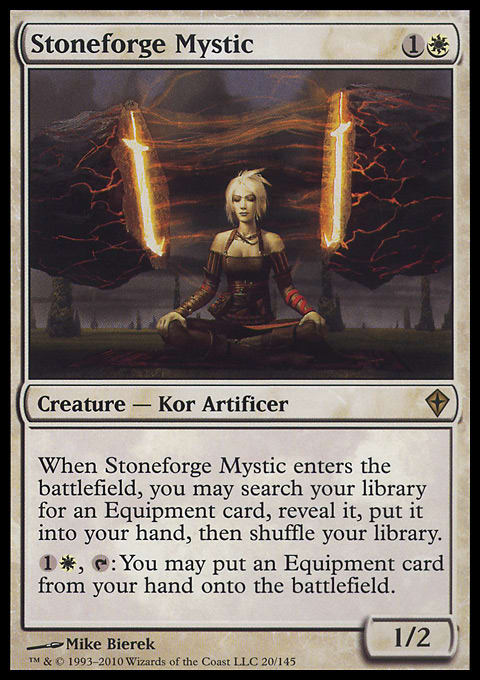 |  |  |
I've also included several options to help you tutor up whatever equipment you need for any kind of situation. Each and every card in the PreDH format that can pull equipment is here - six in total. Stoneforge Mystic and Steelshaper's Gift are probably the best known, but Stonehewer Giant still commands a certain amount of respect in the Commander format. Steelshaper Apprentice and Taj-Nar Swordsmith also fill this role well and thanks to their relative obscurity by modern sensibilities are quite cheap. Quest for the Holy Relic is the last one out. It's probably the most difficult to cast, though, given how there aren't many creatures in the deck proper.
I also went ahead and included a copy of Enlightened Tutor, which might be something to consider if you take Commander brackets into account. PreDH - as an unofficial format - doesn't exactly use them, though there will likely be some amount of expectations on this in your group post-brackets. If your group has a problem with it, though, I'd recommend just finding some other cool card. The only other artifact tutor in these colors is Kuldotha Forgemaster which doesn't exactly play great with only 23 artifacts in the deck (excluding Myrsmith, of course). I just recommended several great equipment, though, so if all else fails just toss another of those in!
I also made sure to go ahead and provide some methods to return artifacts from your graveyard to your hand. I was admittedly a bit surprised by how much there was. For some reason I'd always thought Argivian Find was pretty unique in this area. It turns out it's simply the best and there are plenty of other great options as well. For example, Mine Excavation lets you get multiple cards at once, which is excellent if multiple artifacts hit your graveyard. There's also Sanctum Gargoyle and Treasure Hunter. Both of these not only give you a couple extra copies of this effect but also allow you to fill out your small creature count as well.
 |  |  |
By the way, we should probably talk about that, shouldn't we? Only 20 creatures (excluding Kemba herself) is a pretty low number for a Commander deck, which in theory doesn't give you a ton of creatures to suit up. Perhaps even more notable, several of these are utilitarian creatures that you don't even really want to be suiting up in the first place. For example, you'd rather be using Auriok Windwalker to attach equipment as opposed to putting equipment on it to attack with.
This is where Kemba really shines. The deck itself may not have very many creatures, but it has enough to function. As long as you protect Kemba herself, though, you can generate a veritable army with her ability. Three equipment on Kemba means three tokens a turn, something comparable to a powerful game ender like Elspeth, Sun's Champion in modern-day Commander.
All of this is just what makes her so much fun, though. Not only does she go off super hard, but she has quite a bit of flexibility in how you can build her. Want some more creatures? Add them in. Want more equipment? Go for it. There's even a number of great abilities like Hanna's Custody and Indomitable Archangel to grant shroud and protect your investment. I chose to exclude them, but they're great if you want to put them in.
Kemba provides a powerful deck for a fairly minimum investment. It's the kind of deck that you can put together for a format like PreDH and still manage to crush at Commander today in 2025. Best of all, though, it's a deck that's easy enough for a newer player to be able to pick up and understand while having a huge amount of appeal for seasoned players. Give it a try at your next Commander night and keep the legacy of Mirrodin's Kha alive!
Paige Smith
Bluesky: https://bsky.app/profile/themaverickgirl.bsky.social
Twitch: twitch.tv/themaverickgirl
YouTube: TheMaverickGal