



 Locations


If we can pick out trends in Magic: the Gathering design--and we can--then we can pick out microtrends within the larger context of Magic. Since the post-Recession player acquisition push--which went from the launch of streamlined digital Magic as an onboarding tool (2008-ongoing) to the revision of Magic's ruleset with Magic 2010 (2009) and the Commander era (2011-now, with a huge push during the COVID pandemic and with Wizards of the Coast's taking over of the format in September 2024)--we've seen a trend in cards being all upside compared to past cards. This isn't sinister or conspiratorial--Mark Rosewater has spoken on the fact that players prefer cards without "feel bad" moments, where they lose to an interaction they didn't plan for or are punished for attempting to play the game. Cards with actual drawbacks were rare in this era, and the shifting design parameters meant we tended to see more Questing Beasts and fewer Phyrexian Negators. Still, the past decade wasn't without some intriguing designs that promised power in exchange for payment; many staple cards of this era had drawbacks. Among those:
Hazoret the Fervent
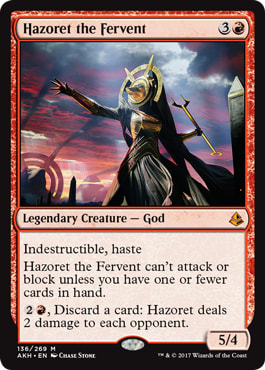
All of the Amonkhet Gods were cheap creatures that couldn't attack or block unless they met a condition that their color was predisposed to achieve. Some were tougher to turn on than others--Kefnet the Mindful reads like a reject from Saviors of Kamigawa, while Bontu the Glorified requires a Lord of the Pit-esque sacrifice to be active. The best of them and a major player in her Standard was Hazoret, who merely asked that you keep your hand size down to one or fewer cards. For many Red decks, that's not even a downside, but how they usually play the game. Javier Dominguez took down the 2018 World Championship tournament with his (barely) Rakdos aggro deck, which featured two copies of the Red God, as well as cards like Bomat Courier and Cut // Ribbons that still allowed him to operate with a diminished hand. Hazoret recently returned in Aetherdrift, where she mirrored her past design by being huge for her cost, with the more restrictive caveat that you need Max Speed for her to function as a creature instead of emptying your hand. As Start Your Engines!/Max Speed only appear in Aetherdrift, and only on a handful of diffidently playable cards, this means that Hazoret 2.0 hasn't made the cut just yet. She still crews Vehicles and charges up Spacecraft exceptionally well for her cost, but until Start Your Engines! returns, I doubt she'll live up to her original Amonkhet card.
Rotting Regisaur
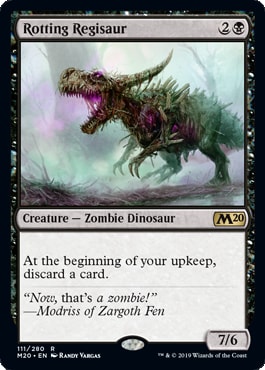
Pre-2010 or so, Rotting Regisaur would have had a more restrictive drawback--I'm thinking specifically a Masticore-style "at the beginning of your upkeep, discard a card or sacrifice Rotting Regisaur." Instead, M19 gave us a more modern design, which doesn't require a discard if you're hellbent and prevents the miserable feeling of top-decking a Masticore when you're desperate for a creature and out of cards in hand. This is a significant upgrade, and also helps balance the card a bit--the earlier you play Rotting Regisaur, the more you'll have to discard to it. Of course, that's generally a trade you're willing to make in exchange for attacking for seven on turn four. One of my pet Pioneer decks, which is off the tier ranking but also off the chart in terms of fun, is a Fight Rigging brew that uses the Regisaur and Shakedown Heavy to trigger Fight Rigging on turn four--it's silly, but it wouldn't be possible without the Zombie Dinosaur.
Archfiend of the Dross
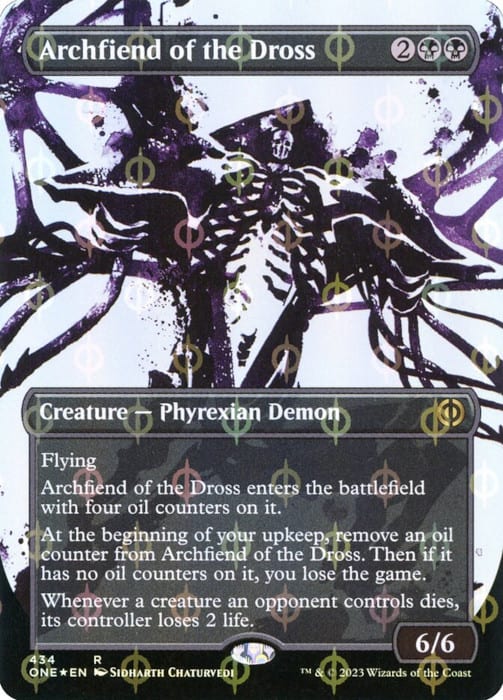
Following 2009's Abyssal Persecutor, Wizards returned to the design space of four mana for a 6/6 Demon with varying degrees of success. Return to Ravnica's Desecration Demon was a powerhouse in mono-Black Devotion decks, where it often functioned more as The Abyss than a creature, while M19's Demon of Catastrophes, in contrast, left its controller begging for a blowout. Archfiend of the Dross had a bit of a Fading feel to it--the presence of Proliferate in Phyrexia: All Will Be One meant you could keep the Archfiend around, or you could just try to race your opponent.
More Desecration Demon than Abyssal Persecutor, Archfiend saw adoption in Javier Dominguez's World Champs 30-winning deck. In Standard, it interacted very well with Unholy Annex // Ritual Chamber and Bloodletter of Aclazotz in evolutions of Dominquez's deck, where it was a massive threat that kept your Ritual Chamber pain-free. It now shows up periodically in Pioneer, where it's a great top-end threat in Rakdos or Dimir aggro-control decks. It's an extremely fun card outside of tournaments, too - sometimes, you run them over with your flying Demon, and sometimes they lock it down with a Pacifism effect and you watch your own demise tick closer each upkeep.
Teval, Arbiter of Virtue

The tension in Teval, between playing big spells to take advantage of Delve and losing life to their mana value, is interesting design that turns each game where Teval shows up into a metaphysical match along a different axis. I wouldn't generally call that a drawback, except for the fact that, unlike with Bolas's Citadel or Gwenom, Remorseless, which offer spells-for-life as a bonus effect, it's possible to lock yourself entirely out of the game with Teval. If you're low enough on life, and can't profitably attack to trigger Lifelink, you won't be able to play further spells. That said, if you're in that situation, you were likely losing that game anyway. It's a very unique design that centers a new kind of tension within the game, and worth praising for that.
Sunset Saboteur

Sunset Saboteur, while the most recent creature with an actual drawback printed, was the genesis of this article series. He's not a good card, but from a design standpoint, I could write 1,000 words on how superbly structured he is for this specific Standard environment. A new player's first impression of this card--"why would I ever want to make my opponent's creatures bigger?" is essentially correct, but there's a ton of nuance to Saboteur in the specific context of 2025 Magic.
- His ability triggers "whenever you commit a crime" without expending a card in hand. Yes, so can Scavenging Ooze or Keen-Eyed Curator, and both are generally better in every context, but it's part of the equation.
- If they have no creatures, Sunset Saboteur has no drawback, which makes removal a possible out, and no color is better at removal than Black.
- If they do have creatures, and you don't want to bolster their creatures, you can tap Saboteur to Crew, Mount, or Station. In addition, he's a decent blocker, trading with a 4/4 for two.
- He turns on Ferocious in older formats and turns on any "4 or greater power" effects like Garruk's Uprising.
Thus far, this is all hypothetical--in practice, Saboteur mostly trades with two Rabbit tokens--but the fact that an all-but-unplayable rare can be worthy of this much scrutiny is why Magic remains the greatest. Our current Standard environment was designed to reward Vehicles, Mounts, and Spacecraft, with the Duskmourn survivors triggering off of tapping to Crew, Mount, or Station, and cards like Sunset Saboteur having a fallback state even if they couldn't productively attack. It doesn't appear that any of this is going to break through into Standard, but there's a very thoughtful design trend that extends back through to the last rotation. Sunset Saboteur is fascinating not just as a link to Magic's past, to the long history of powerful creatures with severe drawbacks, but as a single data point in the broader gestalt of Standard. It was designed to see play, but it currently does not--and yet, that could change at any moment.
A drawback is one of the many knobs Magic design can use to balance a card. A slightly above-rate creature like Carnophage can require a single life per turn to continue to operate, while a more powerful creature like Rotting Regisaur can require a full card. Historically, cards with drawbacks have shown up at the highest levels of tournament play, as they break the expected pattern of mana cost to creature stats, and high-level players are perpetually looking for ways to maximize efficiency. But every player at every level can enjoy a temptingly cheap creature with a drawback--I started playing Magic by casting Skittering Skirge and Albino Troll and still have a soft spot for Dross Harvester and Hunted Phantasm. I fully expect to register Sunset Saboteur in a cheerfully janky Standard deck within the month--it does Station Entropic Battlecruiser well, after all--and every time I drop a game, I'll recall the long lineage of players who have lost to their own Lord of the Pit or Archfiend of the Dross and know that I'm a small part of Magic's history.