


 Locations



I'm not sure quenchiest is a word, but I'll allow creative license for Wizards of the Coast's introduction to the Waterbending mechanic. This is the fourth and final bending mechanic associated with Magic's most recent Universes Beyond set, Avatar: The Last Airbender.
Waterbending is what you get after crossing Convoke, Improvise, and activated abilities on cards. The mechanic is a cost that demands payment in order to activate some sort of ability - it can appear as an additional cost to cast a spell, part of an activation or cost, or anywhere else where mana requires to be paid (e.g., Ward).
The Waterbending Mechanic
What exactly is Waterbending? As mentioned, it's an extra mana cost associated with a card's ability or casting cost that can be paid either via traditional generic mana or by tapping an untapped artifact or creature you control. Let's take a look at an example to bring this idea to life: the eponymous Waterbending Lesson.

This card starts as your basic 4 mana, sorcery speed draw three spell - fairly straightforward at first glance. With this spell, however, there is one additional twist. After drawing three cards you must make a choice: you can either discard one card or you can waterbend 2. Discarding a card is straightforward enough, but how exactly do you waterbend 2? The reminder text does a nice job describing exactly what's required:
"While paying a waterbend cost, you can tap your artifacts and creatures to help. Each one pays for 1."
To waterbend 2, you must choose one of the following:
- Pay 2 mana
- Pay 1 mana and tap an untapped creature
- Pay 1 mana and tap an untapped artifact
- Pay 0 mana and tap any combination of 2 untapped creatures or artifacts
When tacked onto a spell like this, Waterbending is akin to kicker, except you can tap creatures and/or artifacts to help pay the kicker cost. In this way, Waterbending plays out very similarly to Improvise (tapping artifacts to help cast a spell) or Convoke (tapping creatures to help cast a spell).
The mechanic is fairly straightforward, but let's look at one more example to drive home the rules. Water Tribe Rallier is one of my favorite Limited cards with Waterbending.
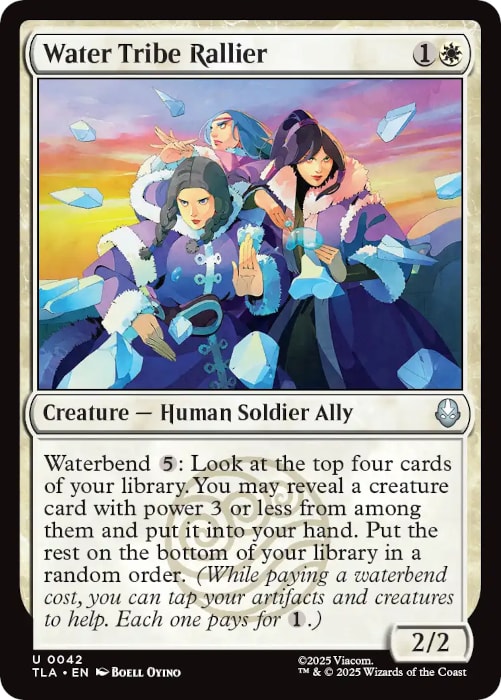
Here, instead of a "kicker" of sorts tacked onto a spell, Water Tribe Rallier has a Waterbending 5 activated ability. Just as before, you can tap your untapped artifacts or creatures to help pay the required cost - each tapped artifact or creature reduces the mana you must pay by 1. Keep in mind, Water Tribe Rallier doesn't have to tap to activate this ability, so you can tap Water Tribe Rallier itself to reduce the cost by 1, even the turn it enters the battlefield.
Noteworthy Waterbending Cards
The Magic World Championship 31 Top 8 didn't include a whole lot of diversity in deck lists. Izzet Lessons reigned supreme, and nearly every deck had some combination of Blue and Red cards (some with Green sprinkled in). Therefore, it may not come as a surprise that there were almost no cards in the Top 8 that referenced Waterbending (despite being a primarily Blue mechanic).
The only card I could find amongst the deck lists that mention Waterbending specifically was a single copy of The Unagi of Kyoshi Island in Arne Huschenbeth's Temur Otters list.

Because it has Flash, this creature is a sneaky disruptor to strategies that wish to draw extra cards. While it doesn't stop an opponent from drawing more cards, it punishes them by allowing you to draw extra cards as well. One of the key strengths to The Unagi of Kyoshi Island is its Ward ability: Waterbend 4. This means that if an opponent wishes to target this creature with a spell or ability, they have to Waterbend 4 or else the spell or ability is countered.
Because the Waterbending is on a Ward cost, it actually makes the creature slightly worse. If Unagi had the more traditional Ward: 4, it would give opponents less flexibility to interact with the Serpent. Despite this, I think it's a flavorful, interesting spin on Waterbending and Ward together.
While it didn't appear in the Top 8, I have run into Aang, Swift Savior a couple times jamming Standard on Arena lately.

For 3 mana, Aang, Swift Savior is a 2/3 flash flying creature that airbends a creature or spell upon entering the battlefield. That's already a powerful, cost-effective card (it reminds me a little of Spell Queller). That's not all you get for your mana, however! If you can manage to Waterbend 8, you transform Aang into Aang and La, Ocean's Fury, a 5/5 reach, trample creature that pumps all your tapped creatures whenever it attacks!
If the activated ability was only payable with 8 generic mana, this transform cost would have been prohibitively high. Instead, by including Waterbending, you can tap a handful of creatures and/or artifacts to help offset that steep mana cost, making the transform ability well within reach.
If you think Waterbend 8 is a steel cost, how about Secret of Bloodbending, a sorcery lesson spell with an extra "kicker" cost of Waterbend: 10!

Unpacking this spell, for starters you control an opponent during their next combat phase for  . I'm not sure that does as much as you'd like it to - it seems like half the time, it would effectively be a combination of Fog and/or a removal spell for some smaller creatures. If you can manage to Waterbend 10(!) when you cast Secret of Bloodbending, however, then the spell turns into a full blown Mindslaver! That's right, you control their turn instead! While this isn't likely to make waves in Standard, I could see players aspiring to maximize this card's potential during casual play.
Even Secret of Bloodbending's Waterbending 10 ability is tame compared to the biggest Waterbend cost there is. Check out the backside of The Legend of Kuruk...

Who says they don't print Time Walk in Standard anymore?! Granted, in order to take an extra turn with The Legend of Kuruk, you need to jump through some hoops. First, you have to wait for the Enchantment - Saga to make it to chapter III to transform. Next, you have to keep Avatar Kuruk around long enough to create a bunch of tokens. Why do you need those tokens? Because taking an extra turn costs a whopping Waterbend 20! That's right, you have to pay a combination of mana and tap untapped creatures and/or artifacts to get to 20 mana.
This card may be more a meme than an actual card, but even without the Waterbending 20 ability, The Legend of Kuruk is still an impressive card in the right deck.
While 20 is the largest absolute number associated with the Waterbending mechanic, there are technically ways to Waterbend even more. It turns out there are a couple of cards with Waterbend X costs, meaning you can pay mana and tap creatures and/or artifacts to your heart's content when activating them. For example, check out Limited bomb Katara, Water Tribe's Hope.
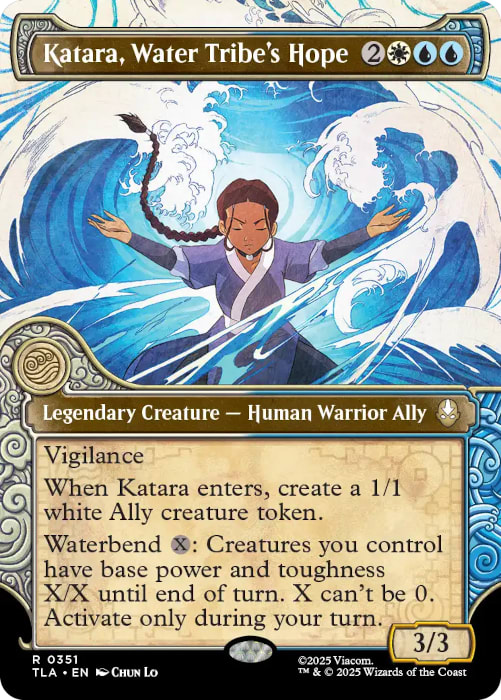
This creature's Waterbend X activated ability turns all your creatures into X/Xs until end of turn. Theoretically, if you could pay 50 through mana and tapping creatures and/or artifacts, you can Waterbend 50 and turn your squad into a field of 50/50 creatures! Granted, if you have that many creatures and artifacts, you're probably already winning the game. Still, I see some dreams being realized in Commander by combining Katara, Water Tribe's Hope with some infinite creature combos.
Wrapping It Up
In total, there are around two dozen cards in Avatar: The Last Airbender that leverage the Waterbending mechanic in some shape or form. It may be an additional cost on a spell (kicker style), it may be an activated ability, or it may be a quirky Ward cost. Whatever the implementation, Wizards of the Coast, found flavorful, creative ways of reinventing an old ability and turning it into something relevant to the Avatar franchise.
Because it has that Waterbending name, associated with the Avatar: The Last Airbender universe, I'm not sure how likely it is we'll see the ability return to Standard. It could theoretically show up as a special one-off, or else in a specialty product. My guess is, if you're a huge fan of Waterbending as a mechanic, you'd best enjoy it now while Avatar: The Last Airbender is in Standard.
There are no guarantees these bending abilities show up again in the near future. Not in this specific configuration, anyway. I'm sure we'll see something akin to Improvise, Convoke, or other derivative of tapping things to pay a cost again and again.