


 Locations


Magic: The Gathering's latest set, Aetherdrift, has introduced a range of exciting new cards into constructed decks and formats. Standard, Modern, Pioneer, and even Pauper decks are finding unique new tools thanks to some of the latest Gods and Gearhulks encountered in Aetherdrif's race across the multiverse.
Although the set is new enough that additional innovations could still emerge in the weeks ahead, early results from online and paper tournaments have highlighted some meaningful innovations that Aetherdrift has introduced to established decks in Magic's competitive formats. Starting with one of the top strategies in Magic's most important constructed format: Standard.
New Toys for the Best Deck in Standard
Any hope that Esper Pixie's Standard dominance might fade after Aetherdrift's release may have to wait until the next expansion, since the self-bouncing tempo deck has already adopted some powerful new permanents for Nurturing Pixie and Fear of Isolation to replay.
 |
 |
Both Momentum Breaker and Grim Bauble have started popping up across decks and sideboards, in Pixie and other Black decks, thanks to their flexible utility against a range of opponents. In both cases, Breaker and Bauble help disrupt opposing boardstates by removing creatures including tough to kill bodies that might have indestructible or ward. Bauble is particularly interesting at just one mana, allowing Pixie players to play it multiple times in a single turn if it's sequenced before a Nurturing Pixie or Fear of Isolation.
Powering Up Modern's Up and Comers
Although some of the most dominant Modern strategies, such as Grinding Station, Boros Energy, and Temur Eldrazi haven't adopted anything from Aetherdrift yet, a handful of tier 2 and 3 decks have picked up some new tech that could elevate the strategies into more competitive positions.
Perhaps the single biggest upgrades come from Ketramose, the New Dawn, which has already popped up in both Orzhov Blink and Esper Murktide decks. Despite significant differences in these decks' strategy and playstyle, Ketramose slots into them nicely thanks to its ability to pair with both proactive and reactive enablers.

By itself, Ketramose can just sit on the battlefield and draw cards if anyone has a card go to exile from the graveyard or battlefield. And though it's quite well-statted, a 4/4 with menace, lifelink, and indestructible for just three mana, it takes some setup to make this thing attack. Like previous Amonkhet gods who had to meet a certain condition to attack, Ketramose can't attack or block unless there are seven or more cards in exile. Fortunately, that counts all players, so if there's at least seven total cards in exile between you and an opponent, the 4/4 is now online. But what are the most efficient ways to make that happen.
Blink and Murktide use different approaches, based on each of their unique game plans. For the Blink players, they're able to trigger Ketramose's card draw ability with most of their supporting creatures. Emperor of Bones, Phelia, Flickerwisp, Skyclave Apparition, Solitude, and Ephemerate can all trigger Ketramose to draw a card, even multiple times per turn. By themselves, meeting the seven card threshold to attack might take a while, but the addition of Boggart Trawler or sideboard Surgical Extractions also help put cards in exile en masse, sometimes making the god an attacking threat seemingly out of nowhere.
Meanwhile, Esper Murktide players are enabling Ketramose a bit differently. In that deck, the Murktide players are primarily exiling their own cards in order to cast the titular Murktide Regent or Abhorrent Oculus. Unlike Blink, the Murktide decks are typically exiling multiple cards in a single turn, and only a handful of times per game, so activating the Ketramose card draw ability comes up less often. As a result, the God's long term inclusion in the deck remains in question, since for now it mostly just serves as a secondary threat after you have already deployed one of your main beaters, or a way to potentially sidestep opposing graveyard hate.
Further down Modern's tier list is the one-time format staple that's been trying to find new life since the recent unban of Faithless Looting: Hollow One.
The combination of Faithless Looting, Burning Inquiry, and Street Wraith all combine to make Hollow One a potentially explosive deck thanks to its ability to deploy multiple 4/4 bodies as early as turn one. However, the randomness of Burning Inquiry coupled with Hollow One's lack of relevant keywords has made it difficult for the deck to keep up with the current Modern power level. But following the release of Aetherdrift, a certain shark pirate might look to change that.
Marauding Mako, a one mana 1/1 that gets +1+1 counters for each card you cycle or discard offers the deck an additional turn one threat. Previously, a similar slot was occupied by Flameblade Adept, and Mako provides an important upgrade over Adept, which only gets +1+0 until end of turn for each discarded card. But paired together, the one-drops can establish a big threat in the early game that plays well with the deck's primary gameplan of repeatedly discarding cards until you can play some number of Hollow Ones for free.
A Gearhulk for Everybody
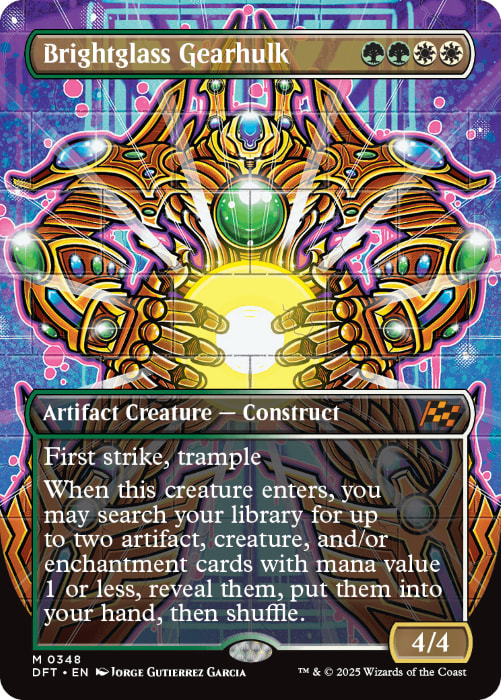
One of the most exciting cycles to return in Aetherdrift are the Gearhulks. First introduced in Amonkhet as giant mono-colored artifact creatures with powerful enter the battlefield effects, the latest additions to this cycle arrive in ally color pairs and push the power level a bit further thanks to their more prohibitive casting costs.
One Gearhulk in particular has stood out as a multiformat player thanks to its powerful ability to fetch up combo or hate pieces, all but making it a one-card "I win" button in certain conditions.
Brightglass Gearhulk has started popping up in a handful of Standard and Modern decks thanks to its ability to grab up to two card from the library, setting it up as both a combo finisher or a simple value engine that can effectively three-for-one an opponent who tries pointing a removal spell at it.
In Modern, Brightglass Gearhulk has popped up in some Samwise Combo decks, which uses Cauldron Familiar, Viscera Seer, and Samwise Gamgee to establish an infinite combo that drains an opponent for all their life in a single turn. Notably, Brightglass can fetch up the first two-thirds of this combo, while additional tutors such as Green Sun's Zenith, Chord of Calling, and even Birthing Ritual can eventually find the critical Samwise to win the game.
Over in the Standard queues, Brightglass has started appearing in Selesnya Cage decks as a powerful top end to aid in the deck's main plan of flooding the board with a ton of cheap creatures, and quickly activating the centerpiece Collector's Cage to help close out the game or cast an extra card for free with Cage's Hideaway ability. Notably in these decks, Brightglass can fetch more than creatures, since it can also retrieve a Basilisk Collar or Dusk Rose Reliquary, along with post-board Ghost Vacuums.
Wrapping Up
Aetherdrift has quickly added a mix of powerful new tools across Magic's most popular Constructed formats, to both reinforce existing strategies and potentially power up some lower tier decks that needed an extra boost. Whether it's enabling infinite combos, providing better tempo options, or introducing explosive, cheap threats, cards from the latest set are racing to impressive tournament finishes. As the meta continues to evolve, expect to see even more innovation as players find new ways to incorporate Aetherdrift's best cards into their favorite decks.