 Locations


Teenage Mutant Ninja Turtles has been a controversial release, and while I'm anxious to build more decks with the Heroes in a Half Shell, there is another deck idea that's captured my attention.
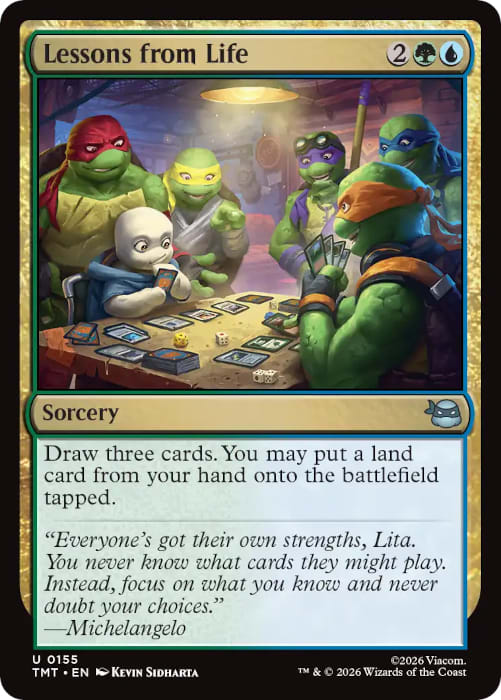
Lessons from Life caught my eye during preview season as a way to accelerate your Land drops while filling your hand, a strategy I've loved since Urban Evolution, and that got me thinking about how to maximize that strategy in Standard. This has led me to spend the last week or so trying to build a Gate deck in Standard.
Why build a Gate deck?
Magic: The Gathering can be played in variety of ways, even when you're operating under the same rules or in the same format. The game encompasses multitudes of strategies, tactics, and play styles. Some people look at it similarly to a game of chess, where calculating each move and planning your master stroke ten turns in advance is essential.
To others, it's kind of like a puzzle, where all the pieces are already present, you just need to maneuver them into the correct order to secure victory.
And then, there are those of us that just want to build a puzzle in the middle of a chessboard that kills the king when it explodes.
I'm talking about players that look to win games outside of the normal parameters of gameplay. Players have long had an infatuation in winning games in unconventional ways and are willing to play some unconventional strategies to scratch that itch.
Something about ignoring the combat step and trying to force your opponent into a war of unconventional means brings out the creative streak in many of us, even though (or maybe because) that path is rarely attainable.
For many of us, the alure of winning a duel in a non-conventional means is one of the true draws to the game. Zigging when you're expected to zag, changing up the game in ways that your opponent can't anticipate. That's what brings excitement to the table tops!
What is an alternate win condition?
There have been many ways to achieve victory in Standard throughout the years, not counting solo cards that outright say, "Do this and you win the game," ala classic cards like Battle of Wits or current cards like Call the Spirit Dragons.
Some of these strategies that exploit the "alternate ways to win a game" loophole over the years have become recurrent, emerging every few years to entice a new generation of brewers.
Poison, for example, has often been a fan favorite. Though it is a rarely reprinted mechanic, it never fails to have a devoted fanbase. Even now, with only three cards in the Standard format that mention Poison counters, you will occasionally run into someone on the Arena Ladder trying to make the deck work.
Other players choose milling their opponent to run out their library (named after the beloved card Millstone) to achieve this. I would say that Mill is the most reprinted means to achieve an alternate form of victory, as witnessed in the Kitsune's Technique prining in Teenage Mutant Ninja Turtles.
I'll admit it, even yours truly has dabbled at being a filthy, filthy mill player at one time or another in his long history. It can be a fun strategy, but even mill can get to be boring after a while.
Fortunately, every so often, Wizards reprints the Gate cards, and we get to renew our love of alternate win conditions.
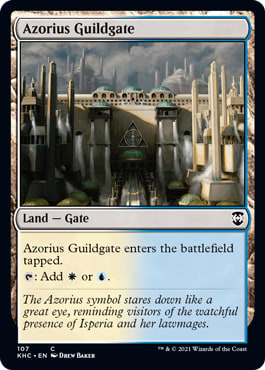 | 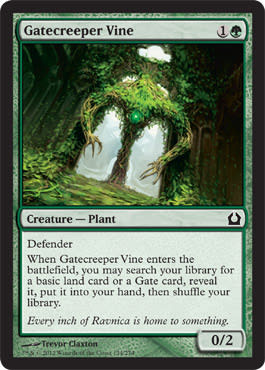 |  |
Just a quick refresher: Gates originally arrived with our Return to Ravnica, an appeasement for the stringent color requirements for the Plane when Wizards needed an additional dual Land cycle but didn't want to reprint the Karoo-style bounce Lands from original Ravnica.
Initially, this was very confusing, as each Land, named for one of the Ravnica Guilds, had the Gate sub-type, but little else to set them apart. There were a few Gate-themed cards here and there, such as Gatecreeper Vine, but not enough to make much of them.
As Mark Rosewater said in the October 8, 2012, "City Mail" column, "The Gates play an important role storywise, but more so later in the block. They weren't supposed to pull focus early, so we just had enough of them to keep players from asking why the Gate subtype even existed. Have patience."
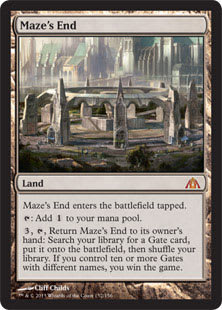
True to his words, with the printing of Maze's End in Dragon Maze, the Gate deck as an alternate win condition deck was born.
Maze's End is the most crucial card in the Gate deck, and the sole reason you should be building the deck in its Standard iteration. There are a few Creatures that interact with Gates in the current Standard rotation, but they aren't powerful enough to really be the focal point for the deck. Maze's End, however, as a Land, is a very difficult-to-interact-with win condition, one that most decks just can't answer.
Where do we start?
When theory crafting the Gate deck, there are three very important barriers you have to come to terms with immediately. The first is that this is a very slowly developing strategy.
All the Gates enter the battlefield tapped, putting your natural progression about a turn behind how decks would generally operate on mana production.
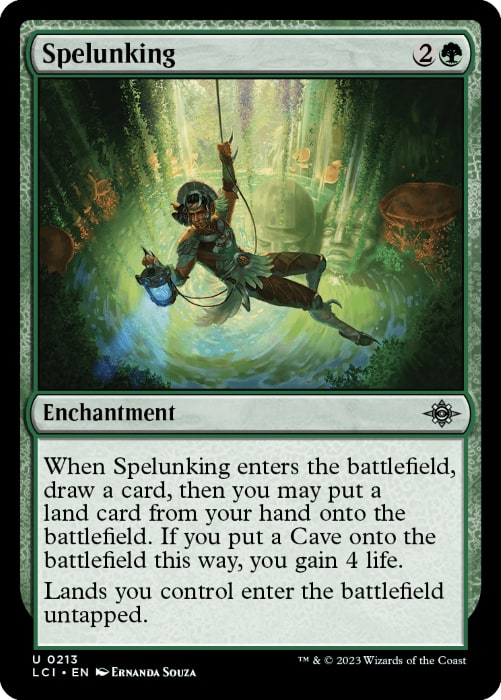
There are ways around this in Standard, if you're willing to run Spelunking (spoiler: I am willing), but you should expect to play your cards a turn behind schedule in many of your games.
The second barrier is you're going to need your games to go long. This can be a problem in a Standard format full of decks looking to drop Omniscience or Craterhoof Behemoth on the board on turn four. Surviving long enough to get ten Lands on the battlefield can be tough.
The final barrier is that is that the Gates are going to massively dilute your mana base. To win with Maze's End you must get ten different Gates onto the battlefield, meaning you're going to have at least ten Gates in your mana base, many of which won't really be on-color for your deck.
Each of these barriers presents a problem to be solved. You're going to have to build your deck with each in mind. This might look overwhelming, but earlier iterations of the deck can give you a blueprint for constructing the deck in the current format.
Using Previous Gate Decks as a Roadmap
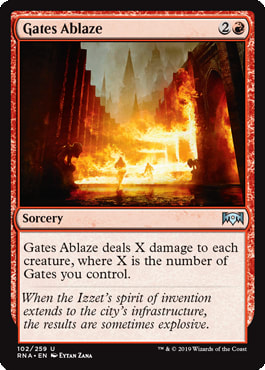 |  |
The most important cards that Gate decks in Standard are missing, that they have access to in older formats, are the cards Gates Ablaze and Guild Summit. Gates Ablazed allowed you to wipe the board, scaling with your turns to keep problematic Creatures away.
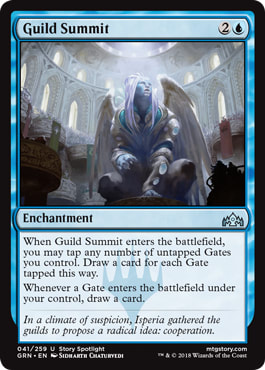
Guild Summit filled your hand and helped you find the cards necessary to make the deck work. These two cards made up the backbone of previous incarnations of the Gate deck, but neither were reprinted, so we need to find another way to get a similar production out of our deck.
"We recreate it in the aggregate," as Moneyball says. To that end, we're gonna need to find ways to take out our opponent's Creatures, preferably en masse, and draw a ton of cards. As such, I went the traditional sweeper route with White cards, and the traditional card draw route with Blue cards.
This means the deck will need to be Bant 

 , because the primary focus of any Gate deck is going to be, "What's the best way to get the most Lands onto the battlefield as fast as possible?" and that means you're going to want to be playing Green cards.
How do we build it?
Let's look back at the barriers and see how this deck meets each of them.
To tackle the first barrier, we are running Spelunking to neutralize the "Enters tapped" drawback inherent to the Gate cards. Since we can't always count on having access to Spelunking (or count on it surviving), we're also going to steer our deck towards lower-costed mass removal options and focus on Lands that can reliably enter untapped so we can hopefully sequence our Land drops to maximize spell efficiency.
I'd love to be able to rely solely upon Day of Judgment and Ultima for mass removal, but we're going to need to cast a sweeper on turn three in a ton of games, so that means we need to look at Split Up and/or Pinnacle Starcage.
We're also going to look at lower-costed card draw options. Stock Up might be better for this deck, but having access to some means of card filtering a turn earlier thanks to Consult the Star Charts may be more important for this deck when you absolutely must have an untapped Land or sweeper on turn three/four.
The final barrier, reliably finding the necessary Lands and smoothing out our draws, locks us into Green. Cards like Circuitous Route, Case of the Locked Hothouse, and Lessons from Life can partner with Spelunking to help us get Lands on the battlefield at an accelerated clip.
That makes this version of the deck Bant. Putting it all together, and this is the deck I would run:
You've Gate to be Kidding Me | TMT Standard | Travis Hall
- Creatures (7)
- 2 Beza, the Bounding Spring
- 2 Ignis Scientia
- 3 Vibrance
- Instants (7)
- 3 Get Lost
- 4 Consult the Star Charts
- Sorceries (12)
- 1 Day of Judgment
- 2 Ultima
- 3 Circuitous Route
- 3 Lessons from Life
- 3 Split Up
- Enchantments (7)
- 1 Case of the Locked Hothouse
- 2 Seam Rip
- 4 Spelunking
- Artifacts (1)
- 1 Pinnacle Starcage
Conclusion
So, after all this, I played the deck for a few days on Arena. I had a blast with this one and caught more than one opponent by surprise.
I tried to keep the number of Creatures to a minimum, since I focused on sweepers, leaving opponents Creature removal spells practically useless, and it helped in some of the matchups.
In others, an early sweeper set them back so much that I had time to find a second sweeper, or a pointed removal spell like Get Lost and won with Gates before they could take me out.
It wasn't all sunshine and roses, however. I lost games where my opponent dropped a turn four Craterhoof Behemoth or turn three thanks to Slickshot Show-off and Leyline of Resonance. I lost games where my opponent kept using Jeskai Revelation to bounce my Azorius Guildgate to my hand.
My biggest take away from this was that I could lose to those decks, and those draws, as well with a Gate deck as I did with a Monogreen Landfall deck. There are some very powerful linear decks in Standard, and losing to their good draws is just going to happen in a format with this many cards and this power level.
So, do I think Gate has what it takes to win in Standard? Well, yes, but no.
I think the Gate deck can win games, but I don't think it is some secret tech just waiting to be fine-tuned to dominate the metagame.
The current configuration of Standard is just too hostile for a deck like this to be consistently Tier 1, and too many other decks prey upon its natural weaknesses (try winning with a Gate deck when your opponent plays Doomsday Excruciator).
But, while I don't think this deck has what it takes to be a consistent top performer, it is very fun deck to play and can surprise people who are not prepared for it. What the Gate deck is, is a great FNM deck, or a deck built to have fun slamming into the Arena ladder.
You can find more of my Magic musings on Twitter/X @travishall456 and on Bluesky: https://bsky.app/profile/anakinsdad.bsky.social