 Locations


They say that Crime doesn't pay. Well, in Magic: The Gathering at least, that's not always true. What would you say if I told you that you commit a Crime almost every single time you play a game of Magic? You no-good, degenerate you. Don't worry, you're not going to look out your window to see Alquist Proft, Master Sleuth knocking on your door, ready to have you Imprisoned in the Moon. In this game, crime doesn't just pay, it wins.
So, let's talk about committing a crime in MTG
The History Of Crime In Magic
The concept of Crime in Magic began with the Outlaws of Thunder Junction set. Crime is a flavor addition to the game, in a setting built around outlaws and villains. In order to be an outlaw, after all, it necessitates that the character breaks the law. This was a natural way to add the concept to the game.
So, how did they decide to show the concept of Crime in Magic? In a fantastic bit of design, it was decided that "committing a Crime" was something we'd been doing all along, a common occurrence of the game, meaning that this wouldn't be strictly limited to cards in the Outlaws set, but game actions in and of themselves.
In designing the set, Mark Rosewater, in the article "Outlaws of the Land, Part 1," noted this:
"Defining 'commit a crime' as a type of action, something many Magic cards do, rather than as a specific new mechanic, allowed us to define the term in a way that made many existing cards part of the theme."
This means that we can use cards that have existed since Alpha when looking at Crime, and focus on cards that care about Crimes being committed. This makes cards from Outlaws the main focus but doesn't limit their interaction to only other cards with the ability or in the set. Is it really a Crime if no one is there to notice it, or if no one cares?
What is a Crime in Magic: The Gathering?

By the letter of the law, Crime is defined in section 100.13 of the MTG Comprehensive Rules.. This states:
"Some cards refer to committing a Crime. A player commits a Crime as that player casts a spell, activates an ability, or puts a triggered ability on the stack and that spell or ability targets at least one opponent; at least one permanent, spell, or ability an opponent controls; and/or at least one card in an opponent's graveyard."
In other words, almost every form of interaction in a game of Magic is one player committing a crime on another. Forcing target opponent to discard a card with? Crime. Targeting your opponent's graveyard with? Crime. Stealing your opponent's Emrakul, the Aeons Torn from their library with Bribery? You're a criminal. Every time you counter a spell? Oh, you better believe that is a Crime! Casting Murder on an opponent's Creature? Obviously, that's a Crime, it's Murder!
Here are some examples of committing a Crime in Magic:
- Forcing an opponent to discard a card with Thoughtseize.
- Using Scavenging Ooze to exile a creature card from an opponent's graveyard.
- Casting a Bribery on an opponent and stealing an Emrakul, the Aeons Torn from their library.
- Murdering your opponent's creature.
- ...and many more.
In other words, almost every form of interaction in a game of Magic is one player committing a crime on another.
This is the best thing about Crime. It's the part of the game we've had with us since the beginning; it just took a set of Outlaws to show us what we were doing.
How do you build around Crime?

Crime is an unusual area of Magic design. It's not really a mechanic, like Kicker, Flashback, or Delve. It's not really an ability, like Flying, Haste, or Double Strike. Instead, it is simply a rules text that triggers whenever a Crime is committed. So, in effect, you're not building a deck around the cards that explicitly commit Crimes as much as looking for cards that notice Crimes have been committed. This would limit your deck to the currently list of 26 cards from Outlaws of Thunder Junction that mention Crime. That may not sound like a lot, but this can lead you in many different directions, because some of the Crime cards are very powerful.
Freestrider Lookout can churn through your deck, giving you multiple Land drops a turn, triggering Landfall in a variety of ways, or even on your opponent's turn. It can dig you out of a Land stall, ramp you towards a powerful end game, or even fix your mana if you are color screwed.

Gisa, the Hellraiser does double duty. She pumps up your existing Zombies and Skeletons to make them sizable threats. She also triggers off of Crimes to generate a flood of Zombie tokens to create an undead army.

Magda, the Hoardmaster can give you a ton of treasure tokens, that you can use to commit more Crimes, thereby creating another token each turn. Or, you can turn those treasures into threats, with an army of 4/4 Flying Scorpion Dragons!
While you really want to focus on these cards for the Crime deck, to establish that you are committing Crime, you have the entire history of Magic to use when you're trying to figure out how you want to trigger the Crimes!
Can committing Crime be a fun way to play MTG?
The great thing about Crime is finding the fun and interesting ways to get away with it. Or, so I've heard. Every deck will generally have some way of committing a Crime, but if you want to maximize the cards that care about Crime, there are ways to tackle this that can be powerful and fun.
The most powerful cards that focus on Crime have the dread, "Once per turn" text to limit just how crazy you can go. So, in order to maximize your criminal enterprise, you're going to want to look for ways to trigger Crime on the opponent's turn, as well as your own. While the natural way to do this is going to be with Instant spell, don't forget about solid, renewable sources of Crime like Artifacts and Creatures with abilities. For example, in the current Standard format, my favorite way to do this is with Ghost Vacuum. Simple, direct, powerful.
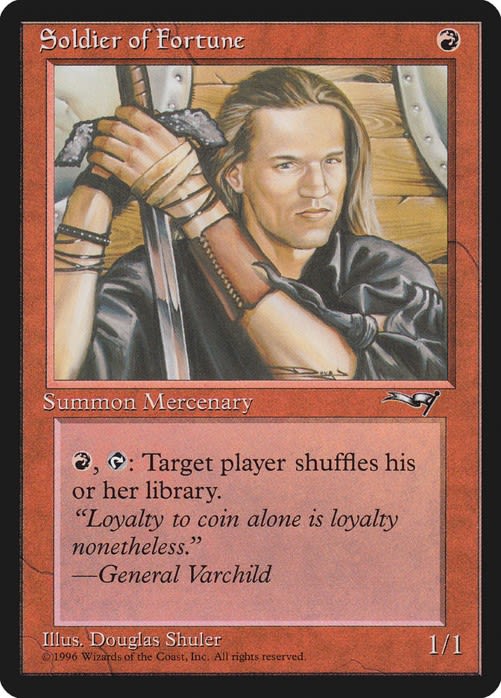
There are, of course, much sillier ways to do this in older formats, or in a game of Commander. One of the best has to be Soldier of Fortune. This card can be tapped to force an opponent to shuffle their library. Since it targets the opponent, it triggers as a Crime. It's an Instant-speed interaction and a great way to make your opponent miserable.
You've hired a mercenary to torture your opponent! This is one of the few cards in Magic that can actually feel like you're doing something wrong when you use it (especially if you're making an opponent with a deck full of shiny or expensive cards shuffle turn after turn)!

How about Forbidden Orchard? Sure, they gain a 1/1 Spirit Creature token, but you get to make a mana of any color and you get to trigger Crime. It's like you're making your opponent a willing accessory to the Crime. Now you're both criminals!
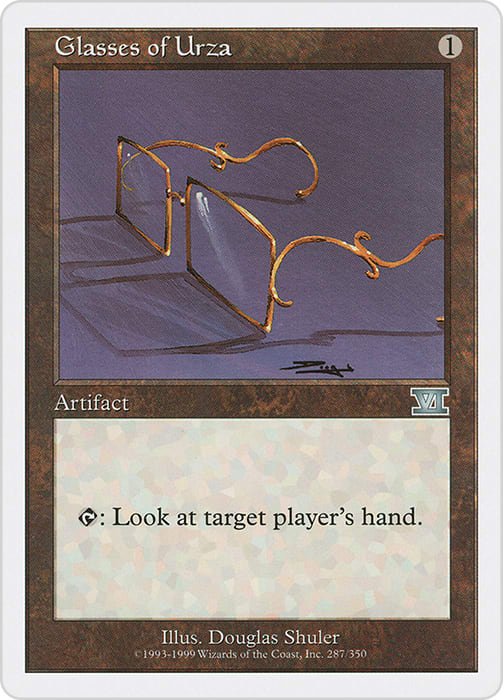
Glasses of Urza is another simple and flavorful way to trigger Crime. When you tap this to look at someone's hand, you'll feel positively voyeuristic. Normally, it's not worth investing a card just to be able to view your opponent's hand, but giving this some extra power with Crime interaction makes this a card worth considering.
The Future of Crime in MTG
The great thing about Crime is that it is an easily referenced game space that is endlessly flavorful and ripe to return. Every setting, every world that Magic ventures to in the future, whether Universes Within or Universes Beyond, will be populated with villains committing some sort of Crime and the heroes that fight them. It's a great way to inject some interesting gameplay into a set since the interaction is something almost every game has to begin with.
It's not a matter of, "if" we will see another set with a strong emphasis on Crime, but a matter of, "when."