 Locations


Slivers are one of the oldest typal (creature-type focused) decks in all of Magic: The Gathering. Almost every older player has a "Sliver story" where they either played one of those decks or was creamed by it. But what exactly are Slivers, where do they come from, and how do you build them properly? For us to have a good idea of what we're facing with Slivers, we have to start from the beginning, in Dominaria.
The Real Story of Slivers
Eons ago, on some unnamed plane, a sentient race created Slivers as beasts of burden. Using their strength, and ability to augment each other, they crafted an empire that none on the plane could rival. What they didn't anticipate was deep down in the crust of their planet, a Sliver Queen was biding her time.
With each generation, the Sliver Queen became more and more powerful until finally, one Queen conquered death and this Sliver Gravemother tapped into the psychic connection that all Slivers shared. In a single night, the unnamed empire was reduced to rubble as former beasts threw off the shackles and overthrew their masters.
Slivers on Rath
Volrath, one of the OG baddies of Magic lore, visited this plane. As a shapeshifter himself, he was intrigued by these creatures, and brought the Sliver Queen back to Rath with him. He intended to study them, and separated the brood from the Queen.
Using the Slivers as a template, Volrath attempted to create artificial Slivers, but these were a poor recreation of the original, and didn't share the hive mind connection to each other. He also used the Sliver Queen as a guard for Urza's Legacy, but Karn, Silver Golem, was able to convince her that the Legacy was as much a part of him as the brood was a part of her.
Volrath used the Slivers as part of his plan to invade Dominaria, and the Rathi Overlay caused both Rath and Dominaria to intersect. This allowed Slivers to enter the plane. Unfortunately, most of them were killed either in the Overlay itself, or in the fighting that followed.
Sliver Rebirth
About a hundred years later, scientists at the Riptide Laboratory on Otaria discovered the remains of those slivers, and planned to bring back the extinct species. However, having no knowledge of the Sliver Queen, they never recreated her. Once they had resurrected the Slivers, they lost control of them without a Sliver Queen to establish dominance of the hive mind. Rampant breeding let the Slivers overtake the laboratory, and eventually enter the rest of the plane.
While this was going on, the Mirari was wreaking havoc all over the plane. Its influence led to rapid growth and enhancement of the Slivers, turning them from just another pest infestation into something dangerous. Its influence was very close to the Sliver Queen's impact on their minds and the Mirari drew the Slivers to the mainland, resulting in them fighting in the battle at Sanctum.
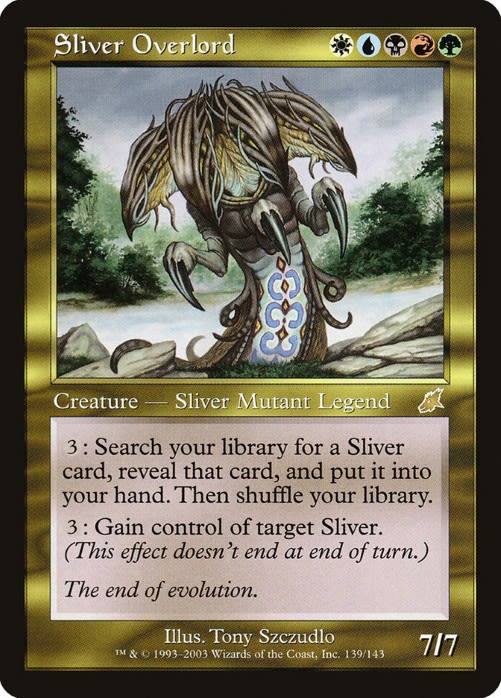
The magical explosion that ended that battle also fused all surviving slivers into a new hive mind: The Sliver Overlord. That explosion also drained most of the mana from the plane of Dominaria, and it led to a slow spiral into death for most of the plane's inhabitants. Slivers were one of the few species that thrived on the dying plane.
Slivers Rise and Fall
During Dominaria's slow collapse, the slivers formed roaming bands, swarming over settlements and consuming all that stood in their way. It was said that these Sliver swarms were a force of nature unlike anything else. The swarms were a result of Slivers roaming the land looking for a new Sliver Queen and that connection to the hive mind that they lacked.
With time, some leaders like Lord Windgrace and the Planeswalker Freyalise learned to control the swarms in their respective domains. However, the Slivers' hivemind was slowly becoming more and more sentient.
In Stronghold, a strange artifact known as the Hivestone was discovered. Volrath's evincars would use the stone to control the Sliver swarms when the Rathi Overlay occurred, but the strength of the hivemind meant that anyone attempting to use it now would immediately be taken over by the swarm.
Slivers Today
Throughout the multiverse, Slivers appeared in various locations. From Alara, to Shandalar, and even as far flung as Mirrodin (or New Phyrexia), Slivers have become part of Magic's lore. They even had a cameo in Edge of Eternities, and an insert in the Sliver Swarm Commander precon. Some argue that today's Slivers feel less flavorful than the originals, but that's a matter of opinion.
As players, Slivers are a powerful creature subtype that either makes you grin in glee, or cringe in fear.
Brewing Tips for Slivers

Building a Sliver Commander Deck isn't a hard task. There are a ton of great Slivers out there, and with the introduction of the Sliver Swarm precon, us Sliver players have more fuel than ever before for our fire. The big takeaway for any builder is that Slivers care about Slivers. Here are some tips for getting the most bang for your buck out of your Sliver experience.
Roles Are Better Than Colors
Sliver decks are usually five-color piles, so colors aren't that important here. All the Sliver commanders are five-color anyway. What's more important is determining what redundancy you have in your Sliver list. However, tightening your deck into two or three colors specifically can give it a different flavor.
For example, if you have a Naya (

 ) Sliver list, then you get access to Haste, Trample, Flying, Lifelink, and other color-specific keywords on your Slivers. If you build in Black, you will lose Trample, but you will get Frenzy, Regeneration, and Lifelink. Colors determine what keywords your Sliver swarm has access to.
What that means in practice is separating your Slivers into ability pools, not colors. For example, if your color focus has Sliver lords (creatures that buff your entire Sliver team), how many are you running? What about Evasion (Shadow, Flying, Menace)? How many Haste enablers? The roles are far more important than the individual colors.
Pay Attention to Wording
There's a distinction between old Slivers and new ones. Aside from the fact that new Slivers are more humanoid looking, they also specify that they only affect Slivers you control. Old Slivers affected all Slivers on the field, including your opponents.
Today, this might not be a big deal, since it's pretty unlikely you'll run into another Sliver deck. However, a lot of players run Changelings in their deck which count as honorary Slivers, and benefit from the abilities that affect all Slivers in play. Ideally, you'll want to use the newer Slivers but you will probably have to use older ones for the redundancy they bring.
Your Mana Base Needs to Support Five Colors
While your whole deck might be focused around a few main colors, your Commander will be five-colored, which means you have to find a way to cast it consistently. Budget mana bases can manage to cast your Commander easily enough, but you still need access to all five colors.
Mana-fixing Slivers like Manaweft Sliver or Gemhide Sliver come in clutch for casting your Commander early on, but depending on them is a huge mistake. Slivers are notoriously easy to remove on their own. It's better to be sure you have lands like Cascading Cataracts that can fix your mana on its own. Alternatively, any-color lands like City of Brass or Command Tower are priceless to allow you to have the mana you need to cast your spells.
Utility Slivers come in all colors, so having the colors to support your Sliver gameplan is crucial to success in any deck you build.
Don't Underestimate Cheap Bodies
As the history of Slivers explains, they're a type of creature that benefits from being in a swarm. It's not uncommon to see a Sliver player with 20 individual Slivers and tokens on their field. Many of those don't cost more than three mana, and that's because Slivers are only as useful as how big their board is.
Having a few payoff Slivers (like lords) only works if you have a wide enough board to make those lords look threatening. One 2/2 Sliver lord is less impactful than a horde of them. And the more of them there are, the more threatening they look.
Support Slots Will Affect Synergy Density
Slivers give other Slivers abilities, so each card in your deck that isn't a Sliver will affect your synergy density. That's why picking your support cards is so important. It could mean the difference between fun games and non-games.
Should you run a creature-only deck? While that is an option, it's usually not a very good one. Slivers are notoriously hard to rebuild after a board wipe (a spell that destroys all creatures at once), so things that address the type's natural shortcomings are obvious includes. How you build your Slivers deck is up to you, but remember, each card that goes into that deck that's not a Sliver should support your gameplan in some way.
Pay Attention to Your Commander's Abilities
Your choice of Sliver commander is relatively limited, and the best options are:
- Sliver Hivelord
- Sliver Overlord
- Sliver Queen
- Sliver Gravemother
- Sliver Legion
- The First Sliver
- Rukarumel, Biologist
- Morophon, the Boundless
Each of these commanders prosecute the game in different ways. So for example, Sliver Legion wants a board of other Slivers and lets each of them turn into a pseudo-lord. Sliver Overlord, meanwhile, is more of a toolbox deck, allowing you to search out exactly what you need. Looking at what your commander does helps you build your deck to best exploit its capabilities. And whichever legendary you don't use as a commander could fit easily into the 99 as a payoff.
Is it worth it to build Slivers?

One of the best (or worst) things about Slivers is that they are always a threat. Anyone who has ever played against a Sliver deck can tell you how they easily get out of hand. If you build a Sliver deck today, it'll be just as feared as they were when Volrath used them to invade Dominaria.