


 Locations



Artifacts have been a key part of Magic: The Gathering's identity since the very first set, and in 1993's Alpha they were considered one of the strongest card types thanks to iconic cards like Black Lotus and the five Moxen. Over the years, the card type has had its ups and downs, but Artifacts have always been consistently powerful and fun to play. As Magic prepares for its 33rd anniversary, We thought it would be fun to look back at the history of the game's Artifacts, breaking down the best new Artifact printed each year. This post will cover Alpha (1993) through Scars of Mirrodin (2010)
A Look At The Best Artifact In Each Year of Magic (1993 - 2010)
Before we get to the list, let's establish the criteria for selecting the best Artifact from each year. This list isn't specific to one format but is instead a look at each card's history and impact on competitive formats like Standard, Modern, and Legacy, and on casual formats like Commander. These cards will also largely be evaluated on how powerful they are today, but along the way there will be shout-outs and honorable mentions for cards that were great during their times.
Since there are so many Artifacts across decades of Magic, we will be splitting this article into two separate articles:
- 1993: Black Lotus
- 1994: Ashnod's Altar
- 1995: Mana Crypt
- 1996: Lion's Eye Diamond
- 1997: Lotus Petal
- 1998: Mox Diamond
- 1999: Memory Jar
- 2000: Phyrexian Altar
- 2001: Millikin
- 2002: Cryptic Gateway
- 2003: The Artifact Lands
- 2004: Skullclamp
- 2005: Umezawa's Jitte
- 2006: Mishra's Bauble
- 2007: Rings of Brighthearth
- 2008: Painter's Servant
- 2009: Expedition Map
- 2010: Mox Opal
Without further ado, let's get to the list.
1993: Black Lotus

Starting off the list with maybe the easiest decision of any year, the best Artifact from Magic's inaugural year was, without a doubt, Black Lotus. Alpha was full of broken cards, but the Artifacts were especially egregious. This was the set with the five Moxen, Sol Ring, Mana Vault, and Time Vault, to name a few. It also had Basalt Monolith, a card that goes infinite with a ham sandwich, and Juggernaut, a card that isn't great by today's standards, but at the time it was one of the best Creatures in the game.
Despite all that power, Black Lotus stands above all. It is not just the best Artifact from 1993, but also widely considered the best card in the game and one of Magic's most iconic game pieces.
 |
 |
 |
If you somehow aren't familiar with the card, it costs zero mana and can be sacrificed to add three mana of any one color. It is one of the most explosive cards in the game, able to accelerate you three turns ahead on the very first turn of the game. For these reasons, it is only legal in Vintage, where it is restricted to one copy per deck, Canadian Highlander, where it is high on the points list, and Cube, where it is often drafted as early as possible.
1994: Ashnod's Altar

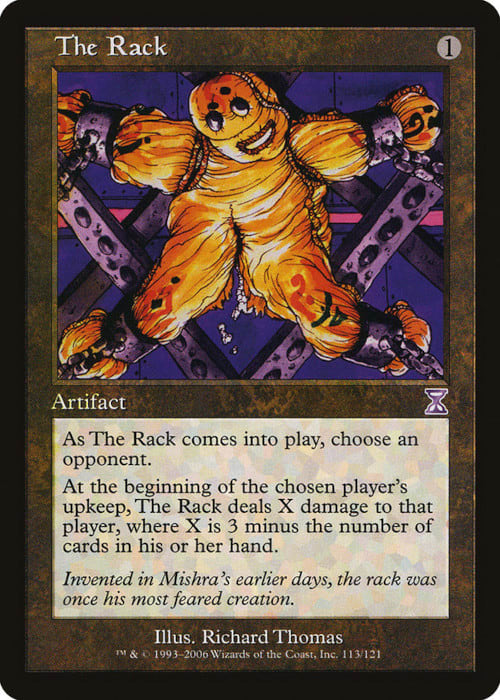
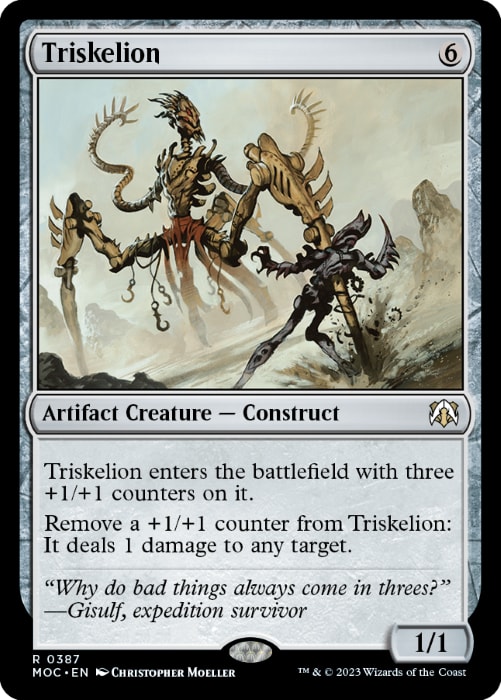
After printing a bunch of powerful and iconic Artifacts in its first year, designers at Wizards of the Coast would ease up the following year. In 1994, two Artifacts stood above the rest: Mirror Universe, which was a pivotable part of one of Magic's first control decks, and Ivory Tower, which would become one of the first cards ever restricted in Magic because its consistent life gain was too good for a metagame where Creatures were bad. While these two Artifacts were powerful at the time, they haven't withstood the test of time. There are several other cards that still see play today though. The Rack is a win condition for discard decks, Tormod's Crypt still sees play as a piece of sideboard graveyard hate, Triskelion is a popular combo piece that also sees play in +1/+1 counter Commander decks, and Candelabra of Tawnos is a great way to make extra mana with Lands that add multiple mana.
 |
 |
 |
My number one pick for 1994 is Ashnod's Altar, a three-mana Artifact that allows you to sacrifice a Creature you control to create two colorless mana. If you've ever played a game of Commander, you've probably had to deal with this card. It provides both a free sacrifice outlet and a way to trade expendable Creatures for extra mana, both of which make it fantastic in casual formats. It sees play in a wide variety of Commander decks, most often in sacrifice decks, combo decks, and big mana decks. Since it was originally printed at common, it also sees a bit of play in Pauper Tron decks.
1995: Mana Crypt

There weren't many Artifacts printed in 1995, and not many of them left a lasting impact on the game. Jester's Cap and Digeridoo are both iconic and Urza's Bauble is a pretty good Commander card, but in the end, there were two Artifacts competing for the top spot.
At the time, Zuran Orb would have been a clear choice for the top spot. This zero-mana Artifact allows you to sacrifice a Land to gain two life. It has a surprisingly long history for a card that seems innocuous by today's standards. Back when it was first printed, this card was incredibly powerful, as Creatures were bad and efficient life gain cards were especially strong (as previously mentioned, Ivory Tower was once banned in Standard).
 |
 |
 |
This card saw quite a few bans back in the 90's, being restricted in Standard and Vintage the same year it was printed and banned outright in Standard just two years later. Because of its Standard ban, it was also included on the initial ban list of both Extended and Legacy when those formats were created, although it was eventually unbanned in Legacy and unrestricted in Vintage a couple years later.
Zuran Orb was broken when it was printed and is still quite powerful today, but the number one Artifact of the year has remained broken after more than 30 years: Mana Crypt. This zero-mana Artifact taps to add two colorless mana, with the downside of dealing three damage to you during your upkeep if you lose a coin flip. Like Black Lotus and the Moxen before it, Mana Crypt is another example of fast mana, or a mana source that produces more mana than you spent to cast it, and this card is up there as one of the strongest pieces of fast mana. Mana Crypt puts you so far ahead on mana that you usually don't care about the life loss, and it is so powerful that it is banned or restricted everywhere. It is restricted in Vintage, banned in Legacy, Commander, and Oathbreaker, and is on the points list in Canadian Highlander. Not bad for a card you could originally get for free as a book promo.
1996: Lion's Eye Diamond

Today, Lion's Eye Diamond is a notorious combo piece, pairing with Underworld Breach in Commander to storm off and with Echo of Eons in Legacy to instantly refill your hand. Its interaction with Underworld Breach even got Breach banned in Legacy and placed on the Game Changers list in Commander.
After having a quiet year, 1996 saw quite a few powerful Artifacts. Cursed Totem is a powerful stax piece against Creature decks and Helm of Obedience is a strong combo piece that can instantly mill players out when combined with graveyard hate. It was a close race for number one, but Phyrexian Dreadnought ended up being the runner-up. This one-mana 12/12 forces you to sacrifice a bunch of Creatures or itself when it enters, but it has been a competitive powerhouse in formats like Legacy and Premodern thanks to its combos with Stifle-like effects, where you can get around its huge downside and put a 12/12 with Trample onto the battlefield on turn one or two.
 |
 |
 |
Mirage's Lion's Eye Diamond tops the list of Artifacts from 1996, the third instance of fast mana on this ranking so far. This card was designed to be the fixed version of Black Lotus, costing zero mana and sacrificing itself to add three mana, but with the added downside of requiring you to discard your hand before you add the mana. Of course, you don't care about that downside if you're playing cards from your graveyard, and that's exactly the kind of playstyle this card enables. It paired well with early mechanics like Threshold, Madness, and Flashback, but its true potential was reached with the printing of Yawgmoth's Will in Urza's Saga. This three-mana Sorcery allows you to play nonland cards from your graveyard, but it also exiles any cards that go to your graveyard for the rest of the turn.
1997: Lotus Petal

1997 was a very good year for Artifacts. Cursed Scroll was a Standard staple when it was legal, where it became a consistent source of damage for grindy decks once they got down to one card in hand. Null Rod was, and still is, a great stax piece against Creatures, Grindstone is a strong combo piece when combined with a card later on this list, and Scroll Rack is a popular Commander card that can manipulate the top of your library for powerful Commanders like Yuriko, the Tiger's Shadow. The best Artifact of the year was, once again, a piece of fast mana: Lotus Petal.
 |
 |
 |
Lotus Petal was meant to be a "fixed" Black Lotus, and while it isn't as powerful as the strongest card in the game, it was still problematic at the time and sees a lot of play today. It is a zero-mana Artifact that can be sacrificed to add one mana of any color, essentially a Treasure token that you play in your deck. As it turns out, a free burst of mana is still really good, and while it wasn't a problem in Standard right away, it would end up becoming problematic when Urza's Block released the following year. Eventually, Lotus Petal would be banned in Standard, where the free mana ended up being too strong in a combo-heavy metagame. Today, it sees a good amount of play in pretty much every format it's legal in. It's a staple in Legacy, Vintage, and Pauper, where even one extra mana in the early turns can decide games.
1998: Mox Diamond

Between Stronghold, Exodus, and Urza's Saga, there were a ton of options for 1998. Ensnaring Bridge, Sphere of Resistance, and Smokestack are among the best stax pieces of all time, Phyrexian Colossus was the finisher for fast Artifact decks in Standard, and Voltaic Key caused major problems alongside Time Vault, Mana Vault, and Grim Monolith. Like 1997, however, even the best stax pieces and combo cards are no match for fast mana.
Surprisingly, despite Urza's Block's notoriety for printing broken Artifacts, the best one of 1998 instead hails from Stronghold. Mox Diamond is a zero-mana Artifact that taps to add one mana of any color, but to play it you need to discard a Land card. This downside is negligible, as having extra resources early is usually worth cashing in resources for later in the game. Today, like most pieces of fast mana, Mox Diamond is a staple of Legacy and Vintage and is on the Commander Game Changers list.
1999: Memory Jar
Urza's Block is arguably the strongest era of Magic, and that made this pick the hardest of the entire list. There were too many broken Artifacts printed this year to cover in detail, like Defense Grid, Junk Diver, Masticore, Metalworker, Thran Dynamo, and Urza's Incubator. It ended up being a brutal choice between two cards: Grim Monolith and Memory Jar.
Grim Monolith is a two-mana Artifact that can be tapped to add three colorless mana, but it doesn't untap during your untap step and instead you must pay four mana to untap it manually. It is reminiscent of Alpha's Basalt Monolith and Mana Vault, and like those cards it is a powerful piece of fast mana and a potential combo piece. It made waves when it was printed into Standard, as players quickly realized that it could make an insane amount of mana when combined with Voltaic Key. It was a key player in that metagame's combo-heavy metagame, and it is still very strong today. It's a Game Changer in Commander, popular in Legacy, and a key piece of several of the best Vintage decks.
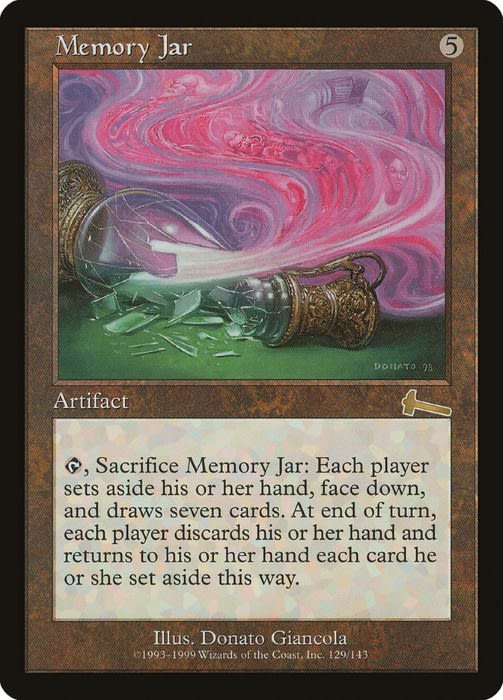
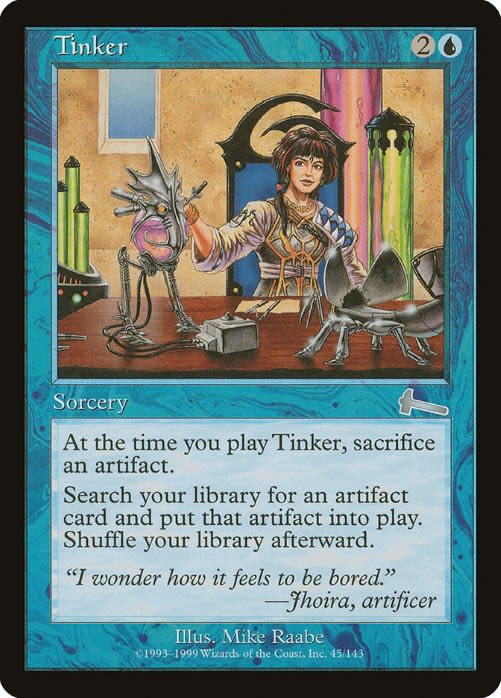
And then there's Memory Jar. This Artifact costs five mana and can be sacrificed to make each player set aside their current hand and draw a new hand of seven and discard that hand at the end of the turn. This card was printed into a combo-heavy Standard and immediately broke the format, giving decks access to both fast mana and a way to refill their hands for a turn. More importantly, players could take advantage of cards like Tinker and fast mana to play Memory Jar as early as turn one and subsequently chain together copies of the card. From there, players could kill their opponents with Megrim, which would make their opponents die when they discarded cards to the Memory Jar triggers.
 |  |
It was so strong and took over so quickly that it had to be emergency banned after only two weeks, which is still one of the fastest bans in the history of Magic. It's still banned in Legacy, but doesn't see as much play today, but it shows up from time to time in Vintage and is a popular Cube card.
It was an incredibly close match, but the top spot is going to go to Memory Jar. There are few cards that break Standard enough to be banned and even further still that needed to be emergency banned, but Memory Jar has continued to be banned and restricted among Magic's most powerful formats. Grim Monolith may see more play today, especially in Commander, but only because Wizards of the Coast have been too afraid to let the Jar out of jail.
2000: Phyrexian Altar

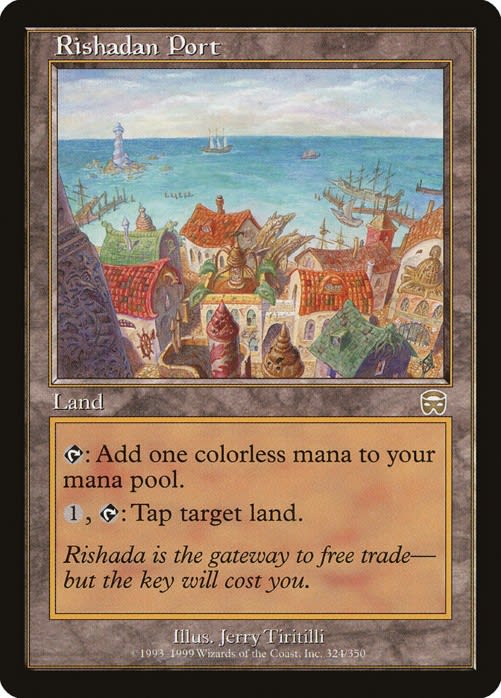
After the insanity of Urza's Block, Magic's designers calmed down on the busted Artifacts for a few years, and the turn of the millennium saw only a few powerful Artifacts. Tangle Wire was a great stax piece that would slowly deny resources until eventually fading away and Tsabo's Web was a fantastic answer to annoying Lands like Rishadan Port. Both cards have seen renewed interest thanks to Premodern, where they see a fair amount of play. Like 1994, however, the best card of the year is another altar that adds mana.
 |
 |
 |
Phyrexian Altar is a three-mana Artifact that allows you to sacrifice a Creature you control to add one mana of any color. There's not too much for me to say about the card. Like Ashnod's Altar, it is simple and very powerful. It can be used fairly to generate mana in token decks, but its true strength is as a combo piece in sacrifice decks, where the mana can be used to loop Creatures from the graveyard. Today, it primarily sees play in Commander, where it is a very scary card to see across from you.
2001: Millikin

Artifacts may have winded down in 2000, but there were still a few really good ones. The same cannot be said of 2001, where most of the year's Artifacts were either forgettable or bad. Draco isn't a very strong card but it's iconic for having one of the highest mana values in the game, Mirari and Dragon Arch both have good effects but cost a lot of mana, and Star Compass is a decent budget-friendly mana rock. The pick for the best Artifact of 2001 is Millikin, which probably sounds insane to most. However, this is a two-mana Artifact Creature that can tap to add a colorless mana while milling a card from your library in the process. The combo of ramp and graveyard fuel for just two mana makes this a great card, and since it's colorless you can put it in any Commander deck.
2002: Cryptic Gateway
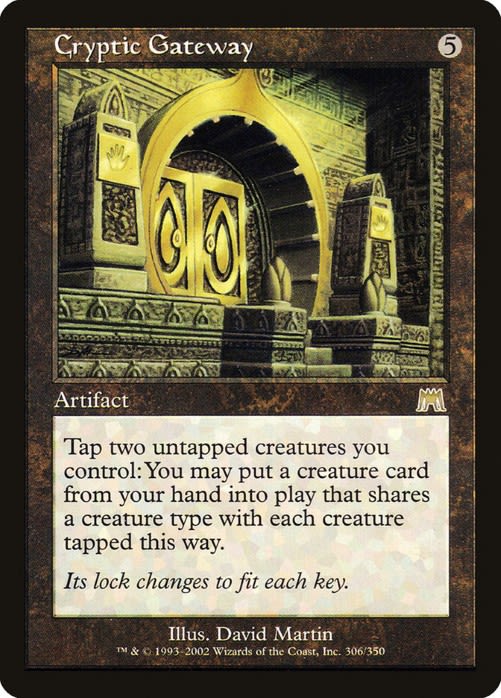
It doesn't get easier to select the best Artifact of the year than this. There were only six new Artifacts printed in the entirety of 2002, and none of them are nearly as good as the Artifacts printed in previous years. Slate of Ancestry can be decent in go-wide decks or discard decks, but I'm going to give Cryptic Gateway the edge here. It's a five mana Artifact that lets you tap two Creatures you control to put a Creature card from your hand that shares a type with both Creatures into play from your hand.
Playing Creatures without spending mana on them is strong, especially for Creature types known for big, expensive cards like Dragons, Demons, Dinosaurs, or Angels. It also isn't limited to your turn or even Sorcery speed, so Commanders like Pantlaza, Sun-Favored that have abilities you can only trigger once each turn will love this card. That's all I've got for this year, let's get back to the good stuff now.
2003: The Artifact Lands
 |
 |
 |
 |
 |
Finally, after three years, Artifacts are back. 2003 saw the release of Mirrodin, the first non-reprint set to feature Magic's new border and the first set since Urza's Destiny to have a heavy focus on Artifacts. Some highlights from the year include Goblin Charbelcher, Isochron Scepter, Lightning Greaves, Myr Enforcer, and Solemn Simulacrum. Three stand out, however, and there is a valid argument for each one being the best of the year. Chalice of the Void is a popular stax piece in eternal formats that can shut down cheap spells and Chrome Mox, which might deserve the top spot, is another piece of fast mana that had to be banned in Modern and added to the Commander Game Changers list. The number one spot, however, goes to the original cycle of Artifact Lands:
So, why did Lands get the number one spot over fast mana and a powerful stax piece? Not only are these cards still incredibly powerful today, but at the time, they completely broke Standard. While Mirrodin Block was legal in the format, Affinity was the strongest deck by far, and its ability to run an additional 20 Artifacts in the mana base was absurd. The deck's primary game plan was to use the Artifact Lands and other cheap Artifacts to get Creatures like Frogmite and Myr Enforcer down for free, but that the deck had lots of tricks up its sleeve.
 |
 |
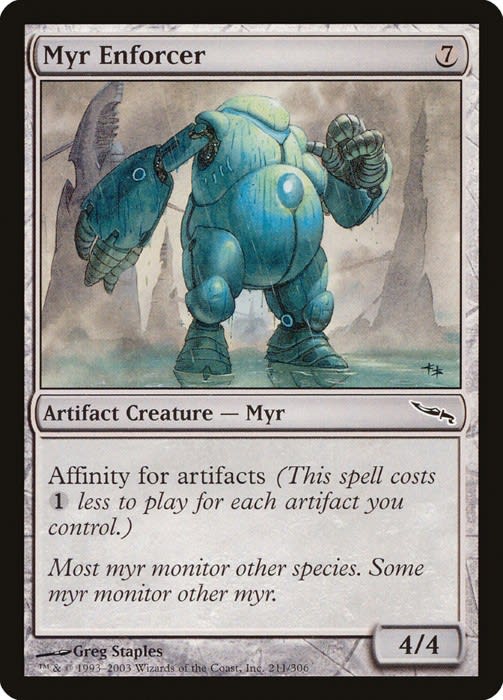 |
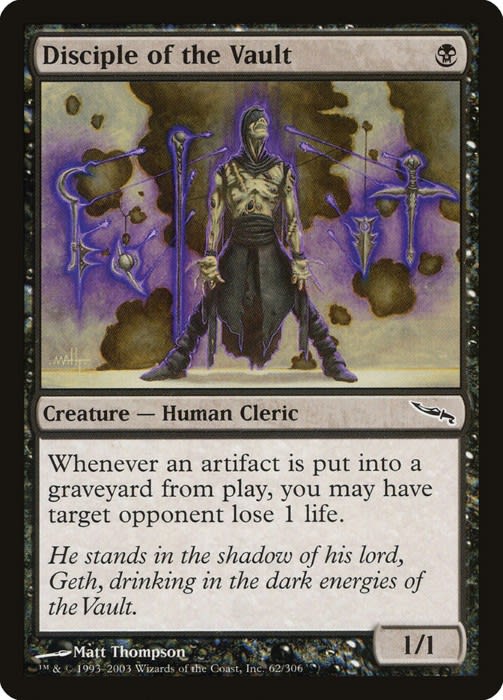
It could also go for explosive combo lines using Disciple of the Vault and Arcbound Ravager or go for one-shot kills using Cranial Plating. The deck was so powerful that it resulted in bans for all five original Artifact Lands, Darksteel Citadel, Disciple of the Vault, and Skullclamp. Today, all five Artifact Lands are still banned in Modern out of fear that Affinity could rise again, and they are also staples of Artifact-based decks in Commander and Pauper.
2004: Skullclamp

2003's Mirrodin was just a taste of the block's power, and the following year, the rest of Mirrodin Block would print even more broken Artifacts. There were so many options for 2004's Best Artifact:
- Arcbound Ravager
- Cranial Plating
- Aether Vial
- Crucible of Worlds
- Darksteel Colossus
- Engineered Explosives
- Krark-Clan Ironworks
- Mycosynth Lattice
- Sword of Fire and Ice
- Trinisphere
- Sensei's Diving Top
All these cards came close to taking the top spot, being banned in multiple formats for taking up too much time during games and offering cheap and efficient card-filtering. Despite all the choices, the top spot was clear: Skullclamp.
This one-mana Equipment has an equip cost of just one mana, gives its equipped Creature +1/-1, and when that Creature dies its controller draws two cards. Skullclamp was famously under-tested before Darksteel's release, and at the last minute, designers added the part that gave the equipped Creature -1 toughness, which sealed its fate. When attached to a one-toughness Creature or combined with a sacrifice outlet, Skullclamp could draw two cards for just one mana while still triggering death abilities, a rate that was far too strong for the Standard environment it was printed into and too strong for many eternal formats. It was banned very quickly in Standard and Legacy and was banned in Modern at the format's inception. Today, Skullclamp is a boogeyman at Commander tables, often requiring an immediate answer before it lets tokens or aristocrats decks run away with the game.
2005: Umezawa's Jitte
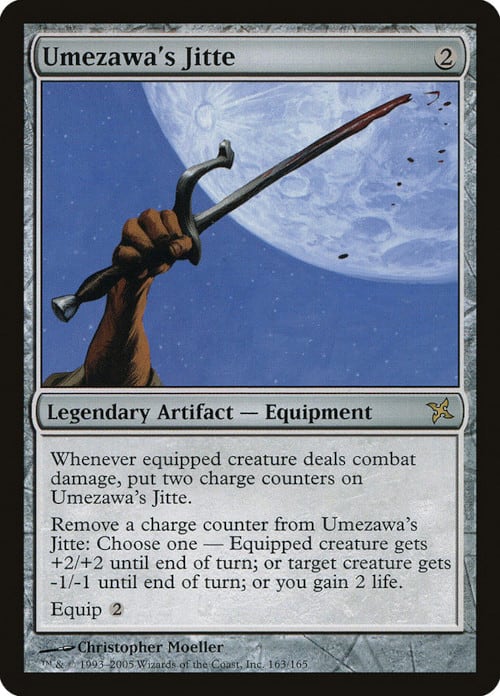
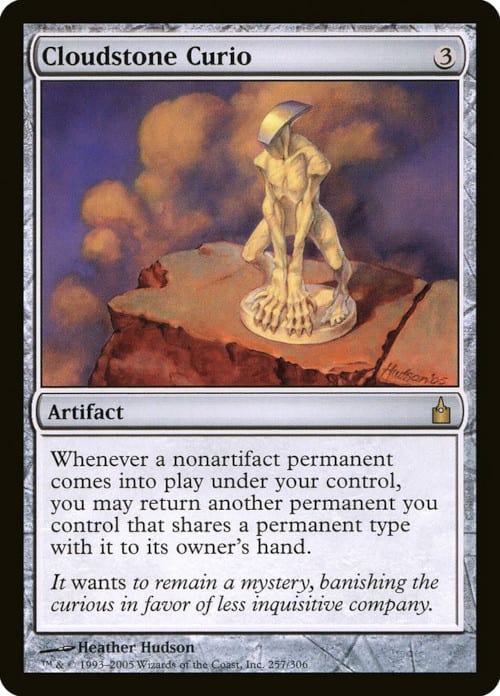
Like Urza's Block before it, Mirrodin block printed Artifact cards that were too strong, and over the next few years, Magic designers would ease up on the card type. Artifacts printed in 2005 were much tamer, with a few notable exceptions. Cloudstone Curio is an infamous combo piece that goes infinite with a bunch of different cards and Pithing Needle has been a sideboard staple for years as an answer to Creatures like Borborygmos. One broken Artifact slipped through, however: Umezawa's Jitte.
 |
 |
This two-mana Equipment can be equipped to a Creature for two mana and, whenever that Creature deals combat damage, the Jitte gets two Charge Counters. Then, you can remove a Charge Counter to give a Creature +2/+2 until end of turn, to give a Creature -1/-1 until end of turn, or to gain two life. All three modes were really strong, as the +2/+2 mode made it really difficult for your opponent to block, the -1/-1 mode effectively shut down Creatures with two or less toughness, and the life gain could help you stabilize against aggressive decks. Umezawa's Jitte was a menace while it was legal in Standard, but it never ended up getting banned while it was in rotation. In 2011, however, it found itself on the original Modern ban list when the format debuted, and it would stay there for nearly 15 years. The most recent ban list update has changed that however, and now time will tell if it makes an impact after decades of power creep.
2006: Mishra's Bauble

After the end of Mirrodin Block and a few standouts from Kamigawa and Ravnica Blocks, the philosophy on Artifacts would change for the next few years. The power level of individual Artifacts dropped immensely, and instead of being singularly strong cards, many of the best Artifacts from 2006-2009 are powerful thanks to their synergies and interactions with other cards.
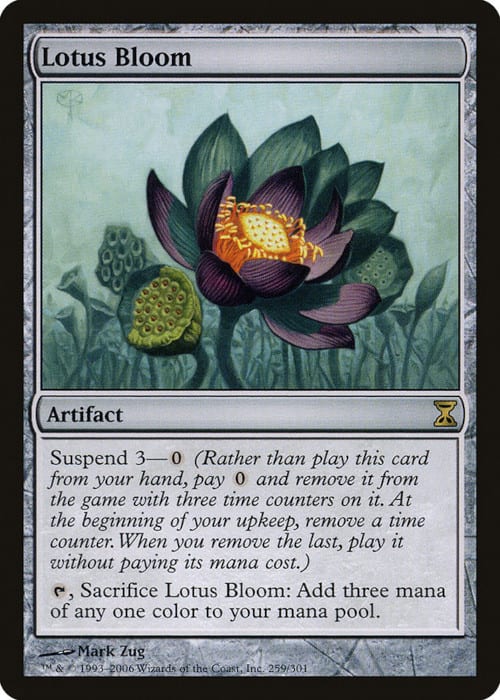
Take 2006 for example. Runners-up Lotus Bloom and Thrumming Stone are fine cards on their own but are best-known for their combos with other cards. Lotus Bloom, another attempt to make a "fixed" Black Lotus, is probably the fairest version thanks to the Suspend restriction, but it was still the cornerstone of a popular Storm deck during its time in Standard. It also still sees some play today in Modern and Legacy, where it can give you a big burst of mana to play and activate Goblin Charbelcher in one turn. Thrummingstone is also a card that doesn't do much on its own, especially when the most popular casual format, Commander, is singleton. It can still be a very powerful card when run with cards that let you play any number of copies of them in your deck, though, letting you cast a bunch of Shadowborn Apostle or Dragon's Approach in a single turn.
 |
 |
The best Artifact of the year is a bit better on its own than the first two, however: Mishra's Bauble. It is a zero-mana Artifact that can be sacrificed to look at the top card of a player's library, then draws you a card at the beginning of the next upkeep. In a vacuum, having a zero-mana card that draws a card makes your deck a little more consistent and there are niche upsides to knowing the top card of a library, like when you're deciding whether to crack a fetchland or not. Its real power comes in conjunction with other cards, and over the years it has seen a lot of play in competitive formats thanks to its synergy potential. For example, while Lurrus of the Dream Den was still legal in Modern and Legacy, it could let you replay Mishra's Bauble from your graveyard repeatedly for more card draw. It is also a zero-mana noncreature spell that replaces itself, making it an excellent inclusion in Prowess decks that aim for quick kills with Monastery Swiftspear and Slickshot Show-off.
2007: Rings of Brighthearth

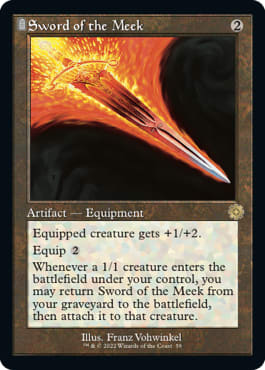
Continuing the trend of Artifact design prioritizing synergy over power, many of the best Artifacts of 2007 do absolutely nothing on their own but become powerful in conjunction with other cards. Akroma's Memorial and Dolmen Gate can both be very powerful, but since their static effects only affect Creatures, they don't really do anything on an empty board, and Sword of the Meek is powerful specifically because of its combos with other cards like Thopter Foundry. Even the best Artifact of the year, Rings of Brighthearth, is not exempt from this design philosophy.
 |
 |
 |
Rings of Brighthearth is a three-mana Artifact that allows you to pay two generic mana to copy another activated ability if it wasn't a mana ability. It's never been a viable card in competitive formats, but it has been a favorite in Commander for almost two decades. In a casual format, this card enables nearly endless shenanigans. If your Commander has a powerful activated ability, this card allows you to spend a little extra mana to double up on it. With Commanders like Krenko, Mob Boss, Osgir, the Reconstructor, and Svella, Ice Shaper, this card can generate a ton of extra value with little investment. It is also really good with Planeswalkers, letting you copy their loyalty abilities. Finally, it can go infinite with cards like Basalt Monolith and Grim Monolith, where you can repeatedly copy their untap abilities to generate infinite mana.
2008: Painter's Servant
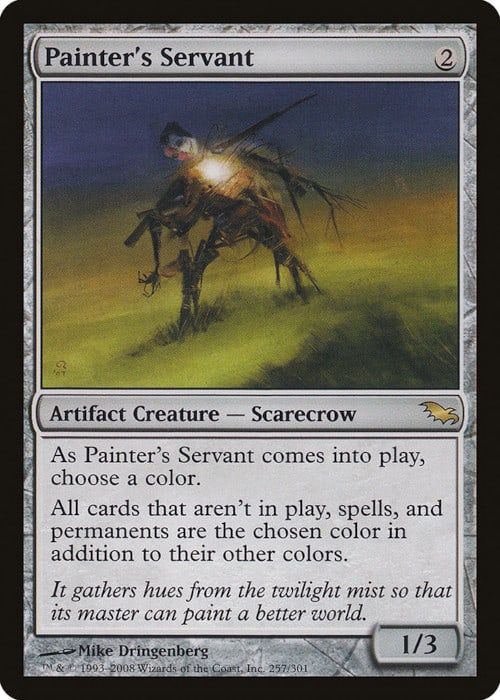
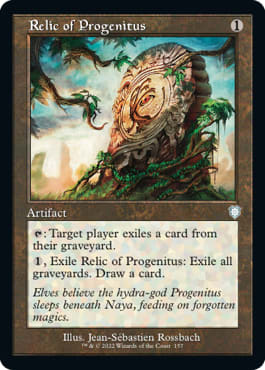
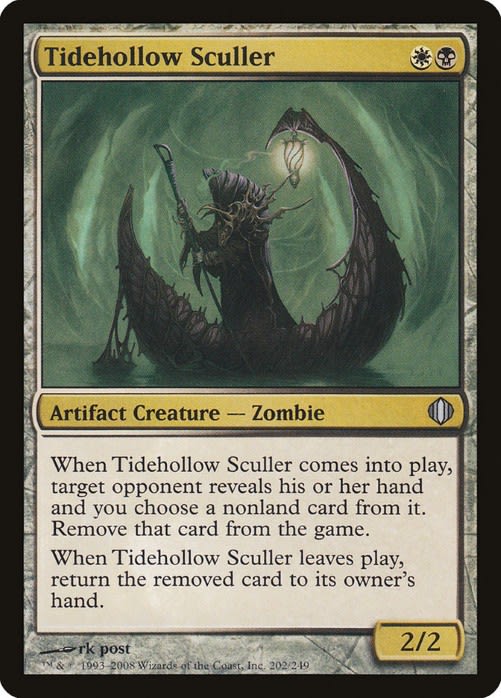
There were a few options for the best Artifact of 2008. Etherium Sculptor is a staple in Commander Artifact decks, Ethersworn Canonist is a popular hate piece against non-Artifact decks, Relic of Progenitus is an incredibly strong piece of graveyard hate, and Tidehollow Sculler was once a popular card in Standard and Modern. The top spot for the year is going to go to the card that has been a competitive player for almost two decades: Painter's Servant. It is a two-mana Artifact Creature that, as it enters, has you choose a color. Then, it makes every card that color, even if they're in zones other than the battlefield. Like Rings of Brighthearth, Painter's Servant is another Lorwyn card that doesn't do much on its own but opens the door for shenanigans. Unlike the Rings, however, these shenanigans are very competitively viable.
 |
 |
 |
Painter's Servant is probably best-known for its role in Legacy, where it is one of two cards at the heart of one of the format's oldest and most prolific combo decks. It goes infinite with a card that was briefly mentioned previously called Grindstone, a one-mana Artifact that taps to mill an opponent for two cards, then if those two cards share a color, the process repeats. Since Painter's Servant affects cards not in play, every card in each library shares a color, meaning your opponent will mill their entire deck and lose during their next draw step. The combo is fast and doesn't require much mana to pull off: one mana for the Grindstone, two mana for the Servant, and three mana to activate Grindstone. This combo is also Commander-viable, but since it only mills out one opponent at a time it is considerably slower. In Commander, it can also be paired with cards that hate out a specific color, like Wrath of Marit Lage, Light of Day, and Llawan, Cephalid Empress.
2009: Expedition Map

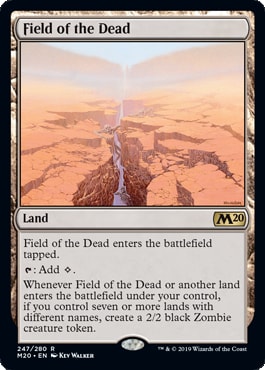
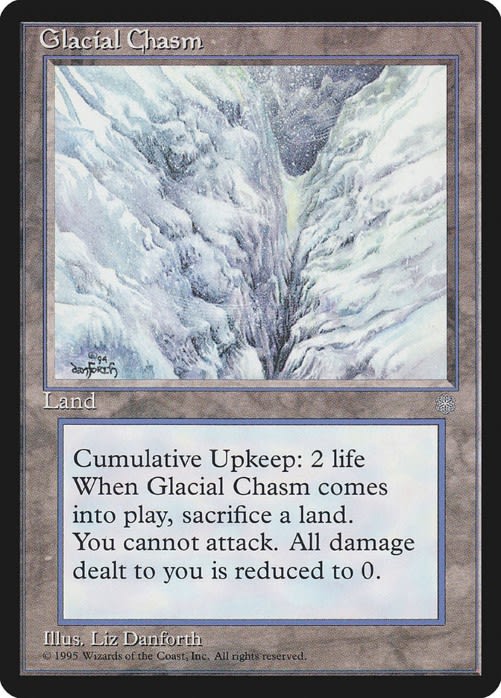
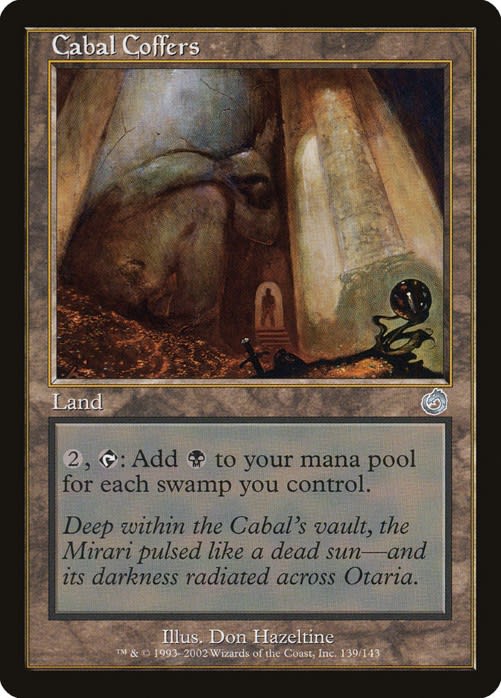
What Expedition Map lacks in raw power it makes up for by boosting the consistency of some of Magic's strongest decks in multiple archetypes. This one-mana Artifact can be sacrificed for an additional two mana to search your library for any lard card and put it into your hand. The card is probably best-known for its prominence in Modern, where it helped Tron become a dominant archetype for more than a decade by ensuring that it was able to search up its Urza's Lands. While Tron has fallen off quite a bit in Modern, Expedition Map still sees play in the Pauper version of the Tron, one of the strongest decks in that format. It is also popular in the Legacy Lands deck and sees a lot of play in Commander, where it tutors up the format's strongest Lands like Field of the Dead, Glacial Chasm, and Cabal Coffers.
 |
 |
 |
Expedition Map has the most impressive tournament pedigree, but it wasn't the only strong Artifact printed in 2009. Also in contention were Blade of the Bloodchief, a card that briefly created a Modern combo deck with Basking Broodscale, Sen Triplets, a bogeyman of Commander, and Time Sieve, which can help Artifact decks close out games with a bunch of extra turns.
2010: Mox Opal

In 2010, we saw the end of the original Zendikar block and a return to Mirrodin with Scars of Mirrodin, and while there weren't a ton of broken Artifacts printed, this year was more about quality than quantity.
Worldwake's Lodestone Golem is notable for being restricted in Vintage, where it does a great job of slowing down non-Artifact decks and can come down as early as turn one, while Scars of Mirrodin gave us Wurmcoil Engine, a iconic Tron and Commander card. This was also the year Amulet of Vigor was printed, a card that has been a backbone of Modern for over a decade thanks to its explosive combos with bounce lands and Primeval Titan.
The best Artifact of the year is Mox Opal, the sixth instance of fast mana, or cards that produce more mana than they cost, on the list so far. It costs zero mana and taps to add one mana of any color, but only if you control three or more Artifacts. It was also the first Mox to be Legendary, which can be a limit to how explosive the card can be. Despite these restrictions, however, this card is still broken.
It has had a tumultuous history in competitive Magic. For years after it was printed, it was a Modern staple in decks like Lantern Control and Affinity, but was eventually banned to slow down Affinity. It was unbanned in 2024, however, and it didn't take long before it broke the format again. This time, it was a key part of a combo deck alongside Underworld Breach and Grinding Station. The deck dominated the format for several months, but eventually Underworld Breach was banned.
Today, Mox Opal continues to thrive in the format as a staple of Modern Affinity decks. It also sees a fair amount of play in Legacy and Vintage, and is one of the few pieces of fast mana that hasn't been made a Game Changer in Commander.
Conclusion
And that does it for part one of this ranking. Tune in next time for the best Artifacts from each year between 2010 and 2026. Until then, if you want to learn more about Artifacts, check out this article on best cards for Artifact decks or this article on Best Artifacts of 2025 For Commander.