


 Locations


One of the great things about Magic is that context always matters. Even the very best Lands in this article have a situational down side.
Wanting the best possible mana base, though? That's universal. If you don't have the colors of mana that you need, you can't cast spells. It's hard to win a game if you can't cast your spells.
Having Lands that can tap for a couple of colors is a huge upgrade in this regard. If your first Land taps for Red or Green, that means you can already cast cards of both colors. If your first Land is a basic Mountain, you're going to need to draw a Forest if you want to cast that Llanowar Elves.
With that in mind, we're going to explore what makes for a good Dual Land. In the process, we're going to look at the premiere two-color Lands and rank the absolute best of the best.
What is a Dual Land?
So, now that we know why they're important, what exactly is a Dual Land?
The name says it all really. Dual Lands are Lands that can be tapped for two different colors of mana. Usually, you get one or the other, but there are some Lands that tap for both of their colors at the same time.
What is a Dual Land's Coloor Identity?
This might seem obvious, but there are some nuances depending on your preferred format. Mechanically speaking, Lands are Colorless. Yep, even your Dual Lands. Mountains aren't Red. Glacial Fortress isn't Blue, White, or Multicolored.
In Commander this becomes a little more complicated. While Lands are still Colorless in terms of game mechanics, they do need to be within your Commander's color identity. Chances are, you wouldn't want to put a Hinterland Harbor in your Edgar Markov deck, but you aren't allowed to anyway. In case you were thinking about doing it for some weird edge case, just know that the rules forbid it.
What to Look for in a Land
There are more moving parts to a Land than you might think. What color (or colors) it taps for is only the beginning.
Some Lands have a Basic Land type. This is a big deal because it means they can be searched out of your deck by a wider array of sources. Farseek can find Green and Black mana by fetching a Bayou, for example. That Bayou can be untapped by an Arbor Elf, too.
The Lands in this article cannot be searched up by a Terramorphic Expanse, however. While some of them do have Basic Land types such as Swamp, they are not Basic Lands themselves. This may seem like a small and unintuitive distinction, but it matters a lot. It means that cards that specifically search out Basic Lands cannot fetch up a Scrubland, for example.
The next important thing is whether a Land comes into play tapped or not. A lot of common Dual Lands enter tapped, meaning you can't use them right away. This is obviously a huge downside. Having early Lands enter tapped slows your game down significantly and can put you a long way behind. It's not necessarily a deal-breaker, as you will see, but you need to consider how many tapped Lands you can get away with.
At higher rarities, entering tapped is usually the price for a powerful bonus. Many Creature Lands, such as Restless Anchorage, enter tapped. Deciding whether the cost is worth the reward is an important part of building your mana base. Ideally, you want all your Lands to be ready to go, but in many formats this is not always possible.
What are the Best Dual Lands in Magic?
While this is somewhat subjective, there are several cycles that are widely considered best-in-class. If you've played Magic for a while, you can likely guess the top two entries on the list but you still might disagree with their order.
- Check Lands
- Slow Lands
- Filter Lands
- Verge Lands
- Fast Lands
- Creature Lands
- Surveil Lands
- Shock Lands
- Original Dual Lands
- Fetch Lands
10. Check Lands
 |
Dragonskull Summit and the rest of its cycle might be the most well-balanced cycle on this list. They ask just enough of you to stop them from being too good, while still being very good in a wide array of situations.
While you're unlikely to see Check Lands in really powerful formats like Legacy or Vintage, they do fit nicely into most other settings. In Standard, you're often happy to take whatever you can get. Play a Mountain on turn one and your Dragonskull Summit is ready to go on turn two.
In a format like Commander, although there are better options, Check Lands are sometimes even easier to turn on. You can play a turn one Steam Vents, for example, and your Dragonskull Summit will be ready on turn two since Steam Vents has the Mountain Basic Land type.
Needing a Basic Land in play already is a real drawback, which is what keeps this cycle form being any higher on the list. It is relatively easy to overcome, however. For a very modest amount of work, these grant you a solid reward. Overall, these Lands are satisfyingly fair.
9. Slow Lands
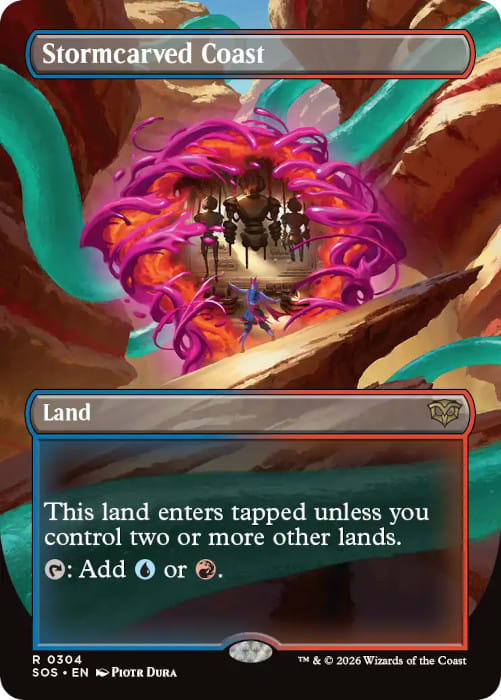 |
This recent cycle of Lands is nicely balanced for decks that don't care too much about the early game. They get their name from the fact that they do the exact opposite of Fast Lands. These only come into play untapped if you have two other Lands already.
Naturally, this makes them much weaker in the first couple of turns of the game. Some decks don't care too much about this, but many do, and that's why they're so low down the rankings.
Still, once they're ready to go, they make two colors of mana for no cost and with no down side. Slow Lands are not exceptional, but they are good. They are at their best in formats (and decks) where games go longer.
In a casual Commander setting, if you don't have Sol Ring in your opening hand, it's usually fine to play an early Stormcarved Coast.
8. Filter Lands
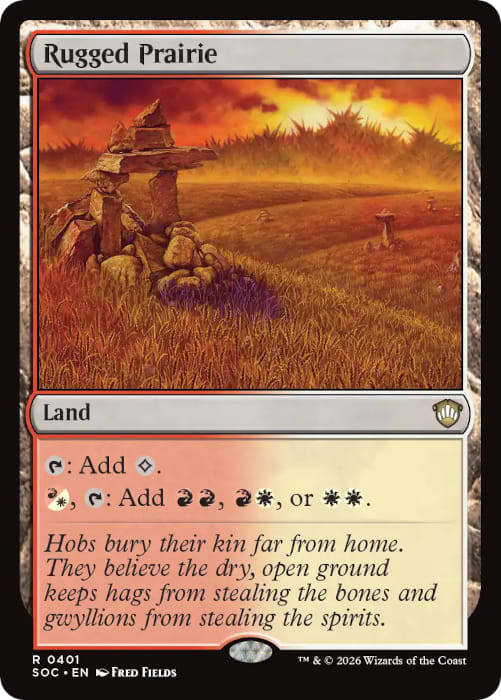 |
There are two cycles of Lands that could be called Filters, but they are not created equal. Sunscorched Divide and its inability to make any mana by itself will not be on this list. Rugged Prairie will.
Unlike some entries, the Filter Lands are arguably better in multicolored decks. They enable some tricky things, like having your Hallowed Fountain indirectly make Red mana. Tap the Fountain for White, "filter" that through your Rugged Prairie and voila, you have two Red mana. You can imagine why this would be useful in a three or more colored deck.
There are costs to Filter Lands, though. While they do come in untapped, which is nice, but they don't make colored mana without help. That makes them a very poor first Land. You can't easily search these from your deck, either, unless it's from something like Primeval Titan. This means Filter Lands are at their best in relatively slow decks that want to cast color-intensive spells like Cruel Ultimatum.
7. Verge Lands
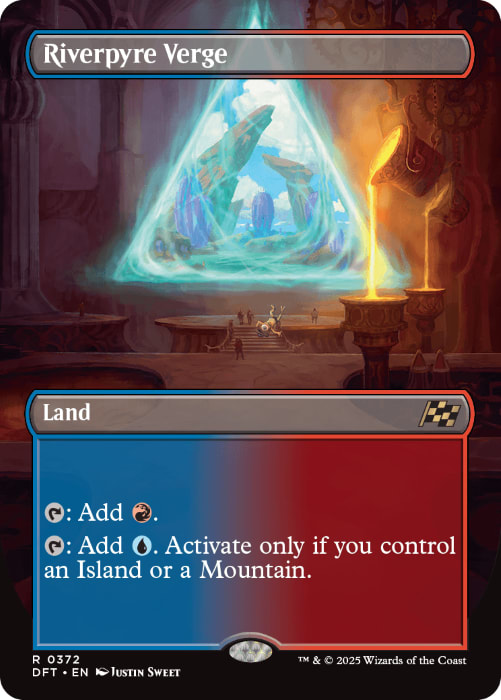 |
Riverpyre Verge and its nine friends is a very well-balanced cycle. They always come into play untapped, which is nice. They trade this for something quite unusual, though. They don't always make two colors of mana. You need an Island or Mountain in order to make Blue mana. They're almost like the Filter Lands in that way, except that this cycle does make one color of mana by itself.
There are better options in many formats, but the Verges are excellent in a wide range of environments. They are an integral part of current Standard, but they're very good in Commander, too. In Standard, it's partly because there are limited options. In Commander, it's because you will easily turn on their second color and you're happy to have another Dual Land to add to the pile of one-ofs.
6. Fast Lands
 |
These are the opposite of the Slow Lands, obviously. Blackcleave Cliffs is often better than Haunted Ridge in formats or decks where the game is expected to end quickly. Your Land won't come into play tapped on turn four if there is no turn four.
The downside is very real, here. These feel bad to draw later in the game, regardless of the board state. If you don't need a Land at all, these are not helping, just like any other Land. Worse, though, is the fact that these are still less than ideal if you do need Lands four and above. In regular Commander, for example, you might not want these at all, since the game is very likely to go beyond the stage where these enter untapped.
The reason they made it to the middle of this list is that coming in untapped early is better in more formats. In Modern, for example, it's not unusual for a game to be over before the down side is even live.
5. Creature Lands
 |  | 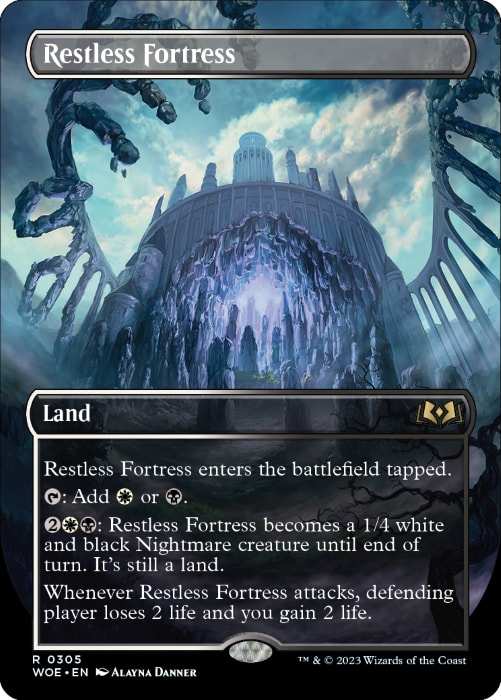 |
Lands that do something other than create mana are often very good. Lands are among the hardest card types to interact with, which gives them a level of safety that Creatures and Sorceries lack. You can't Essence Scatter a Treetop Village.
There have been a few cycles of two-colored Creature Lands at this point, and all of them have been playable in some or other format. Back in Worldwake, Creeping Tar Pit and its ilk were huge in standard and most of that cycle even saw play in Modern. We currently have a full cycle of ten Creature Lands in Standard and most of them have seen play at some point, too.
Why are they so good, though? We already covered the fact that they are hard to interact with, but that's not all. If you've played more than a couple of games of Magic, you have inevitably come up against flooding - drawing Land after Land with nothing to do. If you have a Restless Fortress in play, guess what, you do have something to do. If both players are out of action, but one has a Creature Land in play, that player has a huge advantage.
Yes, these always come into play tapped and, yes, turning them into creatures is expensive. You do need to consider these factors when building your mana base. It is still almost always worth it to run some if you can. They can win games in which drawing another dual Land would be a death sentence.
4. Surveil Lands
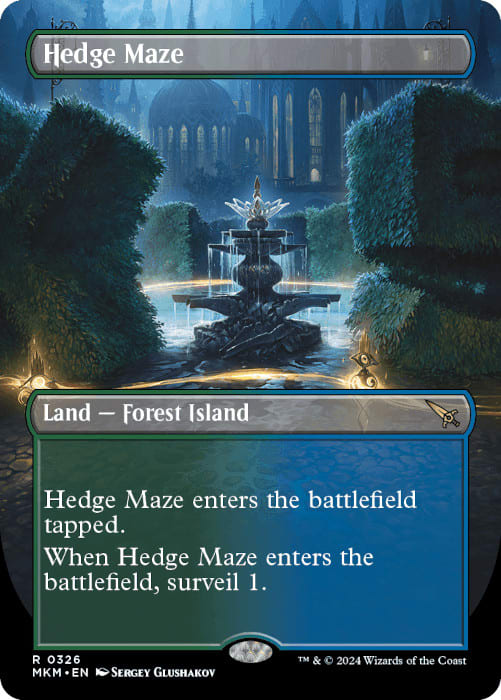 |
The most recent cycle to make this list gets here on merit. Surveil is an extremely powerful ability, way, way better than the Scry on the Temple of Epiphany cycle. While both cycles can help to set-up your next turn, Surveiling into the graveyard is often an upside all on its own.
Look at it like this. Scrying or Surveiling to the top of your deck is identical. Putting an unwanted card on the bottom or in the graveyard is basically the same thing, because you're unlikely to see the bottom of your deck in most games. Putting a card with Flashback into your graveyard, or a creature you want to bring back with Reanimate, is better than scrying it to the bottom of the deck.
Of course, Hedge Maze comes into play tapped, which is not ideal. The benefits far outweigh the costs here, though. Free-ish Surveil is great, but so is the fact that these cards are fetchable. We mentioned this earlier, but being "Land - Forest Island" is a huge upside in older formats. It means these Lands can be found by the likes of Three Visits and Misty Rainforest.
3. Shock Lands
 |
What does it look like if you take the best Lands of all time and give them a genuine downside? Temple Garden, of course.
This cycle is a staple of every format where they are legal and original Duals are not. They have been the backbone of Modern since its inception, even when they only had five Fetch Lands to work with.
The fact that they can come into play untapped when necessary is great. The two life is a real down side, and it can add up quickly, but one could argue that that tension makes them more interesting. Besides, if you're not desperate to cast your spell immediately, you can play these tapped.
Importantly, they have basic Land types, which means they are both fetchable and count double towards Domain effects. While Shock Lands are definitely outclassed in power level by the next couple of cycles, these have the bonus of being significantly more affordable.
2. Original Dual Lands
 |
Over 30 years since their initial release, these highly sought-after Lands continue to be among the best to ever do it. They have almost no downsides whatsoever, freely fixing your mana at a cost that is negligible. Does Wasteland even count as a downside when that also hits all but one entry on this list? There really isn't much else to dislike about the original Duals.
One could argue that the real downside of Tundra and co is that they are a bit too good. They can be searched up by Fetch Lands, thanks to their basic Land types. They enter untapped. They don't cost you life. They pretty much do it all.
Every other cycle in this article was designed with the Original Duals in mind - designed to be worse, on purpose. There's a reason these cards are so eye-wateringly expensive, and it's not just because of the Reserve List.
1. Fetch Lands
 |
The top two entries on this list are perhaps the most debatable. Both are excellent and they work excellently together. They work so well together, in fact, that you could almost consider them a joint number one.
You can definitely argue that Fetches are more versatile. Scalding Tarn is capable of fixing all five colors of mana, despite its Red-Blue text box. Paying one measly life to fetch up a Watery Grave or a Taiga or even a Jetmir's Garden is a bargain. Being able to cast your spells is going to save you a lot more life in the long run.
This flexibility goes a lot deeper than just the fixing they provide. One could write an entire article about the various ways Fetch Lands can be tricky. Filling your Graveyard is relevant. Shuffling away cards you don't want after a Brainstorm is very relevant. Getting multiple Landfall triggers? Extremely relevant. Fetch Lands do a lot.
Honourable Mentions
Now that we've looked at the top ten, lets dig into some honorable mentions that just missed the list.
Commander Lands
 |
In the right environment, this cycle is almost as good as the very best cards on this list. Unfortunately, outside of Commander, Morphic Pool and co are extremely weak, as they will always enter tapped.
Canopy Lands
 |
Horizon Canopy is great. It's fixing with a genuine cost, but it can turn into card advantage later on. It's hard to put an incomplete cycle on the list, though. If you want to play one of the six color pairs that have access to these Lands, you definitely should make use of them.
Pain Lands
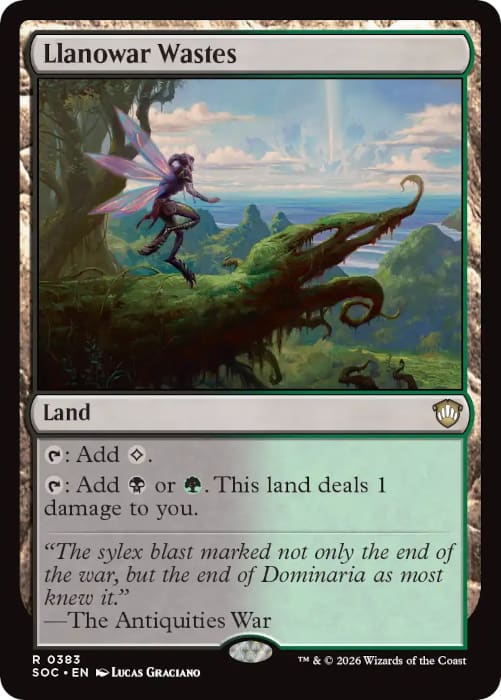 |
At various times in Magic's history, these have been the best dual Lands in Standard. They are tightly balanced around the eponymous pain they cause you. The fact that they can make colorless mana is a neat bit of design too. The reason they don't quite make the main list is that there are always better options in wider formats.
Wrapping Up
Lands are often overlooked by new players. On the surface, they're not very exciting, and a lot of other games keep resources much simpler. It doesn't help that building a mana base can be quite intimidating when you do start to think about it for the first time. How many sources of Blue mana do you actually need?
On a base level, you should start by just playing whatever Dual Lands you have access to in your colors. Some fixing is better than no fixing. Even lower rarity Dual Lands will help somewhat. Turn one Dismal Backwater means that double-Black, double-Blue and Blue-Black mana are potentially open on turn two. That's already better than either regular Swamp or regular Island.
Now, imagine if that first Land was a Darkslick Shores. You would get everything mentioned previously, but with the ability to cast something on turn one as well. The benefits of going from no fixing to some fixing are huge. The benefits of going from some fixing to good fixing are even bigger.
Lands are the foundation that everything else is built on. It doesn't matter how lovely the rest of your home looks if it starts sinking. Similarly, your powerful cards and sweet combos aren't going to do much if you can't cast them. The more Dual Lands you have in your deck, the more likely you are to cast your spells in a timely manner. It's really that simple.